Garden pipe for vegetables: sizes, grades and pitfalls
Choosing a garden pipe for vegetables — sizes from 3/4 to 1.5 inch, rolls from 10 to 100 metres, real prices, and the pitfalls that waste one.
25 September 2026 · 5 min read · REDYPLAST
Garden pipe for vegetables is a simple buy that people still get wrong at both ends — a bore too thin for the run, or a hundred-metre roll bought for a twenty-metre plot. This guide gives the sizes we stock, what each roll costs, which one fits a vegetable patch, and the short list of habits that decide whether a hose lasts eight seasons or one.
The plot a hose serves well
A hose is the right tool for the kitchen garden and the homestead vegetable patch: beds within reach of a tap, a tank or a small pump, watered by a person who is there anyway. Up to a few dozen beds it is the cheapest, most flexible watering there is.
It stops being the right tool when watering becomes a shift. Once the patch takes an hour a day, evenness suffers — the near beds drown while the far ones get a splash — and that is the point where drip in a kitchen garden starts paying for itself. This page serves the plot before that point.
Which garden pipe for vegetables: size first
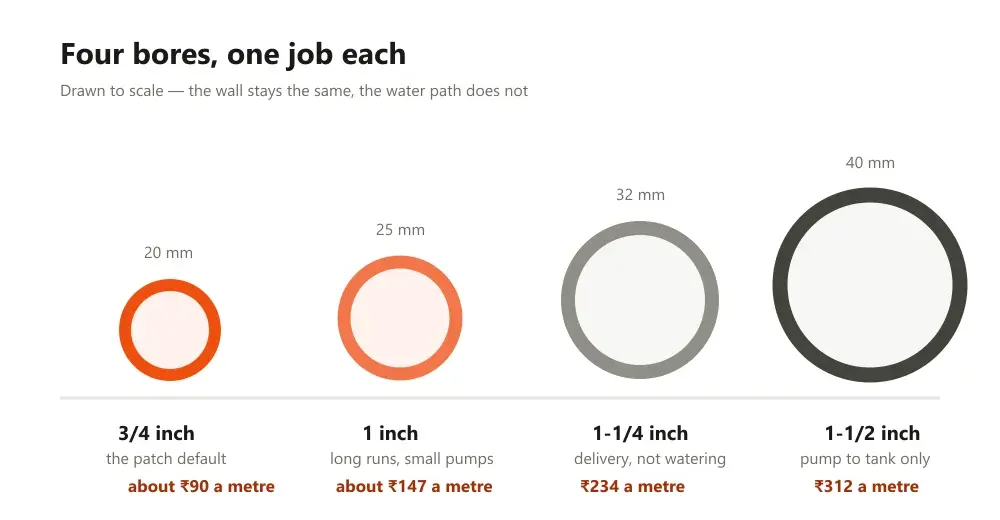
Our garden hose comes in one grade — the yellow premium line, UV-stabilised for a wall that spends its life in Indian sun — in four bores. Pick by run and source, not by price:
The bore must also match your tap or pump outlet. A hose wider than its source gains nothing; one narrower throttles it. On a small monoblock this matters doubly: the pump is already lifting from a sump or well, and forcing its delivery through a skinny hose is how a half-horsepower motor ends up watering at kettle pace. If the hose runs off a pump rather than a tap, start the size decision one bore higher than you would otherwise.
Weight is the quiet half of the choice. A filled 30 metre coil of 1 inch is a real load to walk around beds twice a day, which is why the 3/4 inch stays the default even for people whose tap could feed more — the bore you will actually carry beats the bore that looks better on paper.
- **3/4 inch (20 mm)** is the vegetable-patch default. Light enough to carry between beds all morning, and it fills a bucket in about a minute from a decent tap.
- **1 inch (25 mm)** earns its extra weight on long runs and on small pumps, where the wider bore stops the far end of a 30 metre pull arriving as a dribble.
- **1-1/4 and 1-1/2 inch (32 and 40 mm)** are delivery hoses more than watering hoses — pump to overhead tank, tank to trough. Nobody hand-waters brinjal with a 40 mm pipe.
Rolls and prices
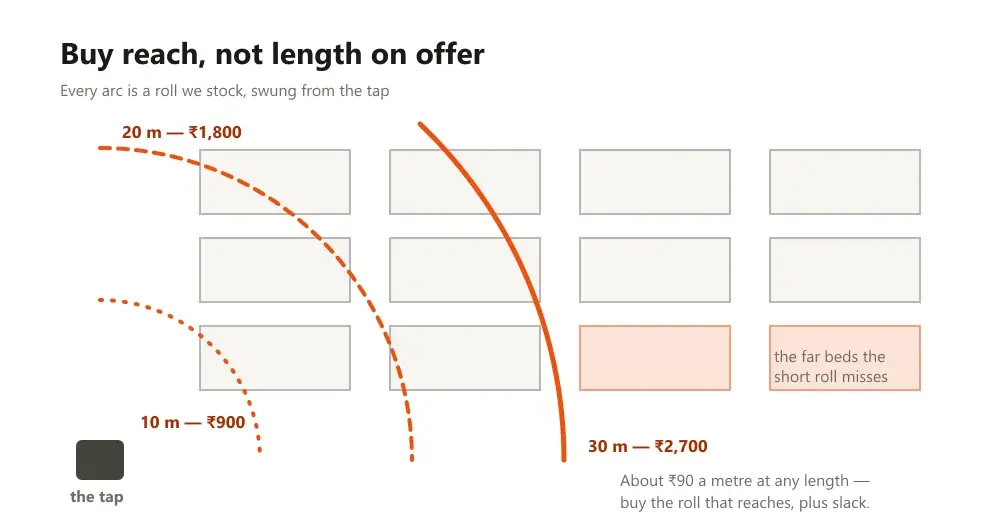
Notice what the list does not do: reward bulk. At 3/4 inch every roll works out to about ₹90 a metre, long or short. So buy reach, not "value" — measure from the tap to the farthest bed, add a few metres of slack for walking the rows, and buy that roll. The 100 metre coils exist for big compounds and field edges, not for discounts.
Worked once, the sum takes a minute. Say the plot is 20 by 15 metres with the tap at one corner: the farthest bed sits about 25 metres away along the paths, so the 20 metre roll strands it and the 30 metre roll at ₹2,700 covers it with walking slack to spare. Buying the 100 metre coil "to be safe" spends ₹6,291 more to drag 70 idle metres around the plot every morning.
Prices are our MRP with tax inside, from the garden pipe listing:
- 3/4 inch: ₹900 for 10 m, ₹1,800 for 20 m, ₹2,700 for 30 m, ₹8,991 for 100 m.
- 1 inch: ₹4,410 for 30 m, ₹14,553 for 100 m.
- 1-1/4 inch: ₹7,020 for 30 m. 1-1/2 inch: ₹9,360 for 30 m.
The pitfalls that waste a hose
Almost every hose that dies young dies of the same few habits:
- **Left pressurised in the sun.** Shut the tap and the hose holds mains pressure all afternoon while UV works on the wall. Open the nozzle end after closing the tap, and coil the hose in shade between waterings.
- **The kink at the tap.** The first metre bends hardest every single day. Leave slack there instead of pulling the hose taut around the wall, and the crease that starts every leak never forms.
- **Dragged across the beds.** A filled hose pulled over seedlings crushes them and snags on stakes. Walk the paths and lift it over corners — or peg a guide stick at each bed end.
- **Push-fit connectors on a pump.** The clip fittings that hold fine on tap pressure pop off a pump line. On anything pumped, clamp the joint properly.
- **Stored on the ground all summer.** Hang the coil off the floor in shade for the off-season; a hose left in a heap outdoors ages a year in a month.
Watering vegetables so the hose helps
Vegetables want steady moisture at the root, not a daily shower on the leaves. Water the base of the plants, in the morning, slowly enough that it soaks rather than runs — wet leaves through a hot afternoon is how fungal trouble starts, and evening watering leaves them wet all night.
A hose rewards a rose or breaker nozzle on seedlings: the open pipe's jet that is handy for filling buckets will wash a nursery bed bare. Once plants are fruiting, take the nozzle off and slow the tap instead — tomato, brinjal and chilli at fruit set want a long drink at the root, and a fast sprinkle wets the surface while the root zone stays dry an inch down.
And count beds, not minutes — the far beds deserve the same soak the near ones get, which is exactly the discipline a tiring arm skips. If the same beds keep coming up short, that is the hose telling you the plot has outgrown it, which is the next section's problem.
When the patch outgrows the hose
The upgrade path is not a bigger hose. If watering has become the day's main job, or the plot has rows rather than beds, move the water to the plants instead of carrying it: the vegetables crop page covers which crops repay drip first, and the drip range holds the parts. For a plot big enough that you are pricing both options, send the measurements and we will tell you honestly which side of the line it falls on.
Where these numbers come from
- TNAU Agritech Portal (opens in a new tab)
Crop-wise spacing, water requirement and drip layout references for southern India.
Keep reading
Lapeta pipe for paddy: sizes, grades and pitfalls
Which lapeta pipe suits paddy — tarpaulin or LDPE, 3 to 6 inch — with real roll prices and the pitfalls that kill a roll in its first season.
GuidesDrip irrigation layout for one acre of chilli, worked
A drip irrigation layout for one acre of chilli at 60 cm rows, fully counted — 105 laterals, seven coils of tape, valves, pump hours and the total.
GuidesDrip irrigation layout for one acre of banana, worked
A complete drip irrigation layout for one acre of banana at 1.8 m rows — lateral runs, spine, valve, pump hours, and the bill added up line by line.