Drip emitter spacing for vegetables on red loam, crop after crop
Drip emitter spacing for vegetables on red loam is relaid with every crop, and each dripper wets a narrow column. The tight pair, the first run, and the mulch.
10 November 2026 · 5 min read · REDYPLAST
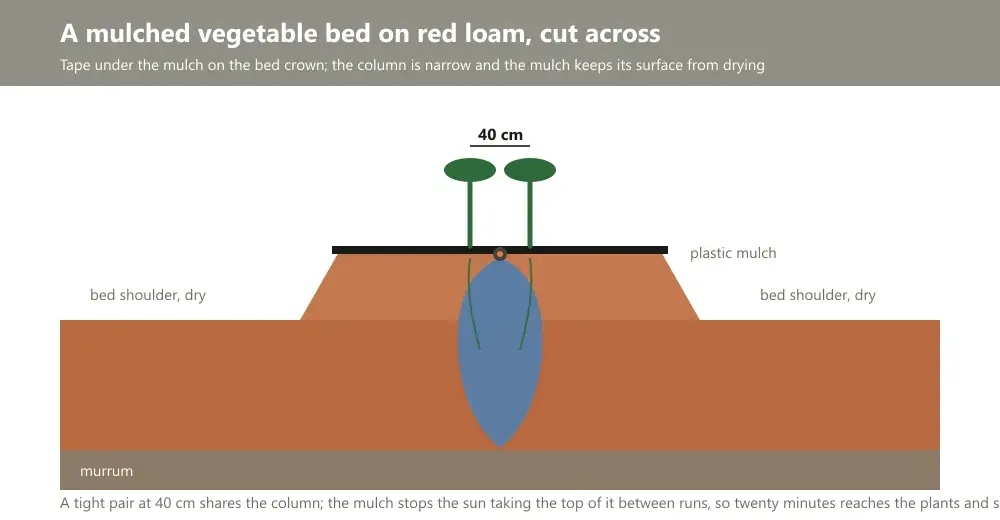
Drip emitter spacing for vegetables on red loam is redone three or four times a year, because the beds turn over with every crop and the tape comes up and goes down again, and each time it goes down the same rule applies: the soil wets a narrow column under each dripper and nothing beside it, so the plants go where the columns are.
Drip emitter spacing for vegetables on red loam therefore comes down to a tight pair of rows around each lateral, a first run before the seedlings arrive, and a mulch over the bed to stop the sun taking what the dripper gave.
Red soil vegetables are the market-garden crops of the uplands around every town, grown on beds that drain in an hour and dry in a day. This guide covers the column on a bed, the pair spacing one lateral can carry, the first run that sets where the plants go, the minutes per day through a relay year, and the two habits that lose a crop on this soil.
The column on a vegetable bed
Red loam takes water down fast and spreads it little. Under a 4 litre dripper the column is 40 to 60 cm across, so at 40 cm between drippers the columns just meet along the lateral and the band is about half a metre wide; the bed shoulders beyond it stay dry. The top 30 cm, where a vegetable's roots sit, holds about a day of crop water, and the bare surface loses a good part of that to the sun between runs.
That is the whole case for mulch on this soil. A plastic or straw mulch over the bed cuts surface evaporation from the narrow column and keeps the band moist to the edge, so the same twenty minutes reaches further and the plants between drippers stop lagging. Every inline pipe we list carries the 40 cm dripper, and the tape is laid under the mulch at planting; the vegetables drip guide explains why thin tape suits beds that are lifted each crop, and that choice holds here.
- Column: 40 to 60 cm across, a band about 50 cm wide along the tape.
- Reach across the bed: about 25 cm each side, so a pair of rows at 40 cm or less.
- Storage: about a day in the root zone; daily runs, twice daily in the heat.
- Mulch: the one change that makes the narrow column go further.
Drip emitter spacing for vegetables on red loam, pair by pair
A vegetable bed with two plant rows and one tape between them works on red loam only when the pair sits 30 to 40 cm apart, each row inside the column's reach. Tomato, brinjal and chilli pairs at 40 cm are comfortable; cabbage, cauliflower and okra wanting 60 cm between rows need a tape per row on this soil, and a bed laid for them with one tape in the middle is a bed with two dry rows.
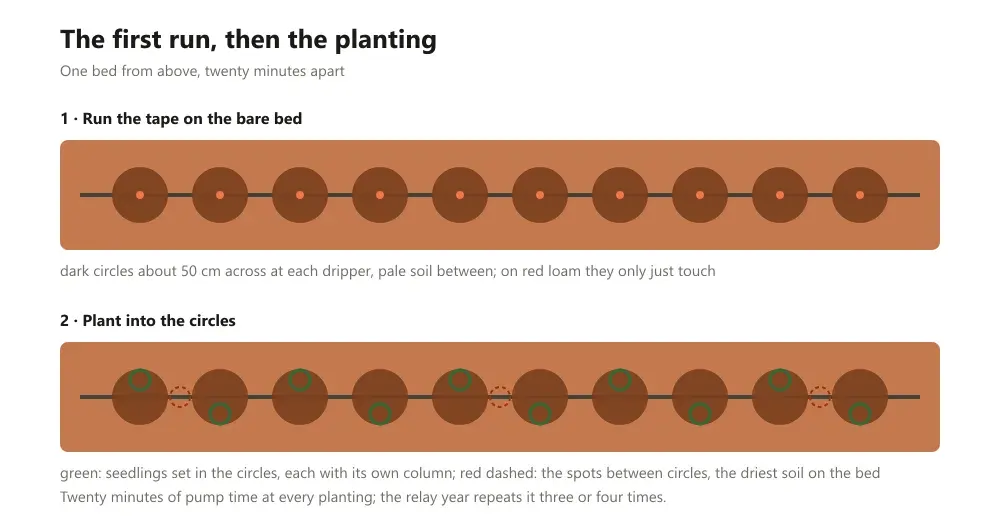
The first run settles where every plant stands. Lay the tape on the bed crown, run it for its first twenty minutes, and transplant into the dark circles rather than between them; a seedling set between two drippers on red loam sits where the columns barely touch and stays small all season.
On a heavier soil the band is continuous enough that nobody bothers; here it is the difference between an even bed and one that alternates.
The vegetables crop page says the relay year makes joiners and caps consumables, and on red loam the first-run habit is the other consumable, twenty minutes of pump time at every planting.
The minutes through a relay year
On a bed with one tape, beds 1.5 metres apart, a metre of tape with 10 litres an hour serves a square metre and a half, about 6.7 mm an hour. An acre is about 2,700 metres of tape drinking about 27,000 litres an hour, so a hot day's 29,200 litres is a little over an hour and a mild day's 15,700 about 35 minutes. With a tape on each row the line applies twice as fast, so those become a little over half an hour and under twenty minutes.
The minutes go in every day on red loam, in runs of about twenty minutes, so a shared tape's hour is three runs and its 35 minutes two. The column refills before the plant meets a dry afternoon.
The relay year changes the crop, not the rule. On a shared tape a leafy crop in the cool months wants its half hour daily and wilts within hours of a missed day; a fruiting crop in the heat wants the full hour, split; a bed between crops gets nothing, and the tape is lifted, rolled loose and kept in shade until the next bed is shaped. Under mulch, the same minutes wet deeper and the surface stays dark between runs.
Vegetables at full cover use about 3.5 to 6.5 mm a day, which on one acre is roughly 14,200 to 26,300 litres at the root, or about 15,700 to 29,200 litres from the pump once drip's losses are allowed for; the water requirement calculator gives the figure for your own acreage and crop.
The two habits that lose a crop here
The first is the wide pair, planted at 60 cm around one tape because the bed was shaped for a heavier soil or copied from a neighbour on black ground. Both rows root towards a column that stops 25 cm from the tape, and the bed looks fine from the path while the outer leaves curl by afternoon.
The second is the skipped day: red loam stores about a day, and a leafy crop or a bed of seedlings that goes two days without a run on this soil does not recover its stand.
A blocked dripper on this soil shows within a day as one wilting plant, which at least makes it easy to find; the blocked-line guide covers flushing, and the filter it depends on is not something we stock. The relay year goes through joiners and end caps, which the fitting-price guide explains are ₹6 a piece in boxes of 100.
- Wide pairs on one tape: both rows at the dry edge, outer leaves curling by afternoon.
- A skipped day on a young or leafy bed: a stand that does not come back.
- Seedlings set between drippers: a bed that alternates tall and short all season.
- The check: a trowel a hand deep beside the stem the morning after a run; moist and crumbling is right, dusty at the stem means the plant is off the column.
The figures are a starting point
The 3.5 to 6.5 mm a day and the column widths are published agronomic ranges, not measurements from your beds, and red loams vary in depth over the murrum from one bund to the next; mulch moves the schedule towards the lower figure and a bare bed in May towards the upper one. Treat twenty minutes daily as the first week's schedule for a new bed and let the trowel correct it.
The same soil's arithmetic for a single long crop is worked in the red-loam chilli guide, and the same crops on a lighter soil in the sandy-loam vegetables guide. If you want the bed layout and the tape count worked for your beds rather than for an acre, send us the bed width, the crops in your relay and the acreage and we will say whether one tape per bed will do on red loam, and how many coils a year the relay needs.
Where these numbers come from
- FAO Irrigation and Drainage Paper 56 (opens in a new tab)
The reference method for crop evapotranspiration and crop coefficients that daily water figures derive from.
- ICAR (opens in a new tab)
Indian Council of Agricultural Research — crop agronomy and regional package-of-practices.
- TNAU Agritech Portal (opens in a new tab)
Crop-wise spacing, water requirement and drip layout references for southern India.
Keep reading
Drip emitter spacing for garden and orchard on red loam, by tree
Drip emitter spacing for garden and orchard on red loam grows with the tree, since each dripper wets its own column. The ring by age, the hours, the pockets.
GuidesDrip emitter spacing for pomegranate on red loam, per bush
Drip emitter spacing for pomegranate on red loam is counted per bush, since each dripper wets its own column. The count by age, the hours a day, and the bahar.
GuidesDrip emitter spacing for cotton on red loam: the dry inter-row
Drip emitter spacing for cotton on red loam keeps the water in a band under the plant line and the inter-row dry. The band, the minutes, the monsoon break.