Drip emitter spacing for vegetables on alluvial soil, by bed
Drip emitter spacing for vegetables on alluvial soil puts a pair of rows on one tape and a bed above the water. The pair, the rhythm by crop, the wet-feet rule.
14 November 2026 · 5 min read · REDYPLAST
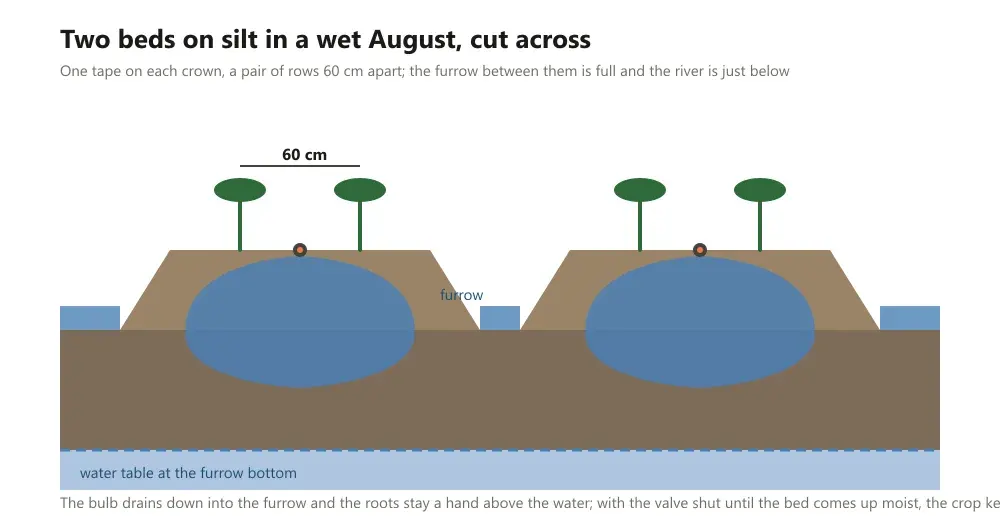
Drip emitter spacing for vegetables on alluvial soil is the easy case for the two-row bed: the bulb under a 4 litre dripper spreads 60 to 90 cm across on river silt, so a pair of rows 60 cm apart shares one tape laid between them, and the 40 cm drippers every inline pipe we list carries merge into a band that covers the whole bed top.
What drip emitter spacing for vegetables on alluvial soil changes is the rhythm, because the silt holds two or three days of water and the river under the field rises every monsoon.
Market gardens along the Godavari and Krishna grow a relay of crops a year on deep silt loam, and each crop in the relay wants a different rhythm from the same tape. This guide covers the wide bulb and the bed it allows, the minutes per run, the rhythm by crop through a relay year, and the wet-feet rule that loses more alluvial vegetable crops than drought does.
The wide bulb and the bed above the water
Silt wets sideways as well as down. A dripper's bulb is 60 to 90 cm across, the columns from drippers 40 cm apart overlap into a band, and a bed 90 to 120 cm wide is wet from shoulder to shoulder off one tape. The root zone holds two or three days of crop water once it is full, so a fruiting crop can be watered every second day in the cool months without a dry afternoon in between.
What silt cannot promise is air in the root zone. The river sits a metre below a delta garden in March and at the furrow bottom in August, and a vegetable keeps most of its roots in the top 30 cm, where a week of saturation kills them. Whole beds of tomato and brinjal collapse to wilt and collar rot on the low ground, and the dead beds map the puddles, not the dry spells.
So every bed on this soil is raised a full 20 cm, the tape goes on the crown, and the bed is rebuilt to height at every relay. The vegetables crop page says the paths stay dry under drip; here the beds have to stay drained as well.
- A bulb 60 to 90 cm wide, so the band is as wide as the bed top.
- Two rows at 60 cm sharing one tape, with reach to spare.
- Two or three days of store, so fruiting crops run on alternate days outside the peak.
- Drainage that is fine on the levee and poor in the low ground once the rains come.
Drip emitter spacing for vegetables on alluvial soil, bed by bed
Along the tape the 40 cm spacing is a comfortable match for plants set at 30 to 45 cm, and on this soil a seedling need not sit exactly at a dripper, because the band is continuous. Across the bed one tape serves a pair of rows 60 cm apart, which halves the pipe against one tape per row; cabbage and cauliflower at 60 cm, tomato and brinjal at 60, chilli at 45 to 60, all share a tape here where on sandy loam only the tightest pair could.
Only the widest beds, 150 cm with three rows, want two tapes.
On silt the bed is reshaped each time to its full height, because a bed that has slumped over a crop is a bed with its roots in the August water.
The relay changes crop, not tape. A bed of tomato comes out, the tape is lifted and the bed reshaped, and the same tape goes down on the crown for the coriander or the okra that follows; thin tape from the drip range suits beds relaid three or four times a year, as the vegetables drip guide explains, and the joiners and caps are the consumables.
The minutes, and the rhythm by crop
On a pair of rows sharing a tape with 1.5 metres between tapes, a metre of tape with 10 litres an hour serves a square metre and a half, so the line applies about 6.5 mm an hour and the hottest day is about an hour; on single rows at 0.75 metres the rate doubles and the run halves.
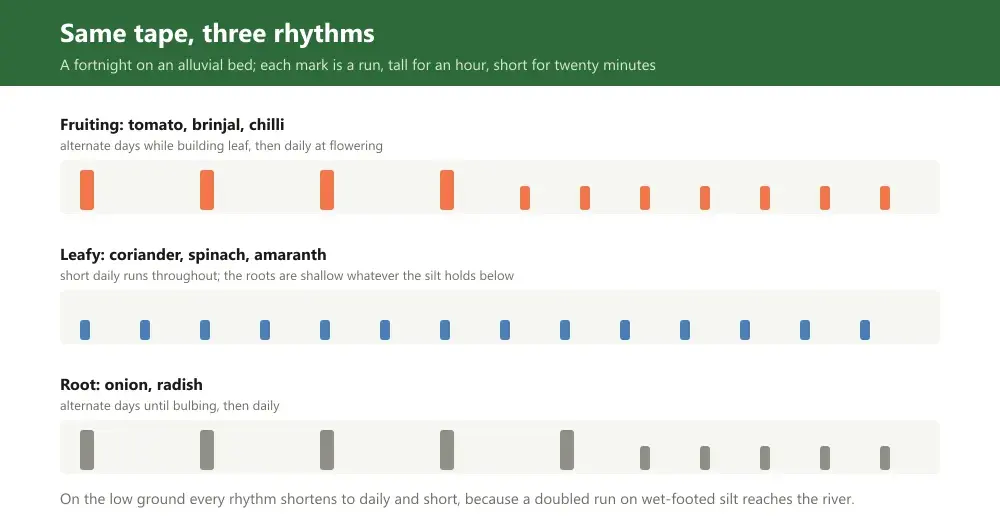
The rhythm then follows the crop. A fruiting crop such as tomato, brinjal or chilli takes a doubled run every second day while it builds leaf and a single run daily through flowering and fruit set.
A leafy crop, coriander, spinach or amaranth, takes a short daily run throughout, because its roots are shallow and its store is a day whatever the soil holds below. Root crops, onion and radish, take alternate days until bulbing and daily after.
Vegetables at full cover use 3.5 to 6.5 mm a day, which on one acre is roughly 14,000 to 26,000 litres at the root, or about 15,700 to 29,000 litres from the pump once drip's losses are allowed for; the water requirement calculator gives the figure for your own acreage and crop.
The wet-feet rule
The schedule that empties beds here is the one brought down from lighter ground upstream: an hour on every bed, every crop, every day. Silt has taken all it can after twenty minutes; the next forty go below the roots, which on the levee is only wasted pumping and on the low ground lifts the river into the root zone within three weeks.
August is the other half. Once the showers come weekly and the furrows stay full, each drip run is water the bed cannot pass on, and the valve stays shut until a trowel pushed a hand deep between the two rows comes out damp instead of glistening. Runs come back brief and daily as the furrows empty. A tape left running through a wet August on a slumped bed is how a tomato crop is lost in September, and because the plants wilt the loss is read as thirst.
A closed dripper can hide in the band on silt until one plant falls behind its neighbours; the blocked-line guide covers flushing, and we stock no filter for the head.
- An hour on every bed every day: forty minutes of each run below the roots, the river lifted into them in the low patches.
- Watering on through a wet August: drowned roots mistaken for thirst, and watered again.
- A slumped bed on low ground: the root zone under water after every heavy run or shower.
- The test: a trowel a hand deep between the rows on the morning after a run, damp and crumbling, never glistening.
The figures are a starting point
The 3.5 to 6.5 mm a day and the bulb widths are published agronomic ranges rather than readings from your beds, and one delta village holds sandy levee soil and heavy backswamp inside its boundary. On the sandy end every rhythm moves towards daily and the August stop matters less; on the heavy end the stop is the rule. Start at an hour every second day on a fruiting pair and let the trowel move it.
The same crops on the drier soils are worked in the sandy-loam vegetables guide, and the same silt under a long crop in the alluvial banana guide. If you want the bed layout and the tape count worked for your relay rather than for an acre, send us the bed width, the crops in your relay, the acreage and whether the field floods and we will say how many tapes a year it needs and which beds want raising.
Where these numbers come from
- FAO Irrigation and Drainage Paper 56 (opens in a new tab)
The reference method for crop evapotranspiration and crop coefficients that daily water figures derive from.
- ICAR (opens in a new tab)
Indian Council of Agricultural Research — crop agronomy and regional package-of-practices.
- TNAU Agritech Portal (opens in a new tab)
Crop-wise spacing, water requirement and drip layout references for southern India.
Keep reading
Drip emitter spacing for cotton on alluvial soil: pairs on ridges
Drip emitter spacing for cotton on alluvial soil lets a pair of rows share a lateral on a ridge, as the bulb is wide. The pair, the minutes, the wet-feet rule.
GuidesDrip emitter spacing for vegetables on red loam, crop after crop
Drip emitter spacing for vegetables on red loam is relaid with every crop, and each dripper wets a narrow column. The tight pair, the first run, and the mulch.
GuidesDrip emitter spacing for sugarcane on alluvial soil: wide pairs
Drip emitter spacing for sugarcane on alluvial soil lets a pair of rows share one lateral, and the silt holds days of water. The pair, the minutes, the stop.