Which pipe size for irrigation: bore, run and pump
Which pipe size for irrigation? Match the pump outlet, step up a size on long runs, and order by millimetres — bore, run and pump in plain terms.
2 April 2026 · 4 min read · REDYPLAST
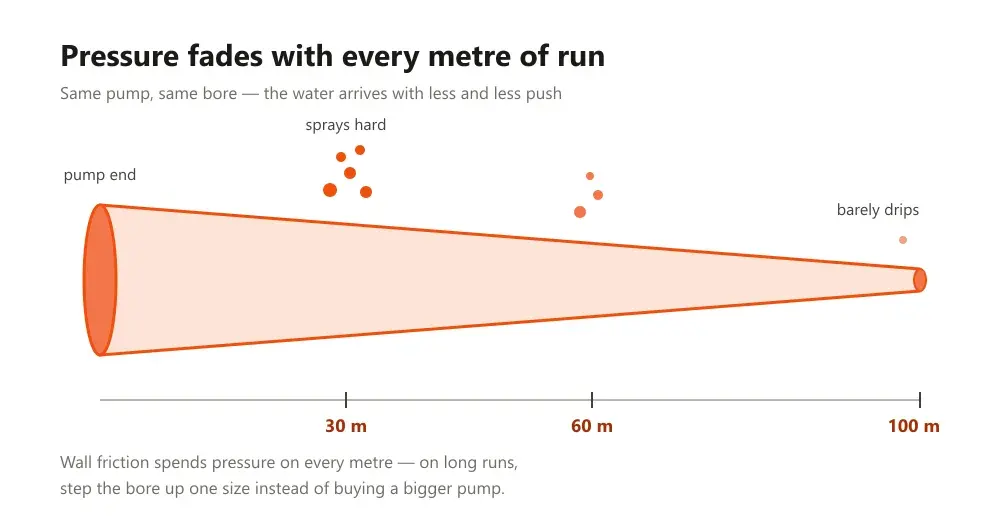
Which pipe size for irrigation your field needs comes down to three numbers: the bore of the pipe, the length of the run, and the size of the outlet on your pump. Get those three to agree and the choice nearly makes itself. Ignore any one of them and the field will tell you at the line's tail end, where the flow fades to a dribble.
This guide takes the numbers one at a time: what each of them actually does, the single rule that anchors the whole decision, and the trade-inch naming habit behind most of the wrong deliveries we see.
One coil, two numbers, two different questions
Every coil on our racks is described by a pair of figures, and they are strangers to each other. The bore is the width of the waterway — 20 mm, 32 mm, 63 mm — and it governs how much water can move and how much pressure survives the trip. The coil length is how many metres are wound onto the roll: 30, 50, 100, 200. It governs how far you can reach, and nothing more.
Neither figure can stand in for the other. A 63 mm coil of 100 m and a 32 mm coil of 100 m are different purchases with different jobs, and so are 100 m and 200 m of the same bore. Quote both numbers every time you order, and read both on every label — reading an Indian pipe listing covers the rest of what a label hides.
Friction, the toll collected on every metre
Water moving through a pipe drags against the wall, and the drag costs pressure. The toll is charged per metre, so a longer run pays more of it. What surprises people is the rate: it climbs steeply as the bore narrows. Go down from one size to the next and the loss does not rise by a step — it multiplies.
That is why one pump can behave like two different machines. Through 30 m, the far end sprays hard enough to sting your palm. Through 100 m — same pump, same bore — the last stretch barely darkens the soil. Nothing failed and nothing leaks. The extra seventy metres simply spent the pressure before the water arrived, and no amount of waiting brings it back.
Friction is also invisible, which is why it gets blamed on everything else first — the pump, the borewell, the electricity board. If the flow is strong near the source and weak far from it, suspect the pipe before any of those.
The pump outlet sets the floor
Here is the anchoring rule: never run a mainline narrower than the outlet on your pump. The pump was built to deliver through that opening. Choke it at the very first fitting — a 2 inch outlet squeezed into a 3/4 inch line — and the whole system is throttled within the first foot. No pipe, fitting or prayer downstream can hand the lost pressure back.
So match the outlet, or go one size wider. Narrowing comes later, out near the plants, where laterals carry less water anyway. The fittings that make those transitions cleanly are a small subject of their own — from the pump to the first lateral walks that chain joint by joint.
On a long run, buy width, not a bigger pump
When the run is long, two purchases solve the same weak-flow problem. The dear one is a bigger pump: a large sum up front, and a fatter electricity bill for every hour it runs, for years. The cheap one is a single size more bore, which cuts the friction toll on every metre — paid once, working for the life of the coil.
The rupees settle it. LDPE lapeta in 3 inch is ₹24 a metre; the 4 inch is around ₹33. Across a 100 m run, the wider pipe costs roughly ₹900 more — once. A pump upgrade swallows several times that before its first season, then keeps charging you at the meter. LDPE carries its own buying quirk too: coils are priced by weight, so always compare per metre, never per kilo.
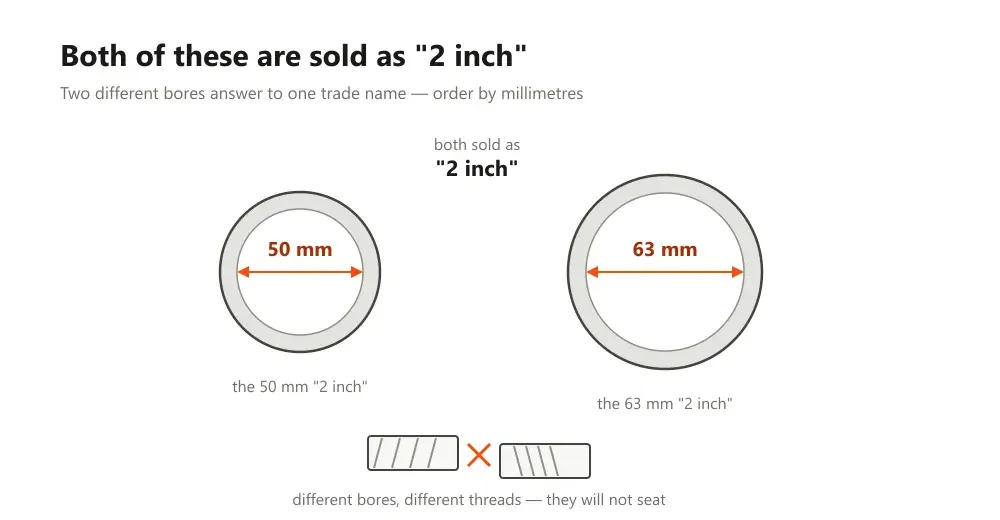
The 2 inch trap: 50 mm and 63 mm wear the same name
Trade sizes are nicknames, not measurements. Depending on the material and the maker, a pipe sold to you as "2 inch" may carry a 50 mm bore or a 63 mm one. The two will not join: a 50 mm pipe swims loose inside a 63 mm socket, and a 63 mm pipe will not enter a 50 mm coupler however hard it is pushed.
The mix-up survives because two naming systems live side by side in every Indian pipe market — metric sizes on most plastic pipe, inch names inherited from older metal fittings — and shops translate between them loosely. The translation is harmless in conversation and expensive in an order.
The habit that prevents the return trip: whenever a new part must mate with something you already own, order by millimetre. Measure the bore, or read the mm figure printed along the pipe wall, and quote that number. Inch names are for talking; millimetres are what actually fit.
So which pipe size for irrigation do you order?
Put the three numbers back together and the sequence is short:
Treat that list as habit, not as engineering. The real answer moves with your flow rate, the lift out of the borewell, the slope of the land and how the blocks are laid out — and every field, whether half an acre or twenty, earns proper arithmetic over instinct. The system estimator does that arithmetic from your field size, crop and pump.
- Start at the pump — the mainline matches the outlet, or goes one size wider
- Pace the run out on foot; guessed distances shrink, and the pipe then arrives short
- On a long run, step the bore up a size instead of shopping for a bigger pump
- Step down only near the plants, where laterals need less flow
- Order by millimetres whenever new pipe must mate with old
- State bore and coil length together, every time, in the same breath
Before you place the order
Three things in hand make the order right the first time. The outlet size of the pump, read off the flange or the old fitting. The true length of each run, paced or taped rather than remembered. And the measured bore of anything the new pipe has to join.
The same discipline scales down to a house plot. A garden pipe run to the far corner of a big yard obeys the same friction rule as a field main — the premium 3/4 inch at ₹90 a metre is lovely pipe, but past a certain distance what you need is width, not quality.
If you would rather talk it through, share the pump's outlet size and each run length through the bulk enquiry form or contact us. We size pipe against pumps every working day, and we would much rather get it right before the coil leaves Secunderabad.
Keep reading
Drip for banana: sizes, grades and the two pitfalls
Which drip laterals suit a banana crop, why the heavy wall earns its keep over a year in the ground, and the two mistakes banana buyers repeat.
GuidesDrip for sugarcane: built to outlast the ratoons
Drip for sugarcane stays buried for years, not months. The wall that survives ratoons, the paired-row lever, and what the water bill says.
GuidesDrip for orchard rows: sizes, grades and the pitfalls
Drip for orchard rows takes the least pipe of any planting — if the system is built for the mature canopy. Sizes, the online-emitter choice, two pitfalls.