Drip emitter spacing for cotton on alluvial soil: pairs on ridges
Drip emitter spacing for cotton on alluvial soil lets a pair of rows share a lateral on a ridge, as the bulb is wide. The pair, the minutes, the wet-feet rule.
11 November 2026 · 5 min read · REDYPLAST
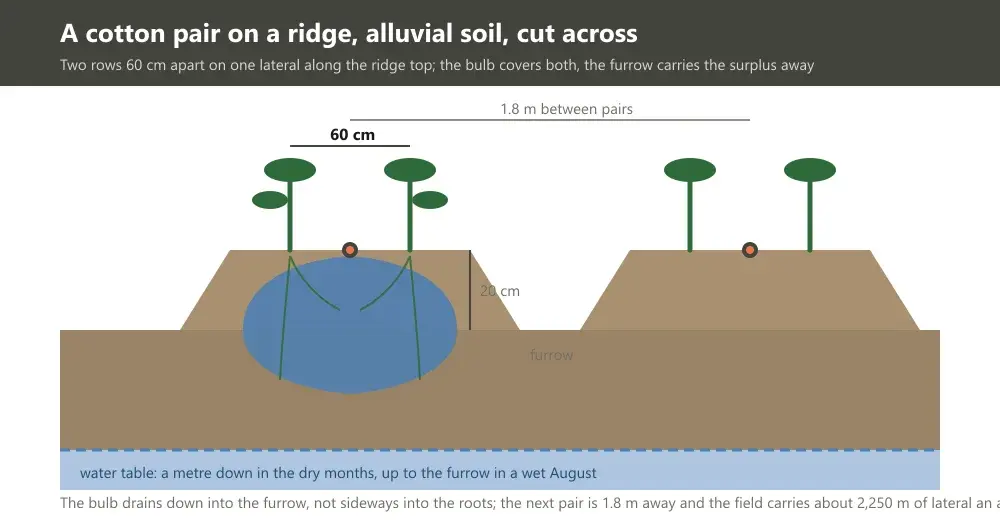
Drip emitter spacing for cotton on alluvial soil is the generous case: the bulb under a 4 litre dripper spreads 60 to 90 cm across on river silt, so a pair of cotton rows 60 cm apart shares one lateral laid between them, and the 40 cm drippers every inline pipe we list carries merge into a band that covers both rows.
What drip emitter spacing for cotton on alluvial soil cannot do is save the crop from the water underneath, because cotton sheds its squares in a wet week and the river sits a metre under a delta field.
Alluvial cotton is the crop of the Godavari and Krishna belts, grown on deep silt loams that hold water for days and, in the low ground, drain slowly. This guide covers the wide bulb and the pair it allows, why the pair goes on a ridge, the minutes per day and the days between them, and the monsoon rule that is the reverse of the one on red soil.
The wide bulb, and the water table under it
River silt wets sideways. A dripper on it makes a bulb 60 to 90 cm wide, the neighbours at 40 cm overlap into one strip, and a filled root zone carries the crop for two or three days before it asks again. Cotton's taproot has wet soil all the way down and its feeding roots have the whole strip to work; on this ground the plant is never short of a place to drink.
What it can be short of is air. A delta field has the river a metre under it in the dry months and at the furrow bottom in a wet August, and cotton suffers wet feet faster than almost anything else grown here: the squares drop within days, boll setting stops, and the patches of wilt and root rot in a delta cotton field map the standing water, not the dry spots.
The cotton crop page says the row spacing decides the pipe; on silt the drainage decides the schedule.
- A wide bulb, 60 to 90 cm, overlapping into one strip both along and across the row.
- Enough reach that a pair of rows 60 cm apart sits inside the strip with room to spare.
- A two or three day store, so the cooler weeks run on alternate days.
- Drainage that is fine on the levee and poor in the low ground once the rains come.
Drip emitter spacing for cotton on alluvial soil, on the ridge
Along the lateral the 40 cm spacing makes one strip and a plant sown at 30 to 45 cm is never off it. Across the field the wide bulb is the saving: cotton planted in pairs 60 cm apart with one lateral between them and 1.5 to 1.8 metres between pairs puts about 2,250 to 2,700 metres of lateral on an acre, against about 3,370 for single rows at 1.2 metres, the spacing the estimator works on. On this soil both rows of the pair are comfortably inside the band.
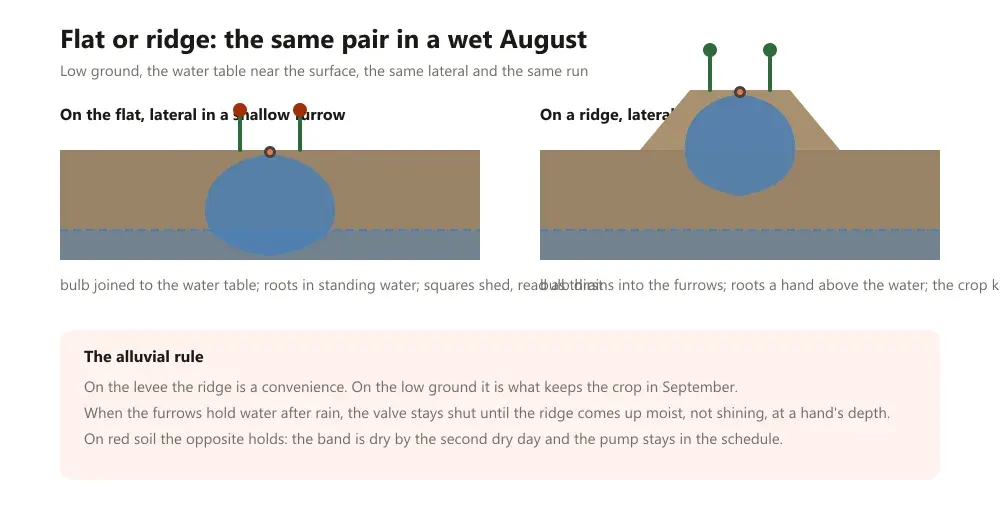
The pair goes on a ridge, not on the flat, and the lateral runs along the ridge top. Twenty centimetres of ridge lifts the root zone above the water that collects in the furrow after a run or a rain, and lets the bulb drain down into the furrow rather than sideways into the roots. On the high ground of a levee the ridge is a convenience; on the low ground it is what keeps the crop in September.
The cotton conversion guide prices the pair against single rows, and the lateral is 16 mm inline from the drip range.
The minutes, and the days between
On pairs at 1.8 metres a metre of lateral with 10 litres an hour serves nearly two square metres, so the line applies about 5.5 mm an hour, and six millimetres a day is about 65 minutes; on single rows at 1.2 metres the rate is about 8.3 mm an hour and the run about 43 minutes.
How often is the silt's decision. In the leafy weeks a doubled run every second day is enough, with the strip carrying the plants between; once the squares form and a dry afternoon costs some of them, the runs turn daily and single, so the ridge is topped up a little each day rather than filled and emptied.
Low ground changes one thing: a doubled run of over two hours on a ridge with water a hand below it joins the strip to the river. Those blocks stay on short daily runs all season, and the trowel, not the calendar, sets how short.
Cotton in active growth uses about 4 to 6 mm a day, which on one acre is roughly 16,000 to 24,000 litres at the root, or about 18,000 to 27,000 litres from the pump once drip's losses are allowed for; the water requirement calculator gives the figure for your own acreage.
The monsoon rule, reversed
Red soil cotton keeps the pump in its schedule through August because the strip there is dry by the second rainless day. Delta cotton does the opposite. Once the showers come weekly and the furrows stay full between them, every drip run is water the field has nowhere to put, and the valve is closed until a trowel pushed a hand deep into the ridge comes out damp instead of glistening. The runs come back as the furrows empty, brief and daily to begin with.
The two mistakes on this soil are both about too much. The first is the red-soil schedule carried over, a run every day of 65 minutes on pairs through the cool weeks, which fills the band in twenty minutes and sends the rest to the water table. The second is watering through a wet August because the calendar says flowering; the squares shed anyway, from wet feet rather than drought, and the grower reads it as a thirsty crop and waters more.
A closed dripper can hide in the strip for weeks on silt, because its neighbours cover for it; the blocked-line guide covers flushing, and we stock no filter for the head.
- Hour-long daily runs in the cool weeks: the surplus goes to the river and comes back up as wet feet in the low patches.
- Watering on through a wet August: squares dropped for lack of air, mistaken for thirst, watered again.
- Pairs sown on the flat in low ground: the root zone under water after every heavy run or shower.
- The test: a trowel a hand deep in the ridge on the morning after a run, damp and crumbling, never glistening.
The figures are a starting point
The 4 to 6 mm a day and the bulb widths are published agronomic ranges rather than readings from your field, and a delta village holds sandy levee soil and heavy backswamp inside one boundary. On the sandy end the runs move towards daily and the August stop matters less; on the heavy end the stop is the rule. Start at 65 minutes every second day on pairs and let the trowel move it.
Cotton on the two drier soils is worked in the red-loam cotton guide and the black-soil cotton guide; a shorter crop on this same silt is in the alluvial chilli guide. For a pair layout and shift plan matched to your own field, tell us the row plan, the acreage, the bore yield and whether the field goes under in August and we will come back with the coil count and the runs a week.
Where these numbers come from
- FAO Irrigation and Drainage Paper 56 (opens in a new tab)
The reference method for crop evapotranspiration and crop coefficients that daily water figures derive from.
- ICAR (opens in a new tab)
Indian Council of Agricultural Research — crop agronomy and regional package-of-practices.
- TNAU Agritech Portal (opens in a new tab)
Crop-wise spacing, water requirement and drip layout references for southern India.
Keep reading
Drip emitter spacing for sugarcane on alluvial soil: wide pairs
Drip emitter spacing for sugarcane on alluvial soil lets a pair of rows share one lateral, and the silt holds days of water. The pair, the minutes, the stop.
GuidesDrip emitter spacing for garden and orchard on alluvial soil
Drip emitter spacing for garden and orchard on alluvial soil needs fewer columns per tree, as the bulbs merge into one patch. The patch, the hours, the mound.
GuidesDrip emitter spacing for chilli on alluvial soil: the wide bulb
Drip emitter spacing for chilli on alluvial soil lets one lateral serve a pair of rows, since the bulb is wide. The pair, the minutes, the wet-feet mistake.