Fixing rats chewing lateral pipe in a rain pipe system
Rats chewing lateral pipe can ruin a stored roll before the season opens. How to tell rat bites from other holes, what to repair, and how to protect the roll.
16 October 2026 · 4 min read · REDYPLAST
Rats chewing lateral pipe in a rain pipe system does a lot of its damage in the store room: the roll goes in whole, sits for months beside grain and cover, and comes out leaking from many places at once. Storage is also where this is cheapest to prevent — our own installation guide lists rodents among the things to store the hose away from. Here is how to confirm rats did the damage, what is worth repairing, and how to keep the next roll whole.
Rats chewing lateral pipe: confirm it first
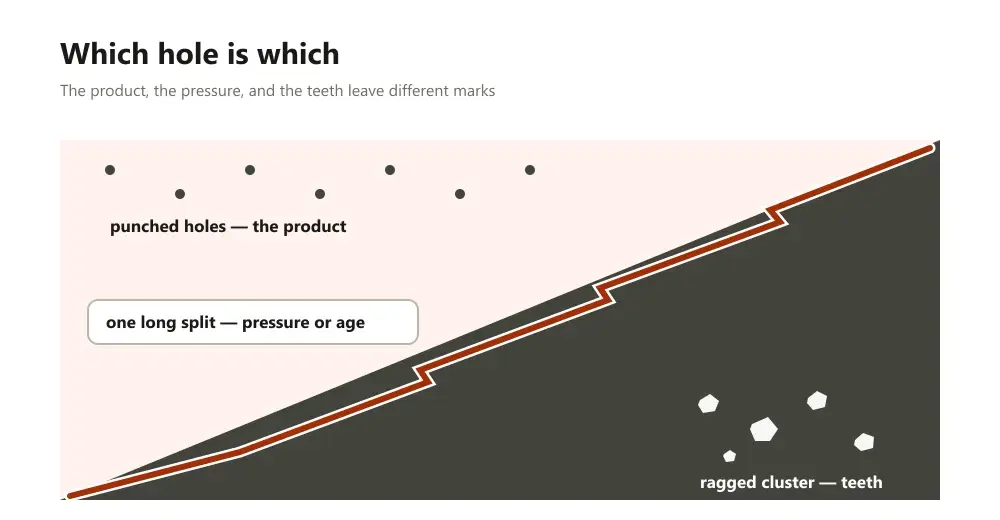
Not every hole is a rat. The pipe's own spray holes are laser punched in the family's zigzag pattern — small, uniform and clean-edged, the product working as listed. Rat damage looks like none of that: ragged-edged holes and gashes, different sizes, no pattern a machine would make.
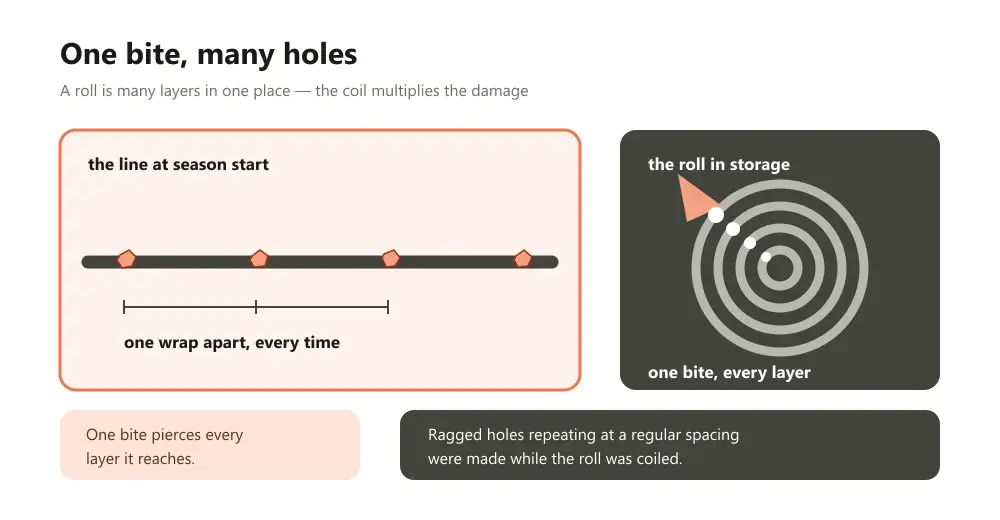
The strongest sign is spacing. A rat gnawing a coiled roll bites through several layers at one spot, so when the roll is laid out, the holes repeat at a regular interval — one wrap of the coil apart. Ragged holes repeating down the line at even spacing were made while the roll was coiled, not in the field.
Field damage reads differently: single ragged holes or gashes, near the field's edges and bunds where there is cover, on a line left out in the weeds between crops rather than rolled up and brought in.
The pressurising walk helps confirm it. Open the valve gradually, stay within the listed 1 to 1.5 kg/cm², and walk the bed as our guide already asks, checking the spray reaches where it should. Use the same walk to find damage: a ragged hole gushes or throws a coarse jet unlike its neighbours — mark every jet that does not match.
Two other marks are easy to pin on rats wrongly. Cracks at the old fold spacing are the shed's crease damage, and a long split or a chalky stiff wall is ageing — the sun-cracking guide reads those marks. And a line that merely weakens toward its far end has a different cause again; the far-end guide covers that one.
- Small, clean-edged holes, all alike, in the punched zigzag pattern: the product, not damage.
- Ragged holes repeating at one-wrap spacing once laid out: a rat working on the coiled roll in storage.
- Single ragged holes or gashes near edges and cover: field damage, on a line left out between crops.
- A straight crack at fold spacing, or a gash where the line was dragged: handling and age, not teeth.
Why the shed is where rolls die
A coiled roll is everything a rat wants in one object: soft material, dense cover, and months of being left alone. And the coil multiplies the damage — the bite that would make one hole in a laid-out line goes through several layers of a rolled one. A little gnawing finishes a stretch faster than a season of sun.
Storage lowers the risk more cheaply than anything else. Keep the roll off the floor, laid flat on a rack. Keep it away from grain, seed and feed bags, which are what the rats actually came for. A lidded drum or bin beats an open corner. Once a month through the off-season, look for droppings, shredded film and gnaw marks on the outer wrap — a bite found early costs the last few metres of that end, not the roll.
That tracks the storage line in our installation guide: drain the hose, let it dry as much as possible, roll it without sharp kinks, and store it away from direct sunlight, rodents, sharp objects and unnecessary knocks. The pipe-life guide turns that one sentence into a routine worth keeping.
Repair, or replace
Nothing on our shelf patches a rain pipe — menders and joiners for this family are not parts we list, so repair here means scissors, not shopping. The question is what the scissors leave you. A bite through the outer wraps of a stored roll shows up as holes strung along one end of the laid-out line, so the end-trim is the common case.
Cut at the damage and keep the longest sound stretch. A shorter line still waters a smaller block honestly, while a line joined in the middle leaks at the join instead — the joints guide explains why two short lines beat two halves joined. Damage near one end is the easy case: cut back past the last marked hole, re-tie, and the roll loses only a little length.
If holes run all through the roll, replace it and change where the new one is kept. A 40 mm roll of 100 metres is ₹1,320 and a 63 mm ₹3,780 at MRP, tax included; whatever discount is running shows on the rain pipe range.
- Holes strung along one end at one-wrap spacing: cut back past the last of them, re-tie, carry on.
- A cluster in the middle: cut there, keep the longest sound length as a shorter line, and give the remnant a smaller job.
- Holes through the whole roll: replace — and fix the storage before the new roll goes in.
Keeping rats off the next roll
The habits cost almost nothing. Store the roll drained, dried, laid flat and off the floor, in a lidded drum if one is spare. Keep it away from anything a rat is actually hunting — grain, feed, seed. And give it that monthly look through the off-season, outer wraps especially.
In season, a drained line lying along the crop between waterings is normal — that is how the product is used. The risk window is between crops: roll the line up and bring it in rather than leaving it in the weeds at the field edge, and keep the strip under a laid line clean.
Peg the laid line too, as the guide says, at intervals where wind or movement could shift it. A pegged line on a clean strip stays where people walk past it, and damage on it gets found early rather than at the next watering.
Controlling the rats themselves — cats, traps, whatever the farm already uses — is outside what we can advise on, and we will not pretend pipe advice covers it.
But if rats are costing you more than one roll a year, the cheap fix is storage, not pipe. Write to us before buying the replacement — we will help pick the right size, and it is worth telling us how the roll will be stored, because that is where the last one was lost.
Keep reading
Fixing pipe cracking in the sun in a rain pipe system
Pipe cracking in the sun has more than one cause. How to read the crack pattern on a rain pipe, what each pattern means, and what to repair or replace.
GuidesFixing joints leaking in a rain pipe system
Joints leaking in a rain pipe system happen at three places on the pipe - the head, any mid-line join, and the tail. The field test and honest fix for each.
GuidesFixing uneven flow at the far end in a rain pipe system
Uneven flow at the far end of a rain pipe has three usual causes. Here they are in order of likelihood, with a field test and an honest fix for each.