Fixing joints leaking in a rain pipe system
Joints leaking in a rain pipe system happen at three places on the pipe - the head, any mid-line join, and the tail. The field test and honest fix for each.
15 October 2026 · 5 min read · REDYPLAST
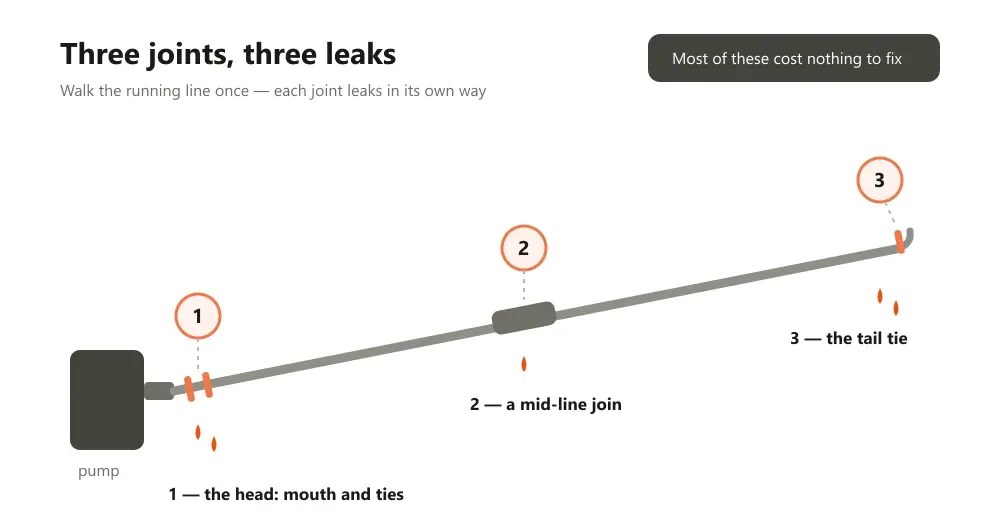
Joints leaking in a rain pipe system happen at three places on the pipe itself: the head, where the roll is tied onto the outlet pipe; any join made mid-line; and the tie-off at the tail. Upstream of all three sit the pump's own threaded joints, which drip for their own reasons. Find which one is leaking before buying anything, because most of these fixes cost nothing but a better tie.
A flat, tie-on rain pipe has no threads or solvent joints of its own — every joint on the pipe is a tied one, and tied joints fail in ways you can see.
Joints leaking in a rain pipe: find which one
Run the line at its normal pressure and walk it once, watching the joints themselves rather than the ground. Wetting the ground is the pipe's job, so wet soil proves little; a drip or a jet at the joint is the evidence.
Do the walk at full working pressure, not at the half-open trickle used while the line fills. A tie that holds a trickle can still weep once the spray comes up, so let the line reach its usual throw before you judge any joint.
A puddle that stands at the pump end can come from the head tie, the pump's own threads or a valve. Check the tie first, because it costs nothing.
One caution before blaming any joint: a jet from a spot with no punched hole — a pinhole or a split in plain film, away from every connection — is damage or ageing, not a joint problem. And a line that merely weakens toward its far end has a different cause again; the far-end guide covers that one.
- At the head: water creeping or spraying from under the tie where the roll is tied onto the outlet pipe.
- At a mid-line join: a drip or jet at the sleeve or joiner itself, sometimes only on one side of it.
- At the tail: a jet escaping past the fold, or the tie working itself loose every few waterings.
The head joint: tie flat, not tight
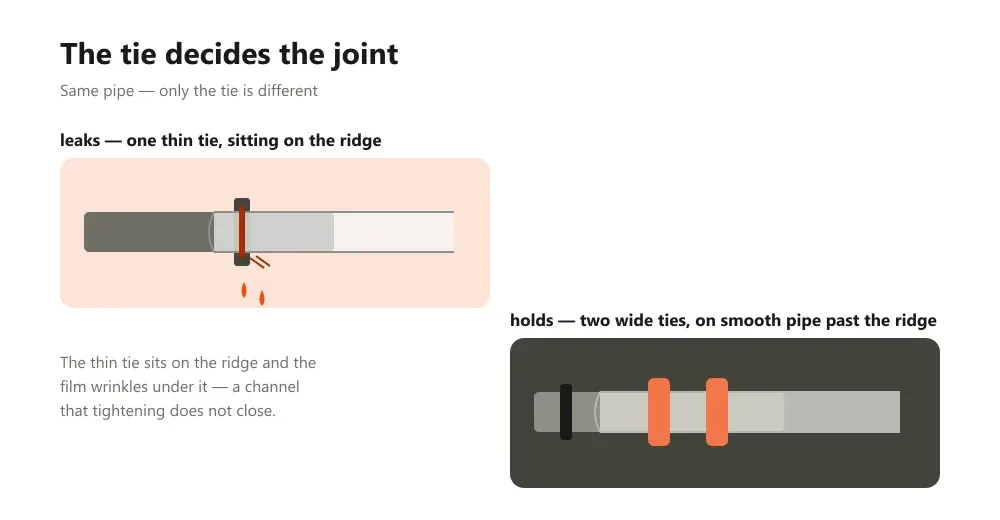
The head — the joint where the roll is tied onto the outlet pipe — is the first place to check. Three mistakes undo it: the tie sits over a weld ridge or a burr on the outlet, a single thin tie presses unevenly into the film, or the mouth was forced over an outlet too big for it and tore at the edge.
The fix is a better tie, not a harder pull. Cut the stretched mouth back square to fresh film, slide it on so both ties sit on smooth pipe clear of the ridge, and tie wide and flat — two ties a hand apart, with a strip cut from an old cycle inner tube under them to spread the pressure. A worm-drive hose clamp from the hardware market does the same job with an even grip; we do not stock hose clamps, and the clamps on our site are sprinkler parts for a different job.
Before re-tying, run a finger around the outlet itself. The fault is a weld ridge, a burr or a piece of old tie wire — not the steps on a step-type steel connector, which are there to grip the pipe. A minute with a file on a rough outlet saves the next three ties.
If the drip is upstream of the mouth — at the pump's threads or a valve — thread tape and a proper connector do what tying cannot. The tape is a hardware-market item we do not stock; the deep-step steel connector for HDPE pipe at the pump end is stocked, from ₹306 for 1 inch up to ₹1,053 for 3 inch at MRP, and the listing may show a discount off these. The pump-end fittings guide is written for drip, but its pump-outlet section applies here too.
Mid-line joins: the honest answer
We list no rain-pipe joiners, so there is no part on our shelf that makes a mid-line join — and we cannot vouch for an improvised one. A sleeve with both ends tied is the likeliest weak point on the whole line, and in our experience, joining rolls end to end does not work.
The better answer is to avoid the join altogether. Two rolls run as two lines, fed in turn, behave better than one long joined line — the same arithmetic that fixes a starving far end. Turn-taking needs a cock for each line, and we list none for rain pipe, so that part too is budgeted elsewhere.
If a join is truly unavoidable, a coupler sourced elsewhere and sized to the pipe is the least-bad bridge. Whatever bridges the join, the film must stretch over something smooth and round and sit without wrinkles — a wrinkle under a tie is a channel, and tightening does not close it. Test the join under pressure before the crop depends on it.
The tail: tie it so it stays tied
The tail is folded over and tied, and it leaks in two ways: a jet past a loose tie, or a fine jet from the fold corner where the film creased sharp. Both are five-minute fixes. Drain the line, fold the end a hand-width further back so the fold lands on fresh film — or trim off the old crease — and tie twice, leaving a short flap past the tie.
Remember the tail has a second job: it is also the flush point. It should untie in a moment when the line needs flushing — at season start and after any work upstream — and a tail knotted so hard it needs a blade gets left dirty instead. A tie that holds pressure and still unties is the standard to aim for.
Repair, replace, or rethink
A joint that keeps leaking after a proper re-tie may not be a joint problem any more. A mouth that tears again each time it is cut back is running out of sound film at that end — keep cutting back to fresh film and the roll works on as a shorter line; when there is no sound film left to cut to, it is a replacement.
A system leaking at every joint at once has a shared cause. Suspect pressure first: the listed working pressure is 1 to 1.5 kg/cm² at the pipe, we stock no pressure gauges or regulators, and the working control is the delivery valve, opened gradually and stopped while the spray is still even. But the same symptom also follows one tying habit repeated at every joint, or film that has aged all over.
When it is time to replace, a 40 mm roll costs ₹1,320 and a 63 mm ₹3,780 at MRP, tax in, and the rain pipe range shows what each size lists at today.
And if the same joint fails no matter what you tie it with, tell us the pipe size and what it is tied onto — the contact page has a WhatsApp link if sending a photo is easier. A mismatch between the two sizes needs a different outlet, not a better tie.
Keep reading
Drip joints leaking: find the joint, then the ₹6 fix
Drip joints leaking are nearly always the take-up at the sub-main, then a joiner, then an end cap. How to find which, why each fails, and what to repair.
GuidesLapeta pipe joints leaking: the head tie, the join, the seam
Lapeta pipe joints leaking are the head tie first, the coil join second, and a seam split that only looks like one. The walk, the fix for each, when to replace.
GuidesDrip pressure dropping mid-season: fixes ranked by likelihood
Drip pressure dropping mid-season is a leak, a supply problem or a filter, rarely the emitters. The cup test, the causes in order, and what to repair.