Fixing pipe cracking in the sun in a rain pipe system
Pipe cracking in the sun has more than one cause. How to read the crack pattern on a rain pipe, what each pattern means, and what to repair or replace.
13 October 2026 · 4 min read · REDYPLAST
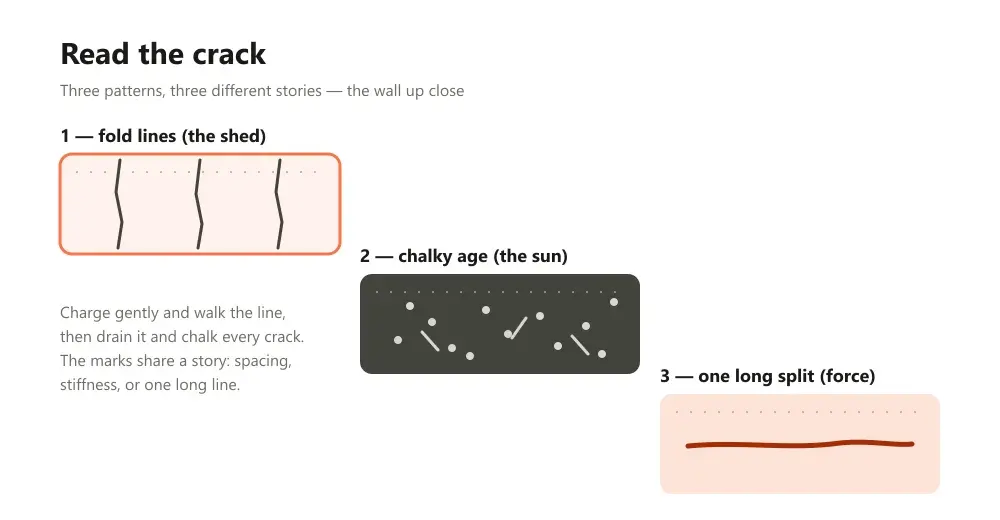
Pipe cracking in the sun is the complaint we hear; the crack itself tells a truer story. A rain pipe wall is thin by design — 350 microns, which is what keeps a 100 metre roll light enough to carry — and a thin wall records how it was treated. Read the crack pattern before blaming the weather, because each pattern has a different cause, a different fix, and a different lesson for the next roll.
First, read the crack
Three signatures cover most cracked lines: cracks spaced like the old folds, a chalky stiff wall, or one long split. Fold spacing means the shed. Chalky stiffness means the sun. A long split in a wall that still flexes soft means force — pressure or damage, not weather.
The test takes five minutes at season start, before the crop depends on the line. Charge it gently and walk it, watching for weeps and whitening; then drain it and mark every crack with chalk. What the marks share — spacing, stiffness, or one long line — names the cause.
Give the first stretch after the valve extra attention. On level ground pressure is highest there, so weakness shows there first, and finding it early leaves time to cut, shorten or reorder before anything depends on the line.
- Cracks along the old fold lines. Straight, evenly spaced, always where the roll was folded. This is the storage crease: a wall folded hard at the same point all off-season whitens there, then opens under pressure — sometimes on the first charge, often a season on.
- A stiff, chalky wall cracking wherever it flexes. Rub a finger across it: a powdery trace on a wall gone hard is sun ageing. Borewell scale also wipes white, but it leaves the wall soft.
- A clean split running along the line. Check the wall around it first. Soft and sound means pressure past the listed 1 to 1.5 kg/cm², old damage, or a drag over something sharp. Chalky and stiff means age finished the job.
Why the sun gets blamed for the shed's work
Crease damage is made indoors and fails outdoors. A roll folded tight all off-season carries a weak line at every fold, and the day pressure finds that line, the pipe is lying out in the field — so the shed's work gets the sun's name.
The crease works like a wire bent at the same point. Folding presses the wall flat into one sharp line; every charge and drain flexes that line again; the wall whitens along it before it opens. Whitening at fold spacing at season start is the early warning — expect cracks there soon.
The fix costs nothing but habit. A roll that is drained, coiled loose instead of folded, and kept on planks in shade between seasons rarely produces this pattern again — the pipe-life guide covers the storage routine step by step. Buying a new roll without changing the storage means the same cracks next season.
Pipe cracking in the sun: what is real
Real UV ageing is slower and shows differently. Season after season in open sun, the surface stiffens, chalks and loses the flex a lay-flat line depends on every time it is charged, drained and rolled. It happens fastest to the line nobody rolls up because the next watering is always soon.
The listing makes no UV-resistance claim either way, and its installation guide says to store the hose away from direct sunlight. Years are the honest unit here: a wall that chalks and stiffens in its very first season points at the material, not the sun.
Two habits slow it right down. Between waterings, drain the line and let it lie empty rather than baking charged through the afternoon. Between crops the roll sits unused, so storage decides how many seasons it lasts — the groundnut guide shows the roll going down and coming up with the season.
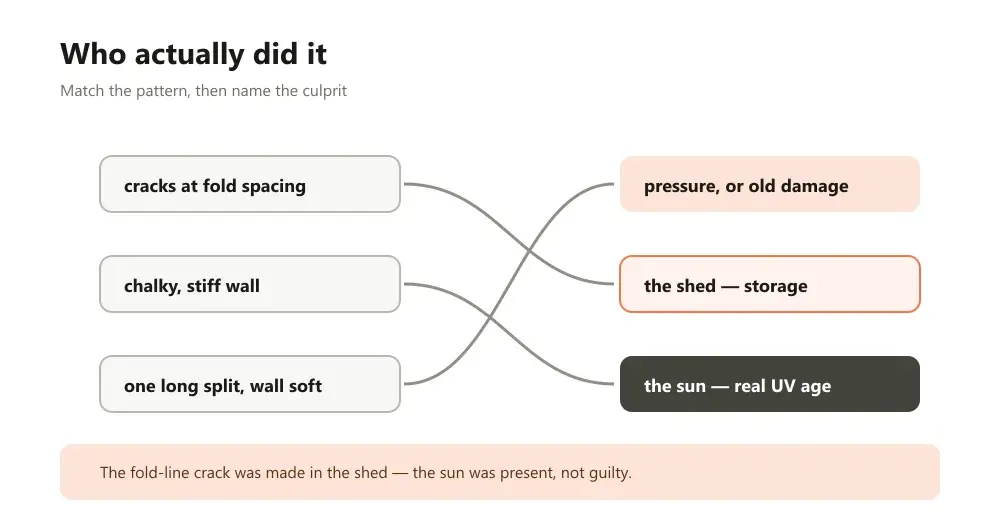
Repair, or replace
Be straightforward about the hardware: we list no rain-pipe menders, joiners or couplers, so a cracked stretch is not patched from our shelf. A coupler sourced elsewhere can bridge one split in an otherwise sound line, and the cut end of a shortened roll ties off the same way a rain pipe tail does.
Cutting to shorten is honest work, not a defeat. Cut square, a hand's width past the last chalk mark, and the healthy length keeps its spray. Give a sound remnant a smaller block of the same crop; narrow-bed duty — nurseries, kitchen gardens — is what the 20 mm roll (₹1,140 MRP for 200 metres) is sized for.
When the wall itself is tired, replace. A new 40 mm roll is ₹1,320 MRP and a 63 mm ₹3,780, both tax inclusive — the rain pipe listing carries the full range and any discount running. While deciding, the pipe quality guide applies the same flex-and-finish checks to an old wall as to a new one.
- Crease cracks near one end: cut the damaged stretch off and keep the healthy length for a shorter run.
- Crease cracks all along the roll: salvage the best stretch if one exists, and plan the replacement — patching every fold is a season of chasing leaks.
- A chalky, stiffened wall cracking in many places: replace. The ageing runs through the material, and a repair buys weeks.
Keeping the next roll whole
Four storage habits cover nearly everything. Coil loose, never fold — the fold is what makes the first pattern. Store drained, shaded and off the floor all off-season. In season, drain the line between rounds instead of leaving it charged and baking. And carry the roll rather than dragging it — the split that appeared in month three usually started on day one, when the roll was dragged.
Pressure is the fifth habit. The family's window is 1 to 1.5 kg/cm² at the pipe, and we stock no pressure gauges or regulators — so the honest control is a valve opened gradually and the spray watched. If a young roll still splits under gentle pressure and careful handling, bring us the roll and the split.
If a line keeps cracking despite all five, something upstream is worth checking before the next roll pays for it — tell us what you are seeing and we will look at the setup first.
Keep reading
Fixing uneven flow at the far end in a rain pipe system
Uneven flow at the far end of a rain pipe has three usual causes. Here they are in order of likelihood, with a field test and an honest fix for each.
GuidesRain pipe for cotton: sizes, prices and pitfalls
Rain pipe for cotton does one job well — the even start — and this guide separates it from the mid-season rescue, with sizes and real prices.
GuidesRain pipe for sugarcane: sizes, prices and pitfalls
Rain pipe for sugarcane has one honest window each cycle — setts to canopy — and this guide covers it: the 75 mm size, prices and pitfalls.