Flood to drip conversion for vegetables: cost and steps
A flood to drip conversion for vegetables, priced at MRP three ways, with the beds relaid every crop, the water and labour that change, and who should wait.
20 October 2026 · 5 min read · REDYPLAST
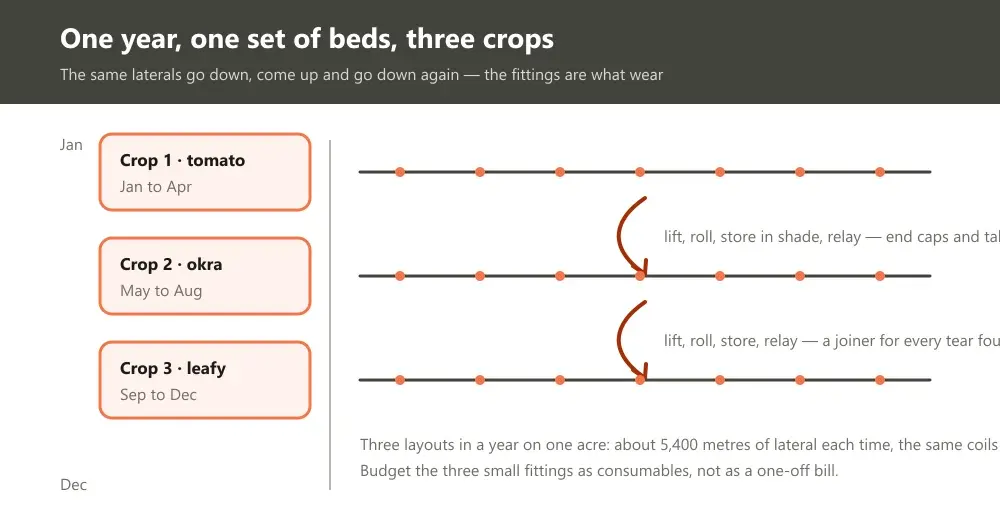
A flood to drip conversion for vegetables keeps the bore, the pump and the delivery main you already run, and adds everything from the pump outlet to the bed: a head with a filter we do not stock, a sub-main, one lateral per bed, and the small fittings that join and close them. What makes vegetables different is that the beds are replanted several times a year, so the laterals are lifted and laid again each time, and the small fittings are consumables.
The cost at MRP depends mostly on the wall you choose for the lateral, because close rows put a lot of pipe on one acre. The three bills below are for one acre at the middle of the vegetable row spacing, every price from our listing.
Flood to drip conversion for vegetables: what changes on the bed
Under flood the water runs down the furrow and wets the path as much as the row. Under drip each bed gets its own lateral, laid along the plants, and the path between beds stays dry — the first thing growers notice, because weeding and picking stop being a wade through mud.
The lateral for vegetables is nearly always a 16 mm inline pipe with the dripper built in at a fixed spacing, fed from a sub-main across the head of the beds. The listing's drip lines all carry 4 lph drippers at 40 cm, which suits a bed planted at 30 to 45 cm along the row.
Three facts shape every choice that follows. The rows are close, at 60 to 90 cm, so an acre carries over five kilometres of lateral. The beds turn over with each short crop, so whatever you lay you will lift. And the lifting wears the system more than sun or water does — the vegetables crop page says the same in fewer words.
- Keep: the bore or well, the pump, the delivery pipe to the field and the valve on it.
- Add: a filter (bought elsewhere), a non-return valve, a sub-main across the bed heads, one lateral per bed, a take-up where each lateral leaves the sub-main, an end cap at each tail, and joiners for every repair.
- Order spares of the three small fittings from the start; a bed relaid without them is a bed watered by hand.
The bill at MRP, three ways
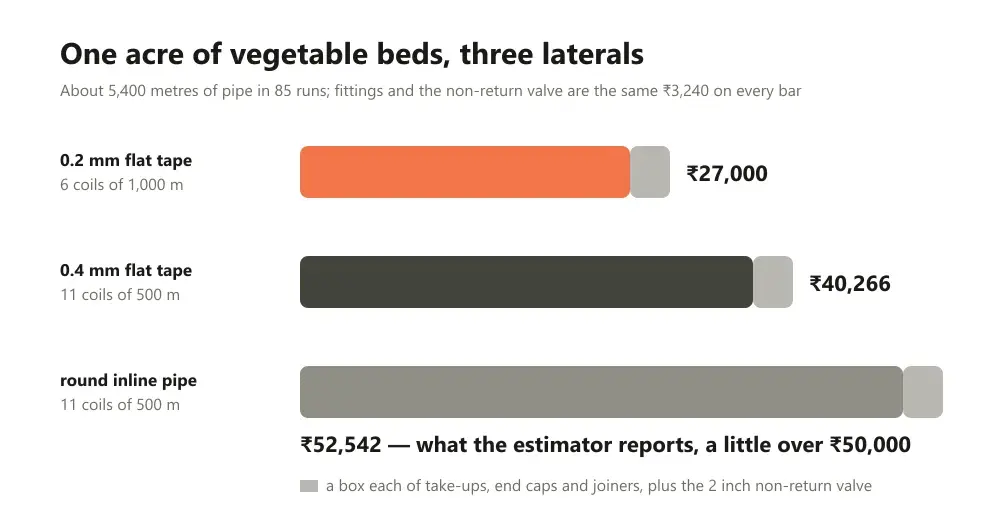
For one acre at 75 cm between rows the field needs about 5,400 metres of lateral in 85 runs. The three bills differ only in the lateral; the fittings and the valve are the same in each.
The thin-wall flat tape, 0.2 mm, is sold in 1,000 metre coils at ₹3,960, so six coils cover the acre for ₹23,760. The 0.4 mm flat tape comes in 500 metre coils at ₹3,366, eleven of them for ₹37,026. The round inline pipe the estimator prices, also 500 metres a coil, is ₹4,482, so the same acre of it is ₹49,302.
Each bill adds a box of 100 take-ups, a box of 100 end caps and a box of 100 joiners, at ₹6 a piece and sold by the hundred, which is ₹1,800 for the three, and the 2 inch socketed ball-type non-return valve at ₹1,440.
That makes the thin tape bill ₹27,000, the 0.4 mm bill ₹40,266 and the round inline bill ₹52,542, all tax inclusive. The 2 inch steel-to-plastic connector at the pump, ₹558, sits outside the bill with the pump-side steel, and the filter is not ours to price.
A sub-main across the bed heads is the one length of plain pipe the bills leave out, because its size follows the pump. A 3 inch LDPE coil of 15 kg is ₹2,160 on the listing if that is the size you run; a bigger pump wants the HDPE range.
The system estimator builds the round inline version from the crop and the acreage alone — laterals, take-ups, end caps and joiners, nothing else — and reports a little over ₹50,000 for an acre of vegetables. Treat it as the top of the range, not the bill: on beds that are lifted every crop, the thin tape is the honest default, and the chilli conversion makes the same argument for a crop that stays down a season longer.
The steps, in order
The order matters because the beds are shaped before the pipe goes down, and the pipe is tested before the seedlings do.
The pump-end fittings guide walks the first three steps part by part, and the drip irrigation range carries every item above that we sell, with any discount running today.
- Shape the beds and mark the row spacing first; the lateral count comes from the spacing, not the other way round.
- Fit the head: connector, non-return valve and the filter from elsewhere, in that order from the pump.
- Run the sub-main across the bed heads and punch a take-up for each lateral.
- Lay one lateral per bed with the drippers facing up, fold and cap each tail, and flush the whole system with the caps off before closing it.
- Charge it gently and walk every bed before transplanting; a dry patch now is a joiner, after transplant it is a lost row.
- When the crop is out, drain the laterals, roll them loosely and store them in shade — the next bed starts with the same coils.
Water, labour and the first season
Flood taught you to water deep and seldom. Drip waters little and often, into the row only, and the first season is spent unlearning the old rhythm. A bed under drip is wetted in a band along the lateral, and a seedling planted a hand's width off the line can sit dry while the soil beside it is soaked.
The listed working pressure is the limit to respect: 1 to 1.5 kg per square centimetre for the 0.2 mm tape, up to 3.5 for the 0.4 mm, 1 to 2 for the round inline. We stock no pressure gauges or regulators, so the control is the delivery valve opened gradually while someone watches the far bed. A 0.2 mm tape pushed to the 0.4 mm figure splits at the seam.
Fertigation is where vegetable growers gain the most, and it needs a venturi or a dosing unit that we do not stock. Labour moves rather than disappears: nobody opens and closes furrows, but someone lifts, rolls and relays the laterals at every turnover, and walks the beds for blocked drippers after each one.
Who should not convert
Drip on vegetables has drawn Pradhan Mantri Krishi Sinchayee Yojana support under its Per Drop More Crop component, with the rate and the paperwork varying by state and year; ask the horticulture office before assuming a figure.
If you want the bill for your own beds, send us the spacing, the bed length and the acreage and we price what we sell at MRP, marking the filter, the dosing unit and the gauge as items from elsewhere.
- A grower on canal water with no pump and no bore: drip needs pressure the canal does not give, and the filter load from open water is the heaviest of all.
- Beds that will not be lifted carefully between crops: a lateral dragged off a bed with the drippers down is the usual first-season failure, and no wall survives it.
- A single short crop on leased land that ends this season; the system is worth it on beds you will replant.
- Anyone unwilling to buy the filter and the dosing unit elsewhere; the laterals block without the first and the gain is halved without the second.
Where these numbers come from
- PMKSY — Per Drop More Crop (opens in a new tab)
The central micro-irrigation scheme. Subsidy rates and eligibility are set here, not by suppliers.
Keep reading
Converting chilli from flood to drip: cost and steps
Converting chilli from flood to drip: what you keep, what you buy, what it costs at MRP, how the work and the water change, and who should not convert.
GuidesConverting banana from flood to drip: cost and steps
Converting banana from flood to drip suits a crop that drinks heavily for a year and suffers with wet roots: the acre bill, the pump check, the steps.
GuidesConverting cotton from flood to drip: cost and steps
Converting cotton from flood to drip roughly doubles the ground one bore can water. The published acre bill at MRP, the order of work, and who should wait.