Converting banana from flood to drip: cost and steps
Converting banana from flood to drip suits a crop that drinks heavily for a year and suffers with wet roots: the acre bill, the pump check, the steps.
16 October 2026 · 5 min read · REDYPLAST
Converting banana from flood to drip answers the crop's own profile: heavy, near-continuous water demand over a ten to twelve month crop, on rows close enough that flooding wastes most of what the pump lifts. Banana also does badly with its roots sitting in wet soil, and flood keeps them there after every watering.
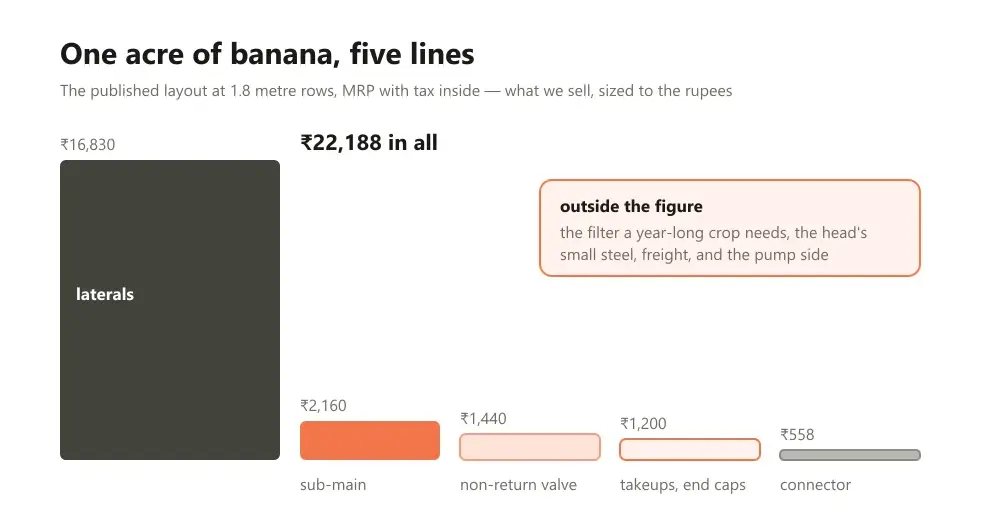
The published one-acre banana layout prices the parts we sell at ₹22,188 at MRP. The lateral is three quarters of that figure, and the filter a long crop cannot do without is bought elsewhere.
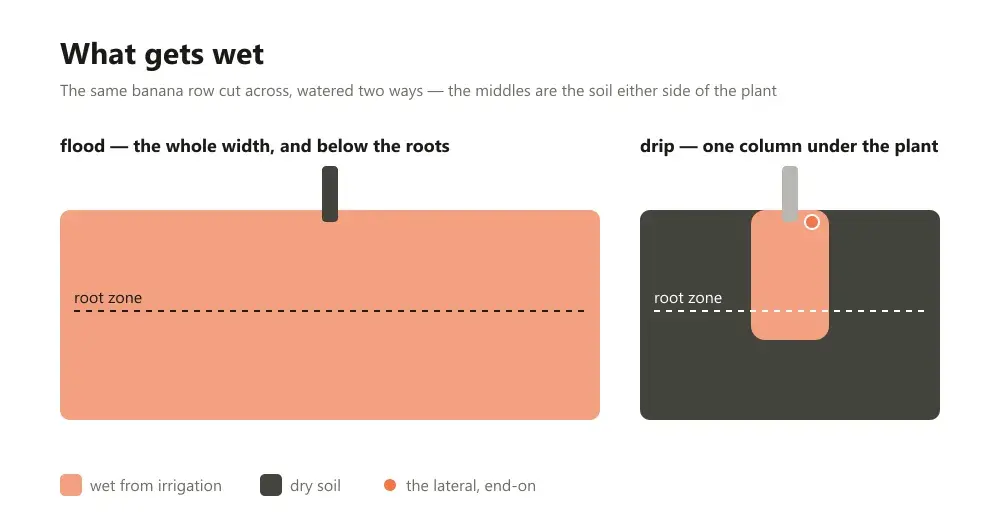
Converting banana from flood to drip: what each method wets
Flood fills the whole width — the plant line and the middles alike — and keeps soaking downward after the roots have taken what they can, so part of every watering is lost below them. Drip wets a column under the plant, built by the several emitters along that stretch of lateral, and the soil between rows stays dry from irrigation.
For banana that matters twice. The mat gets moisture at root depth that is topped up little and often, rather than a soaking followed by a dry spell; and the middles tend to stay firm enough to work in, with fewer weeds coming up where no water lands.
The banana drip guide makes the case for the lateral grades and names the pitfalls, and the banana crop page carries the crop's water figures.
The acre bill, and which lateral grade to buy
Banana rows run 1.8 to 2.1 metres, so an acre needs fewer laterals than a row crop. The published layout takes the tight end, 1.8 metres on a 64 by 63 metre block: 35 rows, 35 laterals of 63 metres, about 2,200 metres of line in five coils of 500 metres.
Five lines add up to ₹22,188 with tax inside. The 16 mm flat lateral with a 0.4 mm wall is ₹3,366 a coil, ₹16,830 for five. Takeups and end caps are ₹6 each and ship in hundreds, ₹1,200 for both boxes. A 3 inch LDPE coil for the sub-main is ₹2,160. The 2 inch non-return valve is ₹1,440, there so the line does not drain back into the bore when the pump stops, and the 2 inch pump connector is ₹558.
The grade is the decision. The thin 0.2 mm tape costs least per metre of anything we sell and is still the wrong lateral for a crop that stands this long: a failure after the canopy closes means crawling between pseudostems to relay it. The 0.4 mm flat is the floor.
The standard round inline at ₹4,482 per 500 metres — five coils, ₹22,410, about ₹5,580 more than the flat — stays round under a standing crop and can water the ratoon after it. The heavy-wall 16 mm inline at ₹7,200 per 400 metres, six coils and ₹43,200 for the acre, is bought once for several cycles on one layout.
The one-acre banana layout prints every line. Outside its figure sit the filter, the block valves, the head's small steel, freight and the pump side; we stock none of the first two. The system estimator totals the laterals, takeups, end caps and joiners from your acres at banana's mid-range 1.95 metre spacing on the standard round pipe — it leaves out the sub-main, valve and connector, so its total will not match ₹22,188.
Size the pump before the pipe
Banana at its peak draws 5 to 8 mm a day, more than cotton or chilli, which on drip, allowing for what the system itself loses, means lifting about 22,000 to 36,000 litres a day for an acre in the hard weeks. Divide that by your bore's honest yield and you have the pumping hours: on 3,000 litres an hour, between seven and twelve a day. A pump and a power window that served a lighter crop can run short in the weeks the bunch is filling.
Measure the bore's yield and the hours the supply allows before any coil is priced. If the whole block cannot be watered in one slot, design it as two valves from the start and water each half in turn; splitting the block later means cutting and re-laying the sub-main with the crop standing.
The borewell guide turns yield and hours into litres a day, and the water requirement estimator gives banana's daily need for your acreage to set against it.
The order of work, around planting
A new block is the easy conversion, because the laterals can go down before the suckers or plantlets do. The head is built first, from the pump outward: the connector, the non-return valve, and then the filter — the one part bought elsewhere.
The sub-main runs across the row ends, sized to the flow it carries — the published layout uses 3 inch behind a 2 inch delivery. Each row then gets a lateral along its marked line, and the plants go in beside it, so every mat is served by the emitters along its stretch of row from the first week.
An established block can be converted too. Lay the sub-main along the row ends between pseudostems, feed one lateral down each row at the base of the plants, flush each line through its open end before capping, and run the first watering slowly while someone walks the rows for a takeoff that has not seated.
The pump-to-lateral fittings guide prices the head chain part by part.
- Measure the bore and the hours; settle on one valve or two before fixing the sub-main route.
- Build the head: connector first, non-return valve second, filter last.
- Run the sub-main across the row ends, sized to the flow of the block it feeds.
- Lay one lateral per row — before planting on a new block, along the plant bases on an old one.
- Flush each lateral open-ended, cap it, and walk the rows through the first watering.
Learning to read a dripped row
Under flood you judged water by the surface; under drip the judgement moves to root depth. The surface between rows stays dry, the wet column is under the plant, and the first instinct is to run longer until the middles look watered — which only wets the middles. Dig a hand's depth beside a mat before each run and let that decide the run time.
Feeding changes too. Fertiliser through the line calls for a venturi or dosing unit; we stock neither. Flushing becomes a fixed habit rather than an afterthought, because the lines stay down for the whole crop: the blocking guide explains why a line closes from the far end first.
Who should wait
Without a water source of its own — bore, open well or tank — a block has nothing to put through a lateral. Canal water reaching the block by gravity needs a pump first, and its organic load is the filter's job to handle.
A pump that cannot meet the peak weeks should be resized before the conversion, because the shortfall arrives when the bunch is filling. And a lease shorter than the crop and its ratoon leaves the lateral on land you no longer farm.
Drip on horticulture crops has drawn PMKSY support under its Per Drop More Crop component; the terms change by year and district, so ask the horticulture office before you buy. For a counted list against your own rows and bore, send the field's details — yield, hours, acres and spacing — and we will return a counted list at MRP for what we sell, with the filter, block valves, dosing unit and gauge marked as items from elsewhere. The drip range carries today's prices.
Where these numbers come from
- ICAR (opens in a new tab)
Indian Council of Agricultural Research — crop agronomy and regional package-of-practices.
- TNAU Agritech Portal (opens in a new tab)
Crop-wise spacing, water requirement and drip layout references for southern India.
- FAO Irrigation and Drainage Paper 56 (opens in a new tab)
The reference method for crop evapotranspiration and crop coefficients that daily water figures derive from.
- PMKSY — Per Drop More Crop (opens in a new tab)
The central micro-irrigation scheme. Subsidy rates and eligibility are set here, not by suppliers.
- Telangana Horticulture Department (opens in a new tab)
State subsidy administration and the district offices that process micro-irrigation applications.
Keep reading
Converting cotton from flood to drip: cost and steps
Converting cotton from flood to drip roughly doubles the ground one bore can water. The published acre bill at MRP, the order of work, and who should wait.
GuidesConverting chilli from flood to drip: cost and steps
Converting chilli from flood to drip: what you keep, what you buy, what it costs at MRP, how the work and the water change, and who should not convert.
GuidesLay flat tube for banana: sizes, grades and pitfalls
Choosing a lay flat tube for banana blocks — 63, 75 or 90 mm, what each roll costs, the 5% GST advantage, and the pitfalls that shorten one.