Drip emitter spacing for banana on laterite soil, pit and lines
Drip emitter spacing for banana on laterite soil is two lines on a mound, over a pit that must not reach the pan. The pit as a bucket, the runs in May.
23 November 2026 · 5 min read · REDYPLAST
Drip emitter spacing for banana on laterite soil is two laterals per row, one each side of the stem line, because the band under a single line of the 40 cm drippers every inline pipe we list carries is only about 40 cm wide on this gravel and a banana mat spreads its roots across a metre.
What drip emitter spacing for banana on laterite soil adds to the sandy-loam rule is the pit: on laterite the planting pit, dug into gravel and filled with compost, is the only soil on the farm that holds water, and whether it sits on the iron pan or above it decides whether the mat stands in a store or in a flood.
Banana on laterite is the crop of the East Godavari uplands and the lighter ground behind Visakhapatnam, grown on red gravel over a hard crust and watered from bores that run orange. This guide covers the pit, the lines and the loop, the runs, and the August that drowns a mat planted on the pan.
The pit as a bucket
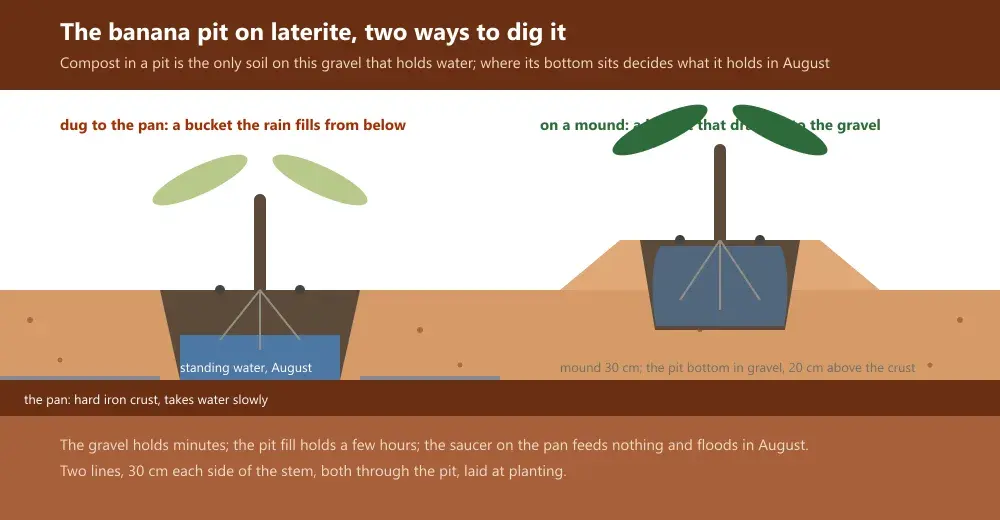
Laterite is leached red gravel over an iron crust at 40 to 80 cm that takes water slowly. The gravel holds almost nothing: the column under a dripper is 35 to 50 cm across, through the top layer in a quarter of an hour, and pooled on the pan in a saucer that a banana's shallow roots, most of them in the top 30 cm, cannot reach.
The bucket has a bottom. A pit dug down to the pan is a bucket that the monsoon fills from below and the drippers fill from above, and a mat whose roots sit in standing water through August loses them. On this soil the pit is dug shallow and the mat is set on a mound 30 cm high, so the bucket drains into the gravel instead of resting on the crust.
So the pit is the root zone. A planting pit 60 cm across, filled with compost, holds a few hours of the mat's water where the gravel around it holds minutes; the drippers wet the pit fill, the roots fill the pit, and the mat lives in a bucket. The banana crop page calls banana the thirstiest crop we size for, and on laterite the bucket is what makes it possible at all.
- Column: 35 to 50 cm across in the gravel, holding minutes; the pit fill holds a few hours.
- The pan: at 40 to 80 cm, below the banana's roots; the saucer on it feeds nothing and floods in August.
- The pit: 60 cm across, compost-filled, on a mound, never dug to the pan.
Drip emitter spacing for banana on laterite soil: two lines, or a loop
A lateral along each side of the mound, 30 cm from the stems, runs both bands through the pit fill so the roots either side of the stem have water. Rows at 1.8 to 2.1 metres need about 4,150 metres of 16 mm inline an acre at the 1.95 metre midpoint, twice the 2,075 metres a single line takes at that spacing.
On laterite the lines are laid with their end caps at the headland, for the fortnightly flush that iron water demands through the plant crop and the ratoons.
The banana drip guide covers the single line for heavier ground; here the second line is not an upgrade for the ratoon but part of the planting.
Where the spacing is 2.1 metres or more, a loop of the same inline round each mound serves better: two and a half metres of pipe with six drippers makes a ring of columns inside the pit, nearer 2,900 metres on the acre with more joints to make. Either comes from the drip range.
The litres, in runs the pit can hold
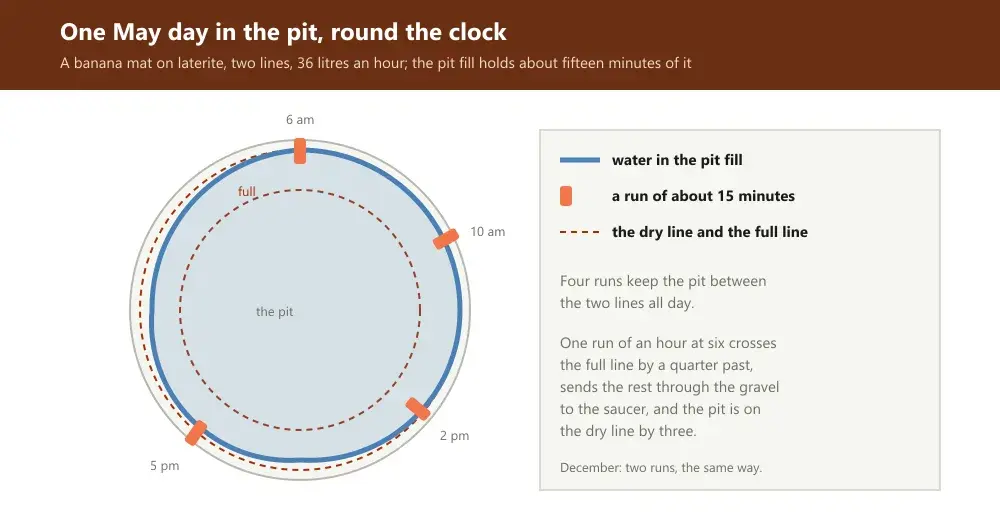
Eight or nine drippers on two lines pass through each pit, 36 litres an hour between them, which makes May's water a little over an hour of pumping and December's about 25 minutes. The pit fill takes roughly 15 minutes of that before the surplus drops through the gravel to the saucer, so May's hour is four runs of a quarter-hour each, and December's is two.
A mulch of straw or dry leaf over the mound and both lines is worth a run a day on this gravel in April, and the compost in the pit is renewed at each ratoon, because a pit that has lost its organic matter is gravel again and holds what gravel holds.
At full cover a banana crop takes 3.5 to 10 mm a day through the year: on an acre, roughly 14,000 to 40,000 litres into the roots, and about 15,700 to 45,000 litres out of the pump after drip's losses; the water requirement calculator works it for your own acreage. For one plant at 1.95 by 1.8 metres the pump's share is about 14 litres a day in December and close to 40 in May.
The August that drowns the mat
The failure on laterite is in the monsoon, not the heat. The pan holds the rain, the saucers under every pit join, and a pit dug to the crust stands in water from the bottom up for weeks; the mat yellows from the oldest leaves, the suckers stop, and by September the growers call it wilt. The pit on a mound above the crust drains into the gravel, and the same rain passes it.
The pump stays off through the wet weeks and comes back on the third dry day for a short run, and the furrows between mounds are opened at the low end of the row so the saucers drain to the field edge.
Iron is the other long game on this country: the bore water passes through an open settling tank and a filter before the main, neither of which is ours to sell, and the blocked-line guide covers flushing from the headland caps; the fortnightly interval is our own habit.
- A pit dug to the pan: a bucket the monsoon fills from below; yellow leaves and dead suckers by September.
- One line through the pit: a third of the mat in the bucket, the rest in dry gravel.
- An hour in one run in May: three quarters of it through the pit to the saucer, where nothing drinks it.
- The check: a trowel a hand deep in the pit fill, both sides of the stem, the morning after a run; in August, a trowel at the pit bottom that comes up wet means the pump stays off.
The figures are a starting point
Only the 3.5 to 10 mm a day is a published range. The band widths, the pan depth and the 15-minute hold are working rules, to be checked with the trowel test above, and none of them is a reading from your field. Laterite varies most in the depth to its pan, which decides how shallow the pit must be and how soon the saucer under it floods.
Treat four runs of 15 minutes on two lines as May's first schedule and let the trowel in the pit fill move it.
Banana on soils without a pan is covered by the sandy-loam banana guide and the red-loam banana guide; the pan itself, under beds, by the laterite vegetables guide. To have the pit, the lines and the runs worked for your own field, tell us the row spacing, the acreage, the depth to the pan if you know it, and whether the bore runs orange, and we will say two lines or a loop, and how high to build the mound.
Where these numbers come from
- FAO Irrigation and Drainage Paper 56 (opens in a new tab)
The reference method for crop evapotranspiration and crop coefficients that daily water figures derive from.
- ICAR (opens in a new tab)
Indian Council of Agricultural Research — crop agronomy and regional package-of-practices.
- TNAU Agritech Portal (opens in a new tab)
Crop-wise spacing, water requirement and drip layout references for southern India.
Keep reading
Drip emitter spacing for sugarcane on laterite soil, on the pan
Drip emitter spacing for sugarcane on laterite soil is a tight pair or single rows over a pan that stores water in April and drowns the stool in August.
GuidesDrip emitter spacing for vegetables on laterite soil, on the pan
Drip emitter spacing for vegetables on laterite soil is a plant at every dripper and runs of ten minutes: the gravel holds nothing, the pan holds too much.
GuidesDrip emitter spacing for banana on sandy loam, two lines at once
Drip emitter spacing for banana on sandy loam is two laterals per row from planting, because one narrow band cannot hold a wide mat. Band, lines, wind.