Drip emitter spacing for banana on sandy loam, two lines at once
Drip emitter spacing for banana on sandy loam is two laterals per row from planting, because one narrow band cannot hold a wide mat. Band, lines, wind.
18 November 2026 · 5 min read · REDYPLAST
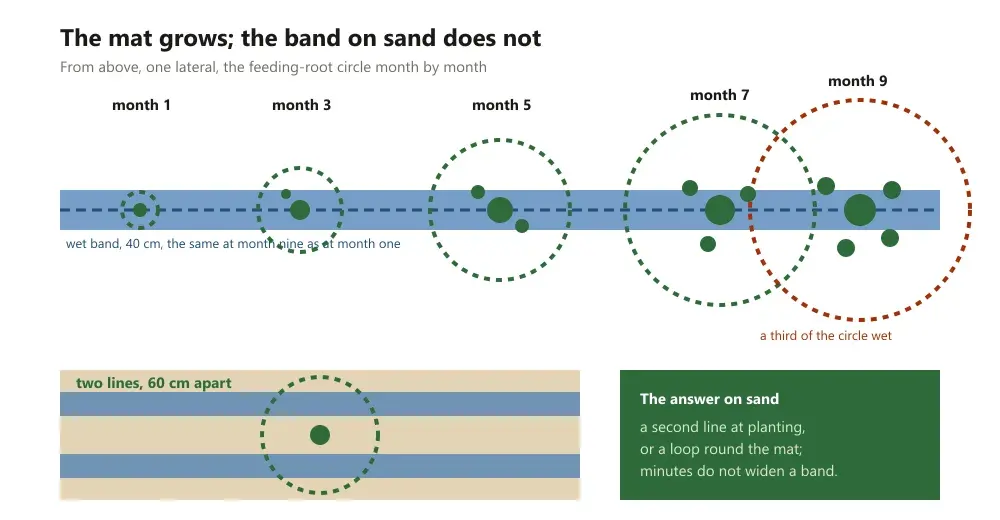
Drip emitter spacing for banana on sandy loam is two laterals per row from the day of planting, one 30 cm each side of the stem line, because the 40 cm drippers on every inline pipe we list wet a band only about 40 cm wide on this soil and a banana mat spreads its roots across a metre by the time the bunch is filling.
Drip emitter spacing for banana on sandy loam is therefore the one case in this series where the plant crop, not only the ratoon, needs the second line, and where the line count is about anchorage as much as water.
Banana on sandy loam is grown under a bore on the lighter soils of the Pulivendula and Anantapur belts, and it is the thirstiest crop we size for on the soil that holds the least. This guide covers the narrow band under a wide mat, the two-line and loop layouts, the litres in runs the column can hold, and the pre-monsoon wind that takes a one-line crop down with its bunch on.
A narrow band under a wide mat
Sandy loam takes water down and barely out. One 4 litre dripper wets a column 35 to 50 cm across; at 40 cm along the pipe the columns merge into a band about 40 cm wide, reaching 20 cm each side of the lateral, and the sand past that stays dry. The top half metre of the band holds about a day of the crop's water in the hot months.
The mat does not stay inside it. A banana plant feeds within half a metre of the stem for its first three months, and by the fifth month, with suckers thrown on every side, its feeding roots work a circle a metre or more across. On a soil that spreads water the band widens with the mat; on sand it does not, and from bunch emergence onward a single line is watering a third of the roots and the rest are in dry sand.
The banana crop page calls banana the thirstiest crop we size for; on sandy loam it is also the one whose root circle outgrows the wet band fastest.
- Band: about 40 cm wide under one lateral, deep rather than wide, fixed for the life of the pipe.
- Store: about a day in the hot months; the field is run every day of the cycle.
- The mat: half a metre across at three months, a metre or more by bunch emergence.
- Roots: only where the band is, which on sand is also only where the plant is anchored.
Drip emitter spacing for banana on sandy loam: two lines, or a loop
The alternative on wide spacings is a loop of the same inline around each mat, about two and a half metres of pipe per plant with six drippers on it, which puts a ring of columns under the whole circle. It is closer to 2,900 metres on the acre but more joints, and it suits a planting at 2.1 metres or wider better than dense rows.
Two laterals per row, each 30 cm from the stem line on opposite sides, give the mat two bands 60 cm apart with the stems between them and the roots on both sides inside a wet strip 20 cm beyond each line. At rows 1.8 to 2.1 metres apart that is about 4,200 metres of 16 mm inline on an acre, double the single-line count the banana drip guide prices for heavier soil, and it goes in at planting, not at the ratoon.
Both come from the drip range. What does not work here is the single line carried into the fifth month and mended with longer runs: the band does not widen, and the extra minutes go to depth.
The litres, in runs the column can hold
Two lines put eight or nine drippers under a mat, about 36 litres an hour, so the May day is a little over an hour of running and the December day about 25 minutes. On sandy loam the column holds roughly 20 minutes of a dripper's output before the surplus drains past the roots, so May's hour goes in as three or four runs spread from early morning to late afternoon, and December's as one or two.
On a single line the same May plant would need two hours and a quarter in six or seven runs, which no field in shifts can fit into a day; the second line halves the hours and is what makes the sand schedule possible at all.
Banana at full cover uses 3.5 to 10 mm a day across the year, which on one acre is roughly 14,000 to 40,000 litres at the root, or about 15,700 to 45,000 litres from the pump once drip's losses are allowed for; the water requirement calculator gives the figure for your own acreage. Per plant at 1.95 by 1.8 metres that is about 14 litres a day from the pump in December and nearly 40 in May.
The wind and the bunch
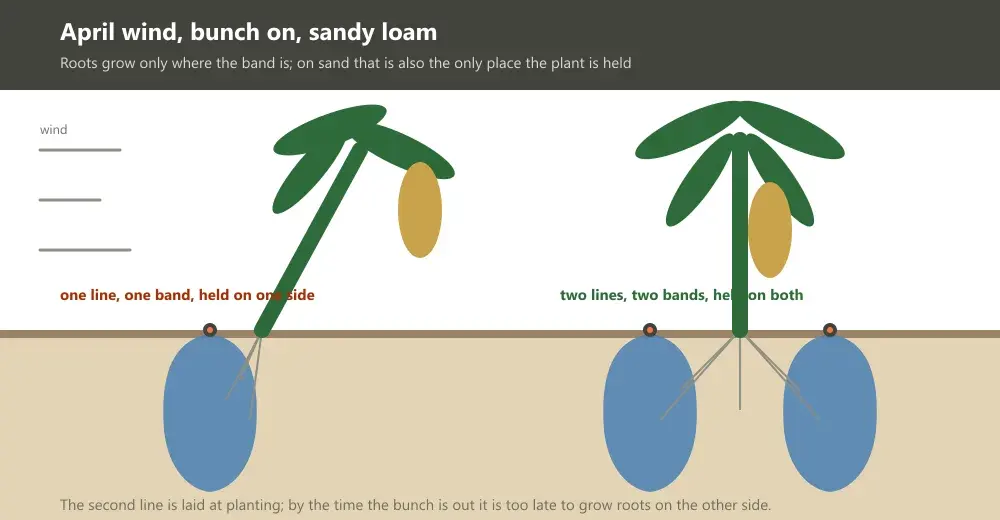
On sand, roots grow in the band and nowhere else, so a one-line plant has its anchorage on one side of the stem. April and May bring the pre-monsoon winds across the Rayalaseema belts at exactly the time the bunch is filling and the plant is top-heavy, and a plant held on one side goes over towards the other, bunch and all. Growers blame the wind; the layout chose which plants would fall.
Two bands or a loop put roots on every side, and a mulch of the cut plant crop's trash along both lines keeps the surface of each band moist enough for the shallow anchor roots to stay in it. Props and windbreaks help, and neither is ours to sell; the cheaper insurance is the second line laid at planting.
A blocked dripper on this soil shows within a day as one side of a mat flagging; the blocked-line guide covers flushing, and the filter it depends on is not ours to sell.
- A single line into bunching: a third of the mat watered, a plant anchored on one side, down in the April wind.
- An hour in one run: the second half past the roots, the band dry again by evening.
- Potash in two big doses: most of it below the roots; banana on sand takes its potash in many small doses through a dosing unit we do not stock.
- The check: a trowel a hand deep on both sides of the stem the morning after a run; dusty on either side means that side has no roots.
The figures are a starting point
The 3.5 to 10 mm a day and the band widths are published agronomic ranges rather than readings from your field, and sandy loam grades from nearly sand to nearly loam between one bund and the next; the sandier the field, the stronger the case for the loop. Treat three runs of 20 minutes on two lines as the first hot-month schedule and let the trowel move it.
The same crop on heavier ground is worked in the red-loam banana guide and the alluvial banana guide, and the same soil under another orchard crop in the sandy-loam pomegranate guide. For the line count and the runs sized to your spacing and bore, send us the row spacing, the acreage, the bore yield and whether you intend a ratoon and we will say whether two lines or a loop, and how many runs a day the pump must give.
Where these numbers come from
- FAO Irrigation and Drainage Paper 56 (opens in a new tab)
The reference method for crop evapotranspiration and crop coefficients that daily water figures derive from.
- ICAR (opens in a new tab)
Indian Council of Agricultural Research — crop agronomy and regional package-of-practices.
- TNAU Agritech Portal (opens in a new tab)
Crop-wise spacing, water requirement and drip layout references for southern India.
Keep reading
Drip emitter spacing for sugarcane on sandy loam: the pump's day
Drip emitter spacing for sugarcane on sandy loam is a tight pair or a single row, run in short bursts all day through June. The column, the pump's day.
GuidesDrip emitter spacing for chilli on sandy loam, mulched or bare
Drip emitter spacing for chilli on sandy loam is one lateral per row and a plant at every dripper, with a day's store beneath. The column, mulch, cool months.
GuidesDrip emitter spacing for cotton on sandy loam, root first
Drip emitter spacing for cotton on sandy loam puts the lateral on the plant line and the taproot down the column. Reach, root-first opening, split runs.