Drip emitter spacing for chilli on laterite soil, by the pan
Drip emitter spacing for chilli on laterite soil is a plant at every dripper on a raised bed, transplanted once the pan has drained. Bed, date, runs.
29 November 2026 · 5 min read · REDYPLAST
Drip emitter spacing for chilli on laterite soil is a plant at every dripper on the 40 cm inline pipe we list, because the wet column under a 4 litre dripper on this gravel is 35 to 50 cm across and holds less than a day of water in the top 25 cm where a transplanted chilli keeps its roots.
What drip emitter spacing for chilli on laterite soil has to settle before the pipe goes down is the date, because chilli is transplanted in August and September, and in August and September the iron pan half a metre under this soil is full of the monsoon.
Chilli on laterite is grown on the coastal uplands of Srikakulam and Vizianagaram and the lighter ground behind Visakhapatnam, on red gravel over a hard crust, watered from bores that run orange. This guide covers the column and the pan, the bed and the pair, the transplanting date the pan sets, and the minutes through the cool-month peak.
The column on gravel, and the pan beneath it
Under laterite's loose red gravel lies an iron crust, 40 to 80 cm down, that water crosses slowly. A dripper's column falls through the gravel in a quarter of an hour, keeps almost none of it, and pools on the crust as a saucer; a chilli plant's fibrous roots stop at 25 cm and never meet that saucer. Through the dry months the gravel above it is the whole root zone, and by evening it is dry.
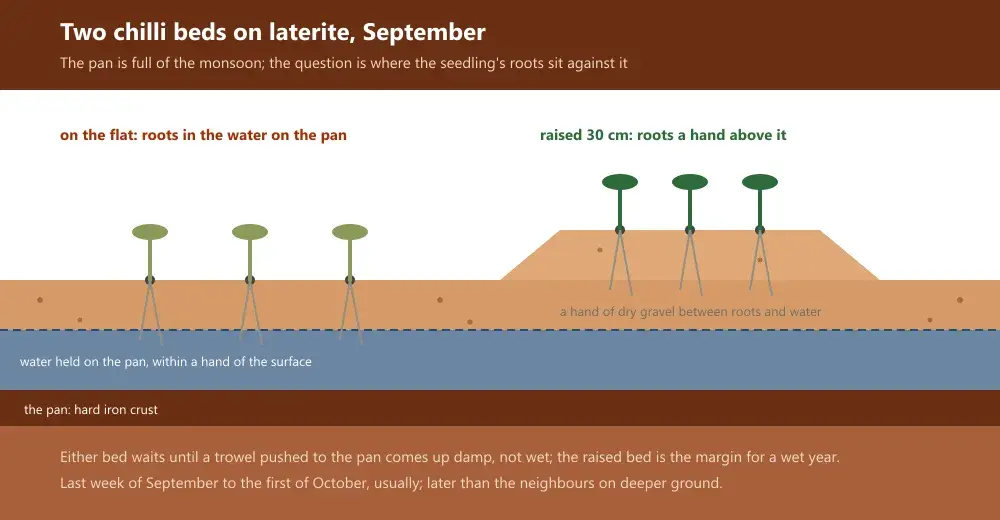
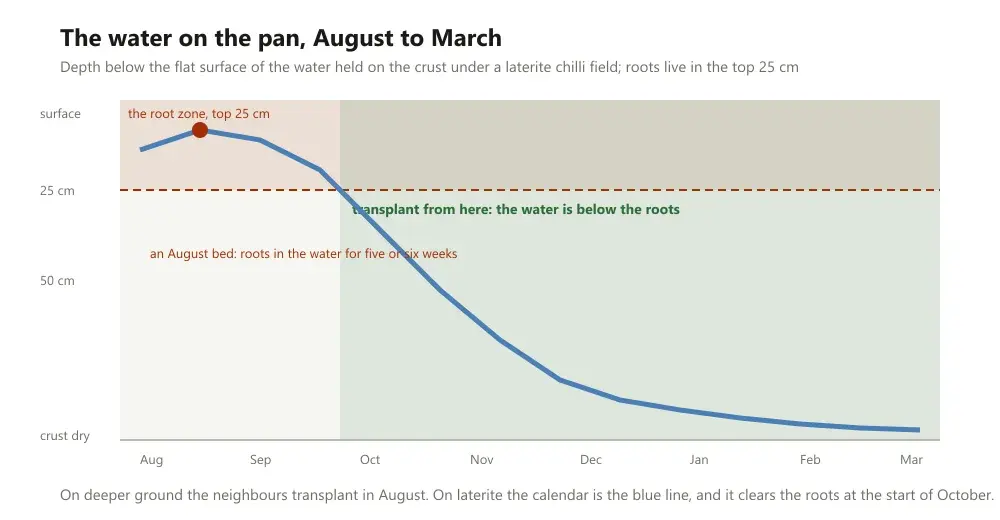
In the monsoon the pan does the opposite. It holds the rain, the saucers under the field join, and from August through September the water on the crust stands within a hand of the surface on the flat; a seedling transplanted into that has its roots in water from the first week, and damping-off and collar rot take the stand before it flowers.
On laterite the plants go at the drippers, 40 cm apart along the line, on a bed, and not before the pan has drained.
- Column: 35 to 50 cm across, through the gravel in minutes; the saucer on the pan is below the roots.
- Store: less than a day in the root zone in the dry months, so the runs are short and many.
- Monsoon: the pan holds the rain within a hand of the surface on the flat through September.
- Reach: about 20 cm each side of the pipe; a plant between two drippers stays small.
Drip emitter spacing for chilli on laterite soil, bed and pair
Chilli on this soil stands on beds 30 cm high with compost dug through the gravel: gravel alone keeps nothing from one run to the next, and a flat bed keeps the monsoon. The lateral lies along the crown of the bed. Two rows can share it if they are 40 cm apart or closer, each within its reach; anything wider gets a line per row.
Where the bed is mulched with film, which we do not sell, run the line before the film is laid and punch the holes over the drippers.
Caps belong at the headland on laterite. The bore water carries iron, iron closes a line from its far end, and the lateral will be opened and flushed every two weeks while it lies on the bed. That interval is our habit for iron water, not a published figure.
Single rows at 0.75 metres come to roughly 5,400 metres of 16 mm inline for an acre, and close pairs at 1.2 metres to roughly 3,400, all from the drip range. The chilli crop page lays one lateral between each pair of rows, 1.5 metres apart, about 2,700 metres an acre. Here the column is too narrow to wet that much ground, so the pair is closer and the pipe more.
The date the pan sets
On other soils the transplanting date is set by the nursery and the market. On laterite it is set by the crust: a seedling goes out when a trowel pushed to the pan at the low end of the field comes up damp rather than wet, which on the north coast is usually the last week of September or the first of October, some weeks after the neighbours on deeper ground.
The weeks are not lost. A seedling held in the nursery a few weeks longer goes out onto a drained bed, roots into gravel instead of standing water, and by December can be level with a crop transplanted in August that spent its first weeks losing plants. The raised bed buys some of that margin, and in a wet year it buys all of it.
The minutes, in the cool months
Each metre of pipe gives 10 litres an hour to three quarters of a square metre on single rows at 0.75 metres, close to 13 mm an hour, which, with drip's losses allowed for, makes a 6 mm day about 30 minutes of pumping and a 3.5 mm day about 18.
Laterite's gravel keeps only some ten minutes of a dripper's flow where the roots can use it, so the peak day is three runs of ten minutes and the cool day two of nine; under film the same water can go in two runs.
Chilli at full cover uses 3.5 to 6 mm a day across the November to February peak, which on one acre is roughly 14,000 to 24,000 litres at the root, or about 15,700 to 27,000 litres from the pump once drip's losses are allowed for; the water requirement calculator gives the figure for your own acreage.
Given as one 30-minute run, two thirds of the water reaches the saucer, and the plant none of it; a pale, slow bed that was "watered properly" each morning is how that shows. The blocked-line guide covers flushing; the settling tank and the filter the bore water needs first are not ours to sell.
- Transplanted in August on the flat: roots in the water on the pan, collar rot before flowering.
- One run of 30 minutes: two thirds on the saucer, a bed that looks watered and grows pale.
- A hole punched off the line under mulch: a seedling at the column's edge, the smallest plant in the row.
- The check: at noon, a trowel a hand down next to the plant should come up moist; in September, one that comes up wet from the bottom says the bed went out too early.
The figures are a starting point
Only the 3.5 to 6 mm a day is a published range. The column width, the quarter of an hour through the gravel, the ten minutes it keeps and the catch-up from a nursery hold are working rules to check in your own field with the trowel, and what varies most from one laterite field to the next is the depth to the crust, which decides when the field drains and how much the gravel above holds.
Start December at three runs of ten minutes on single rows and let the trowel adjust it.
Chilli on the other light soils is covered by the sandy-loam chilli guide and the red-loam chilli guide; the crust itself, under a relay of vegetable beds, by the laterite vegetables guide.
To have the coil count, the date and the runs worked for your own field, tell us the row or pair spacing, the acreage, whether you mulch, and whether the bore runs orange, and we will say how many coils it takes and what must sit between the bore and the main.
Where these numbers come from
- FAO Irrigation and Drainage Paper 56 (opens in a new tab)
The reference method for crop evapotranspiration and crop coefficients that daily water figures derive from.
- ICAR (opens in a new tab)
Indian Council of Agricultural Research — crop agronomy and regional package-of-practices.
- TNAU Agritech Portal (opens in a new tab)
Crop-wise spacing, water requirement and drip layout references for southern India.
Keep reading
Drip emitter spacing for vegetables on laterite soil, on the pan
Drip emitter spacing for vegetables on laterite soil is a plant at every dripper and runs of ten minutes: the gravel holds nothing, the pan holds too much.
GuidesDrip emitter spacing for orchard on laterite soil, on the pan
Drip emitter spacing for orchard on laterite soil is a ring of columns over a pan that stops the roots. The pan sets the depth, the dry season sets the window.
GuidesDrip emitter spacing for banana on laterite soil, pit and lines
Drip emitter spacing for banana on laterite soil is two lines on a mound, over a pit that must not reach the pan. The pit as a bucket, the runs in May.