Drip emitter spacing for chilli on sandy loam, mulched or bare
Drip emitter spacing for chilli on sandy loam is one lateral per row and a plant at every dripper, with a day's store beneath. The column, mulch, cool months.
16 November 2026 · 5 min read · REDYPLAST
Drip emitter spacing for chilli on sandy loam is settled by two facts about the soil: the wet column under a 4 litre dripper is only 35 to 50 cm across, and it holds about a day of water, so every seedling must sit at a dripper on the 40 cm inline pipe we list and the field must be run every day from transplanting to the last pick.
What drip emitter spacing for chilli on sandy loam adds to the red-soil rule is mulch, because most commercial chilli on this soil goes in through black film over a line nobody can see once the film is down.
Chilli on sandy loam is transplanted in August and September across the lighter fields of Khammam, Warangal and the Guntur uplands, and picked from December to March, which puts its heaviest demand in the months growers are least inclined to run the pump. This guide covers the column under a transplant, the lateral with and without mulch, the minutes in the cool months, and the dew that fools a schedule every winter.
The column under a transplant
Sandy loam takes water down and barely out. Under one dripper the wet zone is a column 35 to 50 cm across and deeper than it is wide, the sideways reach stops about 20 cm from the pipe, and what the column holds in the top hand of soil is roughly a day of a chilli plant's water. A long run does not widen it; the extra goes to depth and is gone within the hour.
Chilli has nothing to send after it. The plant is transplanted with a fibrous root ball and keeps its feeding roots in the top 25 cm for its whole life, so unlike cotton on the same soil there is no taproot to coax down into a deep store. The crop lives on the hand of sand the dripper keeps wet, and the schedule is built around refilling it.
The chilli crop page puts the plants at 40 to 45 cm along the row; on this soil they also go exactly at the drippers, which is why the lateral is laid and run before the first seedling goes in.
- Column: 35 to 50 cm across, deep rather than wide, no merging past 20 cm from the pipe.
- Store: about a day in the root zone; a missed day is a dry plant by evening.
- Roots: the top 25 cm, fibrous, never deeper whatever the column does.
- Placement: a plant at every dripper, never between two.
Drip emitter spacing for chilli on sandy loam, with and without mulch
On bare ground the layout is one 16 mm inline lateral per row at the 0.6 to 0.9 metres chilli is planted, about 5,400 metres on an acre at 0.75, and the planting follows a wetting run: lateral down, pump on for twenty minutes, seedlings into the dark spots.
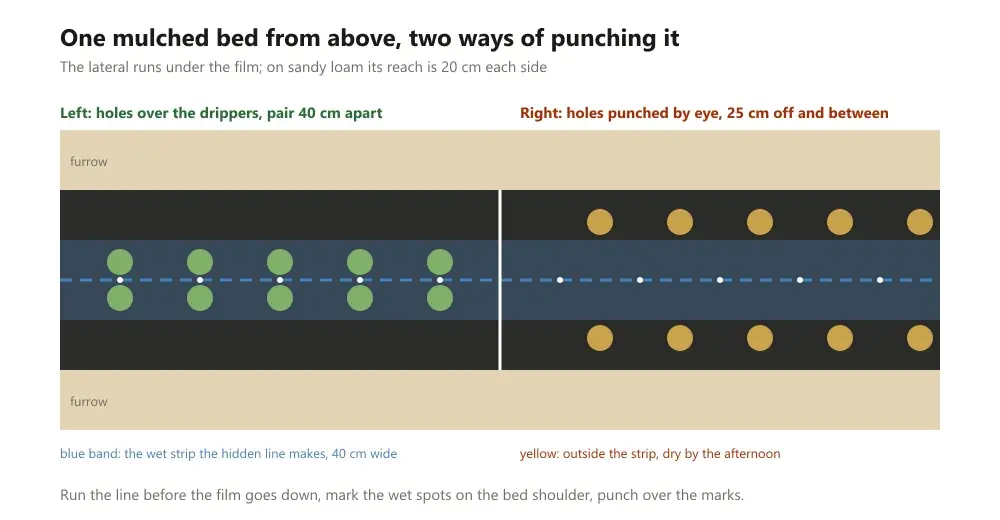
Under mulch the pair comes back. A raised bed carries the lateral down its crown, the film goes over it, and two rows are punched 40 cm apart with the pipe between them, both inside the reach; with 1.2 metres between laterals that is about 3,400 metres on the acre, and the film halves what the sun takes from the bed surface, which on sand is worth a run a day in April. The mulch film is not something we stock.
The trap is the hidden line. Once the film is down the drippers cannot be seen, and a hole punched 15 cm to one side of the pipe puts a seedling at the edge of a column that ends at 20 cm. So the lateral is run before the film is laid, the wet spots are marked on the bed shoulder, and the holes are punched over the marks, one plant to one dripper; the chilli drip guide covers the bed itself, and the lateral is the inline pipe from the drip range.
The minutes, in the cool months
A dripper every 40 cm at 4 litres an hour puts 10 litres an hour onto each metre of lateral, and on single rows 0.75 metres apart that metre serves three quarters of a square metre, so the line applies about 13 mm an hour. Six millimetres is about 28 minutes and three and a half about 16; on mulched pairs at 1.2 metres the rate falls to about 8 mm an hour and six millimetres takes about 43 minutes.
On sandy loam the day's minutes go in as two runs, morning and mid-afternoon, through flowering and every pick, because a single 28-minute run sends its second half below the roots and the column is dry again by dusk. The cool months do not change that. The canopy is full, the fruit is filling, and the demand in December is as high as in any month the crop sees.
Chilli at full cover uses 3.5 to 6 mm a day across the November to February peak, which on one acre is roughly 14,000 to 24,000 litres at the root, or about 15,700 to 27,000 litres from the pump once drip's losses are allowed for; the water requirement calculator gives the figure for your own acreage.
The dew illusion
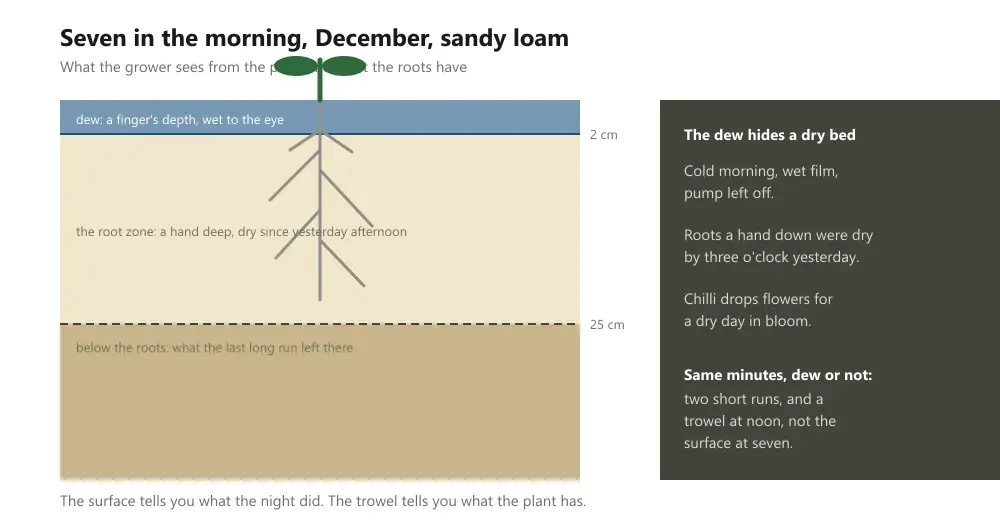
Every December the same thing happens on sandy loam. The grower walks the field at seven, the mulch and the bed surface are wet with dew, the air is cold, and the pump stays off. The dew has wet a finger's depth of sand; the roots are a hand down and were dry by the previous afternoon, and chilli answers a dry day in flowering by dropping the flowers it has.
The catch-up run makes it worse. Two days skipped, the plants flag at noon, and the pump runs an hour to make up for it: forty minutes of that hour pass the roots, the surface is saturated for a day, and on a cold wet surface the fruit touching it rots.
A blocked dripper under mulch shows as one plant flagging a day later than its neighbours; the blocked-line guide covers flushing, and the filter it depends on is not ours to sell.
- A hole punched off the line under mulch: a seedling at the column's edge, the smallest plant in the row all season.
- Skipping on a dewy morning: dry roots under a wet surface, flowers dropped at the next pick.
- An hour's catch-up run: the second half past the roots, the surface sodden, fruit rot where fruit touches it.
- The check: a trowel a hand deep beside the plant at noon; moist is right, and the dew on top means nothing.
The figures are a starting point
The 3.5 to 6 mm a day and the column widths are published agronomic ranges rather than readings from your field, and sandy loam grades from nearly sand to nearly loam between one bund and the next; the sandier the bed, the more the mulch earns. Treat two runs of 14 minutes a day on bare rows, or two of 22 under mulched pairs, as the first schedule and let the trowel move it.
The same crop on heavier ground is worked in the red-loam chilli guide, and the same soil under a taprooted crop in the sandy-loam cotton guide. For the lateral count and the runs sized to your bed plan and bore, send us the row or pair spacing, the acreage, whether you mulch, and the bore yield and we will say how many coils the field takes and how many runs a day the pump must give.
Where these numbers come from
- FAO Irrigation and Drainage Paper 56 (opens in a new tab)
The reference method for crop evapotranspiration and crop coefficients that daily water figures derive from.
- ICAR (opens in a new tab)
Indian Council of Agricultural Research — crop agronomy and regional package-of-practices.
- TNAU Agritech Portal (opens in a new tab)
Crop-wise spacing, water requirement and drip layout references for southern India.
Keep reading
Drip emitter spacing for cotton on sandy loam, root first
Drip emitter spacing for cotton on sandy loam puts the lateral on the plant line and the taproot down the column. Reach, root-first opening, split runs.
GuidesDrip emitter spacing for pomegranate on sandy loam, in short runs
Drip emitter spacing for pomegranate on sandy loam is a ring of narrow columns that empty by evening. The ring per bush, the short runs, fertigation on sand.
GuidesDrip emitter spacing for chilli on alluvial soil: the wide bulb
Drip emitter spacing for chilli on alluvial soil lets one lateral serve a pair of rows, since the bulb is wide. The pair, the minutes, the wet-feet mistake.