Drip emitter spacing for orchard on laterite soil, on the pan
Drip emitter spacing for orchard on laterite soil is a ring of columns over a pan that stops the roots. The pan sets the depth, the dry season sets the window.
27 November 2026 · 5 min read · REDYPLAST
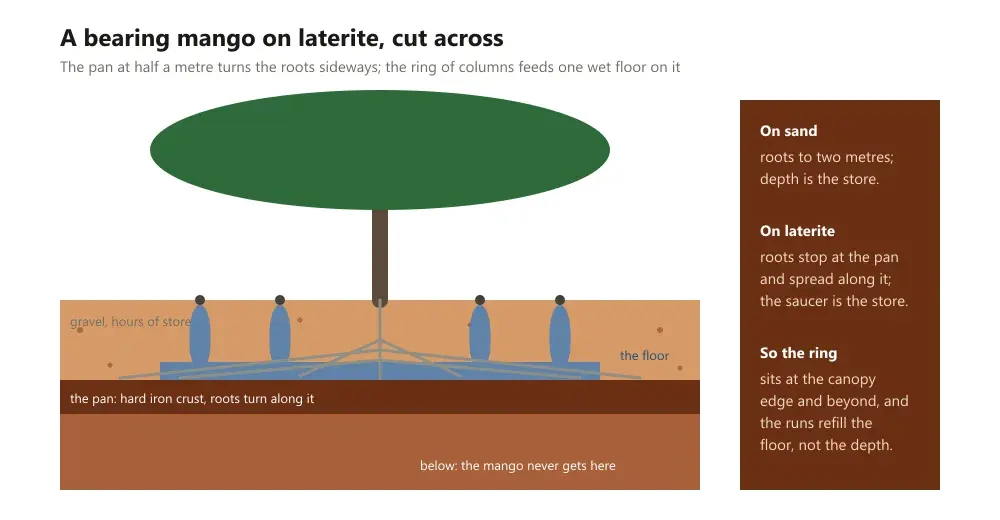
Drip emitter spacing for orchard on laterite soil starts the way it does on every light soil, two columns at the sapling growing to a ring of eight or more under the bearing canopy, because the wet column under a 4 litre dripper on this gravel is 35 to 50 cm across and merges with nothing beside it.
What drip emitter spacing for orchard on laterite soil cannot borrow from the other soils is the run, because the iron pan at half a metre stops the roots of every tree on it: a mango that drinks from two metres on sand is a shallow tree here, spread flat along the crust, and is watered like one.
Laterite is the orchard country of the north coast, the mango and cashew slopes behind Visakhapatnam and Srikakulam. This guide covers the roots on the pan, the ring by age, the dry-season window that drip exists for on this ground, and the two mistakes a rainfed orchard makes when the pipe arrives.
Roots on the pan
Laterite is a leached red gravel over an iron crust at 40 to 80 cm that a crowbar bounces off and that water crosses slowly. The gravel above it holds hours of a tree's water; the column under a dripper drops through it in a quarter of an hour and spreads on the crust into a saucer, and the saucers under a ring of columns join into one wet floor beneath the canopy.
The tree lives on that floor. A mango's sinker roots meet the pan in the second year and turn along it, a cashew's do the same, and a bearing tree on laterite has its whole feeding system in the half metre of gravel above the crust and the saucer on it. The saucer is the store, and the rain also fills it.
The garden and orchard crop page says build for the mature canopy; on laterite build also for a root system that is wide and not deep, whatever the tree.
- Column: 35 to 50 cm across, through the gravel in minutes, pooling on the pan beneath.
- Roots: flat along the top of the crust, for mango, cashew and guava alike.
- Store: the saucer on the pan, a day or two in the dry months; the gravel above holds hours.
- Monsoon: the pan holds the rain, the saucers join, and a tree in a hollow stands in water.
Drip emitter spacing for orchard on laterite soil, ring by ring
The lateral runs along the tree row at the 5 to 8 metres mango and cashew are planted on these slopes, one line per row, and the columns on it multiply with the tree: two at 30 cm from the trunk in the first year, four at 60 to 80 cm by the third, six under the canopy edge by the fifth, and eight to twelve in a ring at the drip line of a bearing tree.
Because the roots spread wide along the pan, the bearing ring on laterite sits at the canopy edge and a little beyond it.
On a slope, lay the first part of the loop on the uphill side of the trunk, so water running down the pan meets the trunk.
The plain online lateral with emitters from elsewhere pushed in where each column stands is the pattern the orchard drip guide leans to for trees, and the 40 cm inline pipe laid as a loop round each tree gives a ring that is lengthened as the canopy grows. Each lengthening takes a joiner (₹6, minimum order 100). Both come from the drip range; the emitters themselves are not ours to sell.
The window, and the hours in it
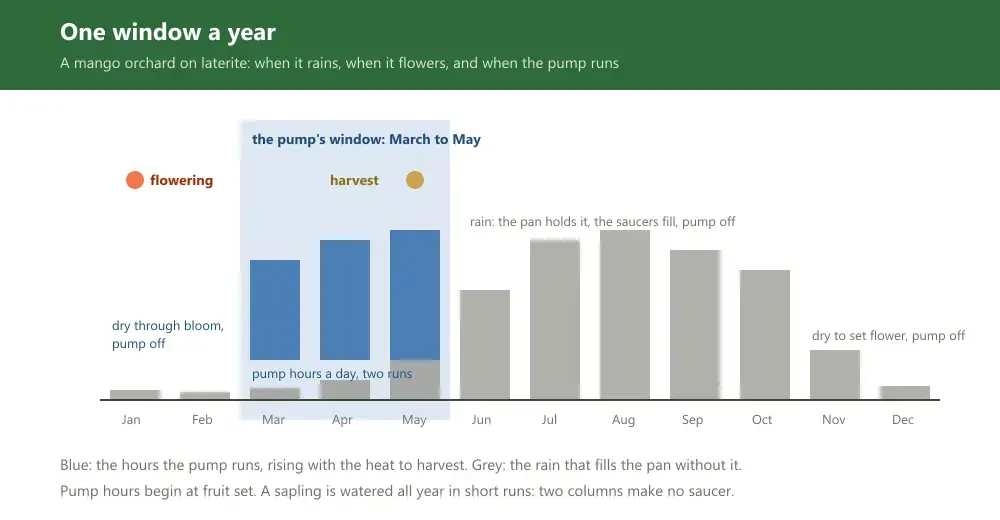
Through that window a bearing tree on ten columns, 40 litres an hour, takes two and a half to eight hours of running a day, given as two runs, early and late, each long enough to refill the saucer on the pan.
Outside the window the pump is off: the monsoon fills the saucers, and from October through flowering in January the tree should dry to set flower. A sapling is the exception and is watered the year round in short runs, because its two columns make no saucer worth the name.
Orchard trees on a closed canopy use 2.5 to 8 mm a day across the year, which on one acre is roughly 10,000 to 32,000 litres at the root, or about 11,000 to 36,000 litres from the pump once drip's losses are allowed for; the water requirement calculator gives the figure for your own acreage. Per bearing tree at 6 by 6 metres that is about 100 litres a day from the pump in a mild month and 320 in May.
A rainfed mango on laterite does not get all of that. Drip on this ground exists for one window: from fruit set in March, through the hot months, to harvest in May, when the saucers are empty and a tree with no store drops its fruit in April. Mango wants a dry spell before it flowers, as the red-loam orchard guide says. Here the water starts once the fruit has set and ends with the harvest in May, before the June rains.
The two mistakes a rainfed orchard makes
The first is the year-round schedule. The pipe arrives, the grower waters daily through the monsoon and the cool months, and the trees that stood for twenty years rainfed begin to rot at the collar in September and refuse to flower in January, because the saucers were never allowed to empty and the tree never felt the dry spell that sets its bloom.
The second is the trunk ring on a bearing tree. Two drippers at the base, laid when the tree was a sapling, feed a saucer under the trunk while the roots are two metres out along the pan; the tree looks fine in February and drops fruit in April. The ring at the canopy edge, added a step at a time from the third year, is the fix.
Iron in the bore water closes the far columns first; the settling tank and filter it needs are not ours to sell, and the blocked-line guide covers flushing.
- Watering through the monsoon and the cool months: collar rot in September, no flower in January.
- Two drippers at the trunk of a bearing tree: roots two metres out on the pan, water under the trunk, fruit dropped in April.
- The check: a trowel at the canopy edge, down to the crust, the morning after a run in March; wet on the pan and moist above is right.
The figures are a starting point
Only the 2.5 to 8 mm a day is a published range, and it is for a full canopy. The column width, the quarter of an hour through the gravel, the sinker roots meeting the pan in the second year and the day or two the saucer stores are working rules to check in your own orchard with the trowel.
Treat two runs totalling four hours on ten columns as the first March schedule for a bearing mango and let the trowel at the canopy edge move it.
The same trees on soils with depth to drink from are worked in the sandy-loam orchard guide and the red-loam orchard guide, and the same pan under a long crop in the laterite cane guide. For the column count and the window's hours sized to your trees and bore, send us the tree spacing, the species, the planting years and the acreage and we will say how many columns each tree needs now.
Where these numbers come from
- FAO Irrigation and Drainage Paper 56 (opens in a new tab)
The reference method for crop evapotranspiration and crop coefficients that daily water figures derive from.
- ICAR (opens in a new tab)
Indian Council of Agricultural Research — crop agronomy and regional package-of-practices.
- TNAU Agritech Portal (opens in a new tab)
Crop-wise spacing, water requirement and drip layout references for southern India.
Keep reading
Drip emitter spacing for banana on laterite soil, pit and lines
Drip emitter spacing for banana on laterite soil is two lines on a mound, over a pit that must not reach the pan. The pit as a bucket, the runs in May.
GuidesDrip emitter spacing for sugarcane on laterite soil, on the pan
Drip emitter spacing for sugarcane on laterite soil is a tight pair or single rows over a pan that stores water in April and drowns the stool in August.
GuidesDrip emitter spacing for vegetables on laterite soil, on the pan
Drip emitter spacing for vegetables on laterite soil is a plant at every dripper and runs of ten minutes: the gravel holds nothing, the pan holds too much.