Drip emitter spacing for cotton on red loam: the dry inter-row
Drip emitter spacing for cotton on red loam keeps the water in a band under the plant line and the inter-row dry. The band, the minutes, the monsoon break.
5 November 2026 · 5 min read · REDYPLAST
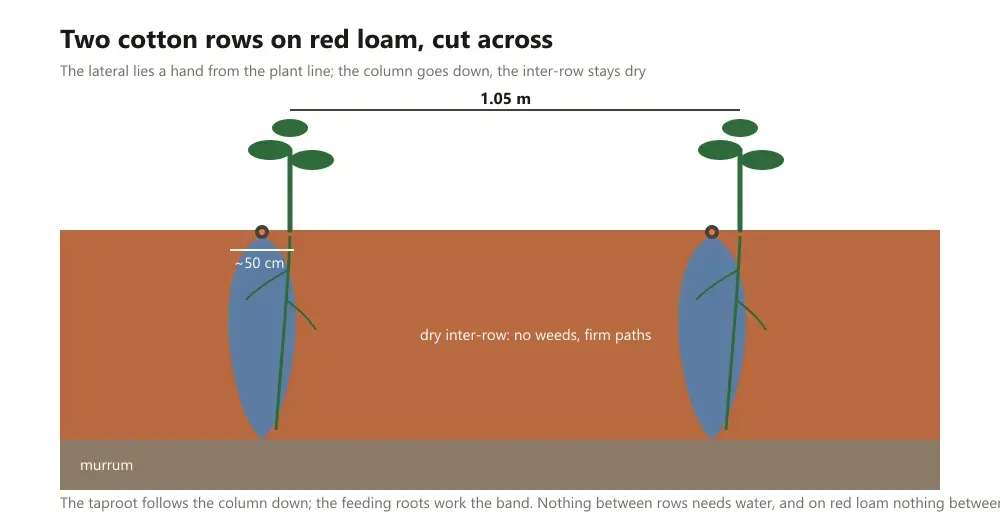
Drip emitter spacing for cotton on red loam puts the water into a band about half a metre wide under the plant line and leaves the other half metre of each row dry, because this soil takes water down rather than out and the 40 cm drippers every inline pipe we list carries merge into one strip along the row and nowhere else.
Drip emitter spacing for cotton on red loam is therefore settled along the row by the pipe and across the row by the crop: one lateral per row at the 0.9 to 1.2 metres cotton is planted, with the line laid 10 to 15 cm from the plant line so the column and the taproot go down together.
Red soil cotton is the crop of Warangal and the districts around it, and the soil suits a crop that roots deep and hates wet feet. This guide covers the column and the band, why a shared lateral between two rows fails here, the minutes per day from the calculator's figures, and the monsoon break that catches growers on this soil every year.
The column, the band and the dry inter-row
Red loam spreads water little and drains fast, and the wet column under a 4 litre dripper is 40 to 60 cm across, deeper than it is wide, reaching the murrum gravel most red soils lie on within a couple of hours of a long run. At 40 cm between drippers the columns overlap into a continuous band along the lateral, so every plant in the row has water; between rows, at a metre apart, the soil is as dry as the bund.
Cotton is built for that. Its taproot goes down a metre or more if the soil lets it, and on red loam the column gives it a wet path to follow. The dry inter-row costs nothing, because cotton's feeding roots work the band, and it earns something: weeds between rows have no water, the paths stay firm for picking, and a wet canopy's diseases have less to work with.
The cotton crop page says the row spacing you planted decides the pipe; on red loam it decides the water too.
- Column: 40 to 60 cm across, deep rather than wide; a continuous band at 40 cm drippers.
- Reach across the row: about 25 cm each side of the lateral, no more.
- Storage: a day or two in the band; daily runs through the growing season.
- Drainage: anything past the roots reaches the murrum and is gone.
Drip emitter spacing for cotton on red loam, across the rows
One lateral per row is the layout, laid 10 to 15 cm to one side of the plant line, not on it, so the seed row is not disturbed at sowing and the column still takes in the taproot. On heavier soils growers save pipe with one lateral between two rows, or with paired rows 45 cm apart around a shared line at 135 cm between pairs.
On red loam the shared line between ordinary rows wets neither; the paired layout works only because the two rows hug the lateral inside its 25 cm reach, and it must be planted that way from the first seed.
That rule sets the coil count. Single rows put about 3,370 metres of lateral on an acre at 1.2 metres, the spacing the estimator works on, and about 3,850 at 1.05; tight pairs at 1.8 metres between pairs put about 2,250.
The choice is made at planting, and the cotton conversion guide prices both against the wall thickness a season in the sun demands. The lateral is 16 mm inline from the drip range, and on red loam the 40 cm spacing it carries is right for a crop sown at 30 to 45 cm along the row.
The minutes, in a season
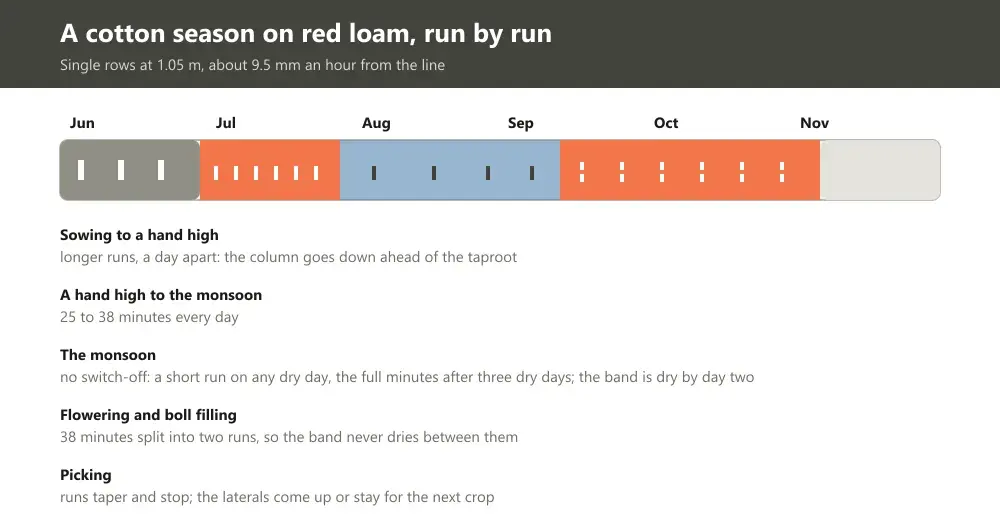
A dripper every 40 cm at 4 litres an hour puts 10 litres an hour onto each metre of lateral, and on rows 1.05 metres apart that metre serves about one square metre, so the line applies close to 9.5 mm an hour. Six millimetres a day is about 38 minutes of running and four is about 25; on tight pairs at 1.8 metres the rate halves and the minutes double.
On red loam those minutes are given daily, and in the flowering and boll-filling weeks of September and October they are split into two runs so the band never dries between them.
Cotton in active growth uses about 4 to 6 mm a day, which on one acre is roughly 16,000 to 24,000 litres at the root, or about 18,000 to 27,000 litres from the pump once drip's losses are allowed for; the water requirement calculator gives the figure for your own acreage.
The early weeks are the exception. After sowing, the first runs are a little longer and a day apart rather than daily, so the column goes down ahead of the taproot and the seedling roots deep instead of sitting in a wet surface; once the plants are a hand high, the schedule turns daily. The dry commissioning that cotton's pre-monsoon sowing forces is covered in the cotton drip guide.
The monsoon break
The mistake red loam cotton growers make is not in May but in August. The monsoon arrives, the system is switched off, and the three or four dry days between rains are read as rest. On a black soil they are; the store carries the crop between showers. On red loam the band is dry by the second dry day, the plant at square formation sheds squares it will not replace, and the loss appears in October as fewer bolls.
So on this soil the pump stays in the schedule through the monsoon: a short run on any day without rain, the full daily minutes after three dry days, and the system never drained and forgotten until picking. Protective irrigation in a dry spell is the drip advantage cotton pays for fastest, and red loam is where the dry spell bites quickest.
- Switching off for the monsoon: a dry band by the second dry day, shed squares, fewer bolls.
- A shared lateral between ordinary rows: neither row wetted.
- Long alternate-day runs after the seedlings are up: water to the murrum, a dry band on the second evening.
- The check: a trowel a hand deep beside the plant line the morning after a run, and again on a dry day in the monsoon.
The figures are a starting point
The 4 to 6 mm a day and the column widths are published agronomic ranges, not measurements from your field, and red loams vary in depth over the murrum from one bund to the next. Treat 38 minutes as the first week's schedule once the plants are a hand high, and let the trowel correct it.
The same soil's arithmetic on other crops is worked in the red-loam chilli guide and the red-loam cane guide, and the same crop on the heavy soil in the black-soil cotton guide. A blocked dripper on red loam shows within days as one wilting plant; the blocked-line guide covers flushing.
If you want the lateral count and the shifts sized to your row plan and bore, send us the spacing, the acreage and the bore yield and we will say how many coils and how many runs a day the field needs.
Where these numbers come from
- FAO Irrigation and Drainage Paper 56 (opens in a new tab)
The reference method for crop evapotranspiration and crop coefficients that daily water figures derive from.
- ICAR (opens in a new tab)
Indian Council of Agricultural Research — crop agronomy and regional package-of-practices.
- TNAU Agritech Portal (opens in a new tab)
Crop-wise spacing, water requirement and drip layout references for southern India.
Keep reading
Drip emitter spacing for chilli on red loam, and the run time
Drip emitter spacing for chilli on red loam matters, because the wet bulbs barely meet. Where the plants go, the minutes per day, and two schedules that fail.
GuidesDrip emitter spacing for cotton on black cotton soil: run times
Drip emitter spacing for cotton on black cotton soil is the easy part; run time is the hard one. The minutes per day, and how the standard schedule fails.
GuidesDrip emitter spacing for sugarcane on red loam, and the minutes
Drip emitter spacing for sugarcane on red loam settles the paired-row question, since the bulb is narrow. The pair that works, the minutes by phase, the ratoon.