Flood to drip conversion for groundnut: what to buy instead
A flood to drip conversion for groundnut is the wrong buy; a rain pipe shower is the right one. The acre at MRP, the test lateral, and who should keep flooding.
25 October 2026 · 5 min read · REDYPLAST
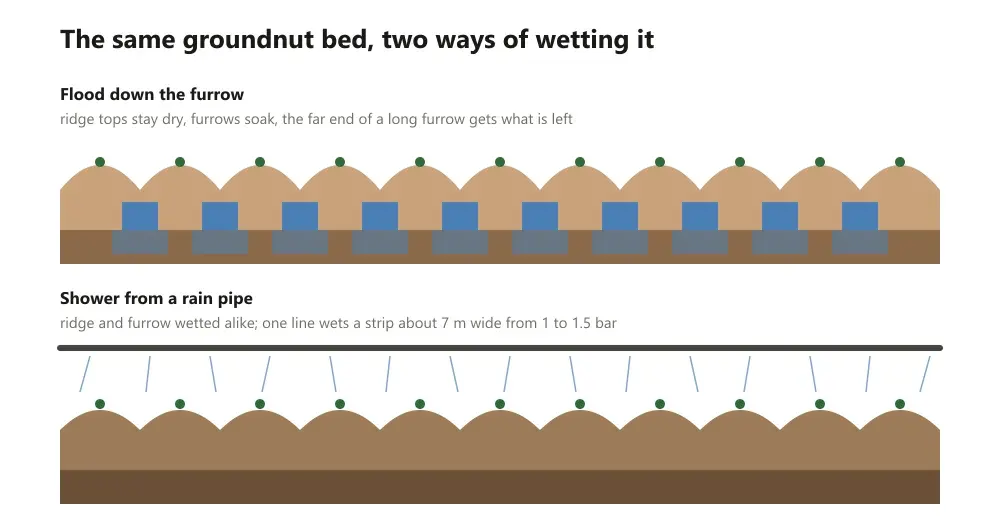
A flood to drip conversion for groundnut is the conversion we most often refuse to quote, because a crop sown at 30 to 45 cm would need a lateral in every row and the pipe bill buries the saving. What a flood to drip conversion for groundnut should become is a conversion to an overhead shower: rain pipe lines laid about 7 metres apart that wet the whole bed from above, on a small pump, for less than a tenth of the drip bill.
This guide prices that acre at MRP from our listing, sets out the work with the test lateral first, says how the water and the labour change, and names the farmers who should keep the furrow. Sprinkler sets are the other overhead option, and we say plainly below why we do not price them today.
Flood to drip conversion for groundnut: why the answer is a shower
Groundnut sets its pods underground, and the weeks that decide the crop, flowering, pegging and pod fill, want the soil around the pegs soft and evenly moist across the whole bed. Flood delivers that unevenly: the furrow is soaked, the ridge top dries first, and the far end of a long furrow gets what is left. A shower from above wets the ridge and the furrow alike.
Drip cannot do this at a sane price. At the crop's spacing an acre carries more than nine kilometres of lateral, and the drip case for groundnut walks that arithmetic to its conclusion. Rain pipe needs about 640 metres for the same acre, because each line wets a strip roughly 7 metres wide from 1 to 1.5 bar of pressure.
Sprinkler sets would also wet the bed from above, but they want more pressure than rain pipe and a riser and mainline we do not stock, and the impact nozzles on our listing are out of stock as this is written. So the honest conversion we can price is rain pipe, and the groundnut crop page says the same in three lines.
- Keep: the bore or well, the pump, the delivery pipe to the field and the valve on it.
- Buy from us: the rain pipe rolls, the 3 inch LDPE lapeta from pump to field if you lack one, and the steel connector at the pump.
- Buy elsewhere: the joiners and on-off cocks for the rain pipe lines, which the estimator lists as not stocked, and a filter if your water carries silt.
The bill at MRP for one acre
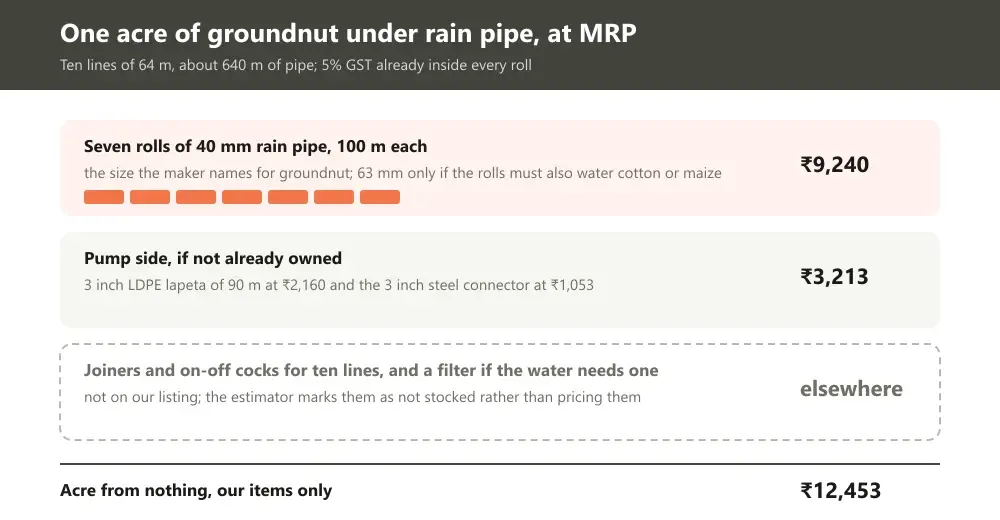
A square acre is about 64 metres a side. With lines 7 metres apart that is ten lines of 64 metres, close to 640 metres of pipe, or seven rolls of 100 metres with a little spare. In the 40 mm eco series roll at ₹1,320, which is the size the maker names for groundnut, the acre of pipe is ₹9,240 with 5% GST inside.
If the same rolls must also water the cotton or maize the field grows in other seasons, the 63 mm roll at ₹3,780 carries more flow further, and seven of them are ₹26,460. For groundnut alone that is money spent on flow the crop never asks for; buy it for the other crops, not this one.
The pump side is often already owned. If not, a 3 inch LDPE lapeta of 90 metres is ₹2,160 for the run from pump to field, and the 3 inch steel connector that joins it to the delivery is ₹1,053. That puts the 40 mm acre at ₹12,453 from nothing, before the joiners and cocks from elsewhere.
The system estimator plans groundnut on rain pipe, reports the same seven rolls of 40 mm at ₹9,240, and marks the joiners and cocks as items we do not stock rather than pricing them. The rain pipe range lists every roll above with any discount running today.
The steps, with the test lateral first
The spacing between lines comes from your pump, not from a chart, because pressure decides how far each line throws. One roll laid and run before the field is cut settles the count for the other six, and it is the step every first-season failure skipped.
The uneven-flow guide covers what to do when one line throws short, and the line-lifting guide covers the day the rolls come up.
- Lay one roll along a bed with the hole rows facing the sky, open the valve slowly until the arc stands up evenly, and measure the wetted width on both sides.
- Space the remaining lines a metre inside that measured width, so the strips overlap slightly and no stripe stays dry.
- Fit the head in order from the pump: steel connector, then the filter if your water needs one, then the lapeta to the field.
- Lay the lines on swept lanes, not on stubble or stones, with a cock from elsewhere at each line's head so lines can run in turn.
- Run the lines in groups the pump can hold at 1 to 1.5 bar; a line that mists at the pump end and dribbles at the far end wants fewer lines open, never a longer run.
- After the last watering, drain the rolls, coil them loose and store them in shade until the next sowing.
Water, labour and the first season
Flood taught the field to drink by the furrow, a lot at once and then nothing for a week or more. A shower waters little and often, and the first season is spent learning how long the pump must run to wet the pegging zone without ponding the furrow. Walk the bed with a trowel after the first few waterings; the depth the water reaches is the number you are learning.
The water saving is in the furrow ends and the paths, which no longer drink, and in the runoff that a long furrow sends off the field. We will not put a percentage on it, because soil and scheduling move it too far. The pumping saving is plainer: rain pipe runs at a pressure a small pump reaches, and the hours drop with the volume.
Labour moves from opening and closing furrows to laying and lifting lines, which one person can do with the crop, and to sighting down each line for twisted hole rows before the first run. Over the season the rolls need little, but they need the cocks worked in turn and the ends flushed when a line throws short.
Who should keep flooding
Rain pipe has drawn Pradhan Mantri Krishi Sinchayee Yojana support under Per Drop More Crop in several states, with the rate and the paperwork varying by state and year; ask the agriculture office before counting on a figure. If you want the rolls priced for your own field, send us the acreage, the field shape and your pump and we will quote what we sell at MRP, marking the joiners, the cocks and the filter as items from elsewhere.
- A grower on canal rotation with no pump and no bore; rain pipe needs 1 bar of pressure that a canal does not give.
- Fields where the wind blows hard through the growing months; a fine shower drifts, and the far strip goes dry while the near one drowns.
- A grower who will not lay the test lateral; spacing copied from a chart is how an acre ends up with dry stripes between every line.
- Anyone who will leave the lines down over the off-season; a roll left in the sun on bare ground does not see a second crop.
Where these numbers come from
- TNAU Agritech Portal (opens in a new tab)
Crop-wise spacing, water requirement and drip layout references for southern India.
- ICAR (opens in a new tab)
Indian Council of Agricultural Research — crop agronomy and regional package-of-practices.
- PMKSY — Per Drop More Crop (opens in a new tab)
The central micro-irrigation scheme. Subsidy rates and eligibility are set here, not by suppliers.
Keep reading
Flood to drip conversion for paddy: what actually works
Flood to drip conversion for paddy is the wrong buy for the flooded crop. Where rain pipe earns a place, what it costs at MRP, and who should keep the channels.
GuidesFlood to drip conversion for garden and orchard: cost and steps
A flood to drip conversion for garden and orchard priced at MRP for this year's rows and the finished acre, with the main sized once and who should wait.
GuidesFlood to drip conversion for pomegranate: cost and steps
A flood to drip conversion for pomegranate costs less than most crops because the rows are wide. The acre at MRP two ways, the steps, and who should skip it.