Fixing laterals lifting off the ground in a rain pipe system
Laterals lifting off the ground in a rain pipe system can be a flat hose rolling as it fills, or moving in the wind. Three causes, each with its test and fix.
16 October 2026 · 4 min read · REDYPLAST
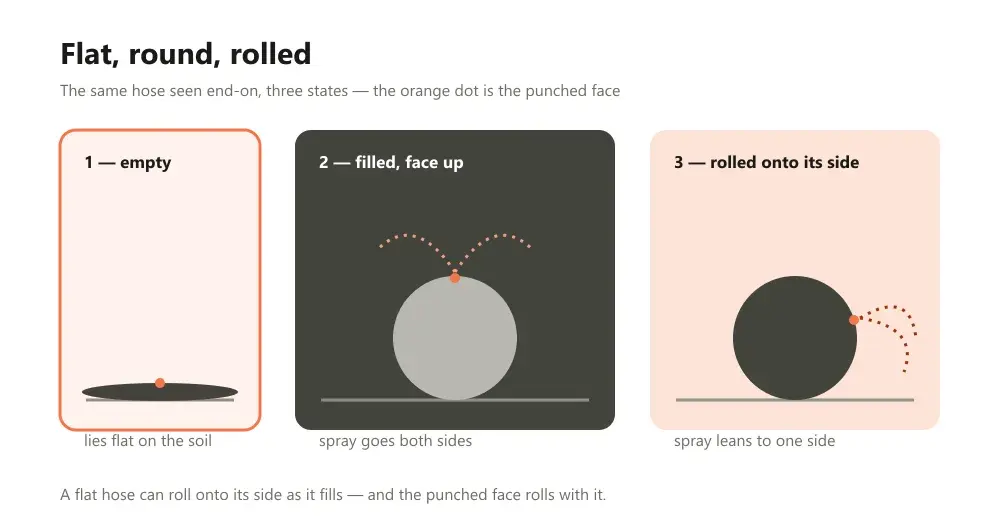
Laterals lifting off the ground in a rain pipe system are often a flat hose rolling, not rising: as it fills it can turn its punched face to one side, and the spray goes with it.
Three common causes — a valve opened too fast, nothing holding the line down, and a twist laid into it — each have a test and a fix. Our installation guide, attached to every rain pipe listing, deals with the first two directly and gives the remedy for the third, and none of the fixes costs more than a few pegs and care at the first fill.
Laterals lifting off the ground: watch the first fill
A lay-flat line is two different shapes. Empty, it lies flat on the soil. Filled, it is a round tube, and the change from one to the other is where the movement comes from: as the hose rounds out it can roll on the ground, and a twist laid into it shows wherever it sits. What looks like lifting is often the line rolling onto its side, which carries the punched face round with it.
The test is to watch, not to guess. Stand at the head, open the valve a little, and follow the line with your eyes as it fills. Where it starts to roll points to the cause, and the three signs below each have their own section.
If the spray stays even on both sides but fades toward the far end, the line is not moving — it is starving, and the far-end guide covers that. This article is for a line whose spray goes to one side.
- The line kicks and rolls near the valve as water arrives: the valve was opened too fast.
- The line drifts or rolls along open stretches, worse on windy days: nothing is pegging it down.
- The spray leans to one side from the same spot every time: a twist was laid in there.
Cause one: the valve opened too fast
The installation guide is blunt about this: do not open the valve abruptly, because gradual pressurisation is what keeps the flat hose from rolling or shifting. A line filled in a rush rounds out unevenly, kicks as the water front runs down it, and can settle on its side with the holes pointing at the next row.
The fix is how you open the valve. Open it a little and let the hose fill progressively, as the guide's own installation steps say; once water reaches the tail and the spray is even, open further to working pressure, staying within the listed 1 to 1.5 kg/cm². We stock no pressure gauges or regulators, so the spray itself is the gauge — stop opening while it is still even.
Pumps differ in how they like to be started, so follow your pump's manual for the valve position at start; once the pump is running, it is the line valve that opens slowly.
Cause two: nothing holding the line
The installation guide says to anchor or peg the hose at intervals where wind or movement could change its position. A filled line is heavy with water, but an empty or part-filled one moves easily, and on bare soil in an open field the first fill of a windy day is when a line drifts. Pegging is the whole answer, and it is cheap.
We stock no pegs, and the guide names no material or spacing — only "at intervals". Anything smooth that pins the hose to the soil without sitting on the hole row does the job; what it must not be is sharp, because the wall is 350 microns and the guide warns against sharp edges.
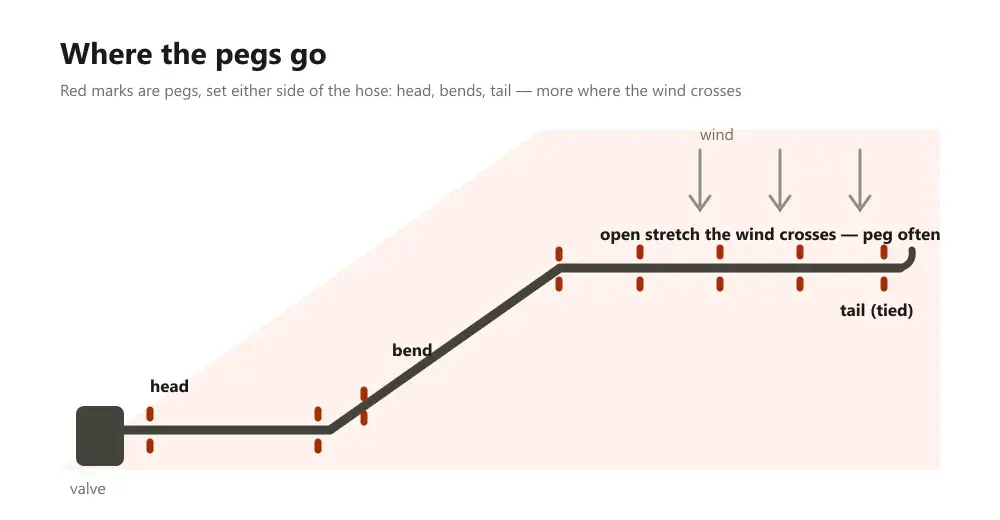
Put the pegs where movement starts: at the head, where the line meets its tie; at every bend; at the tail; and more of them along any stretch the wind crosses. A line that stays where it was laid keeps its punched face up, which is what you want.
Cause three: a twist laid in
The installation guide asks for the punched face upward, and tells you what to do when the spray ends up to one side: depressurise, reposition, and secure the hose before restarting. A partial twist laid in while rolling the line out is easy to miss on a flat hose unless you look for it, and shows plainly once the hose fills and the holes come round to one side.
Look for it before the water does: the groundnut guide has you stand at the pump end and sight down the line for the hole rows before the first watering. A tight twist also chokes the flow past it, which is the far-end guide's other reason to find it.
Fix it empty, not filled. Drain the line, walk it, and turn it back so the punched face is up along its whole length, then peg either side of where the twist was so it cannot return. Do not yank a filled line over to face the right way: dragging a hose over sharp stones or edges is the damage the installation guide warns against, and the sun-cracking guide lists a drag over something sharp among the causes of a split.
When it keeps happening
A line laid along the contour — across the slope — is the layout the far-end guide recommends for pressure, and it is also the one that tends to roll downhill as it fills, even with a gentle fill. Peg the downhill side closely. A line running straight up or down the slope rolls less but pays in pressure instead — a rise costs head and a fall adds it, toward the 1.5 kg/cm² limit — and the far-end guide covers that side of the trade.
A line that moves at the head pulls on its own tie every time it fills, and a joint that held at the start of the season can start to weep — the joints guide covers that tie and how to make it wide and flat.
Size matters a little too. A 63 mm line holds far more water per metre than a 20 mm one, so once filled it is heavier and moves less in wind; the rain pipe range lists all five sizes. That is not a reason to buy wider — the crop and the pump decide the size — but it explains why a thin nursery line needs more pegs than a wide field line.
If a line still rolls after a gradual fill, pegs and a twist-free lay, the pressure is worth questioning before the pipe is. Tell us the pump, the line length and the size, and we will say whether the match is the problem.
Keep reading
Fixing pressure dropping mid-season in a rain pipe system
Pressure dropping mid-season in a rain pipe system means something changed since week one: the bore, the lines, leaks or silt. How to find which, and fix it.
GuidesFixing rats chewing lateral pipe in a rain pipe system
Rats chewing lateral pipe can ruin a stored roll before the season opens. How to tell rat bites from other holes, what to repair, and how to protect the roll.
GuidesFixing joints leaking in a rain pipe system
Joints leaking in a rain pipe system happen at three places on the pipe - the head, any mid-line join, and the tail. The field test and honest fix for each.