Flood to drip conversion for paddy: what actually works
Flood to drip conversion for paddy is the wrong buy for the flooded crop. Where rain pipe earns a place, what it costs at MRP, and who should keep the channels.
20 October 2026 · 5 min read · REDYPLAST
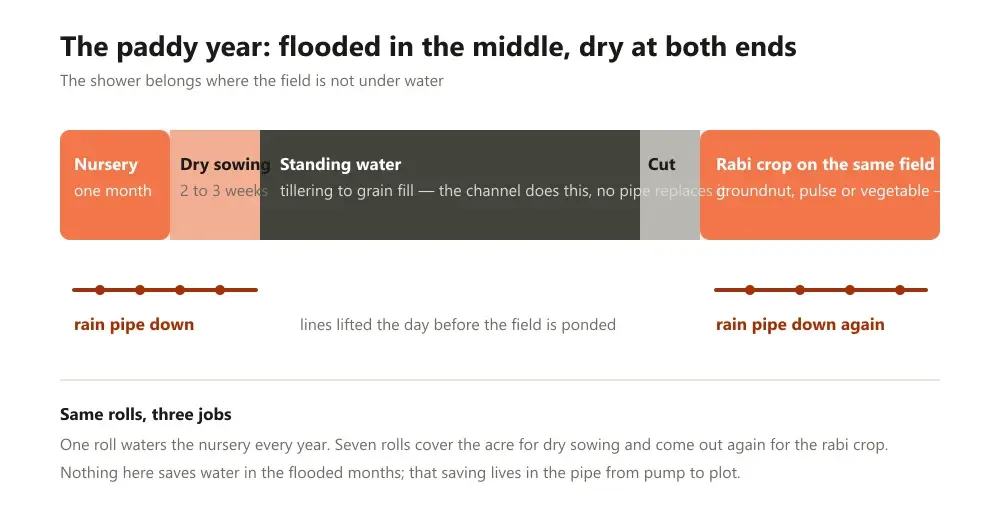
A flood to drip conversion for paddy is the one conversion we talk farmers out of, because transplanted paddy is grown standing in water and no lateral replaces that. What a flood to drip conversion for paddy can honestly mean is a rain pipe for the three stretches when the field is not flooded: the nursery, the dry weeks after direct seeding, and the rabi crop that follows the harvest on the same ground.
This guide prices those three at MRP, says what the work is, and names the farmers who should spend nothing and keep their channels. If it is the flooded months you want to save water in, the answer is a better conveyance pipe, and the paddy conveyance guide covers that.
Flood to drip conversion for paddy: the honest answer
Puddled, transplanted paddy wants a standing layer of water through tillering and again at flowering. Drip wets a band along a lateral and rain pipe lays a soft shower on a strip; neither can hold water on a field, and a system sold to do that is money spent for a plot that still has to be flooded by the channel.
So the conversion is not of the crop, it is of the calendar. Look at a paddy year and the field is dry or merely moist for longer than most growers reckon: a month of nursery, two to three weeks of establishment if the crop is direct seeded, and three to four months of whatever grows in rabi. Those are rain pipe months, and the same rolls serve all three.
The estimator will not cost a paddy layout for exactly this reason. Ask it for paddy and it says conveyance; ask it for the groundnut or vegetables you grow after paddy and it prices the pipe. The paddy crop page states the same position in three lines.
Three places a rain pipe earns its roll
The nursery comes first and teaches the most. A nursery bed for an acre of transplanted paddy is roughly a tenth of the field, and under flood it is soaked from a channel and then puddled; under a rain pipe it is kept moist with a short shower morning and evening, and the seedlings lift cleaner because the bed never slumps into mud.
Direct-seeded paddy is the second. Dry-sown seed needs light, frequent watering until the stand is up, and only then does the field go to standing water. Flooding a just-sown field washes seed into the low corners; a shower does not. The third place is the rabi crop, where the paddy field becomes a groundnut, pulse or vegetable field and rain pipe is simply the right method for the crop.
- Nursery: one roll, a month, every year, on the same small bed near the pump.
- Direct-seeded establishment: the whole acre for two to three weeks, then the lines come up before the water goes on.
- Rabi crop: the whole acre for a season, the same rolls laid again on dry ground.
The bill at MRP for each window
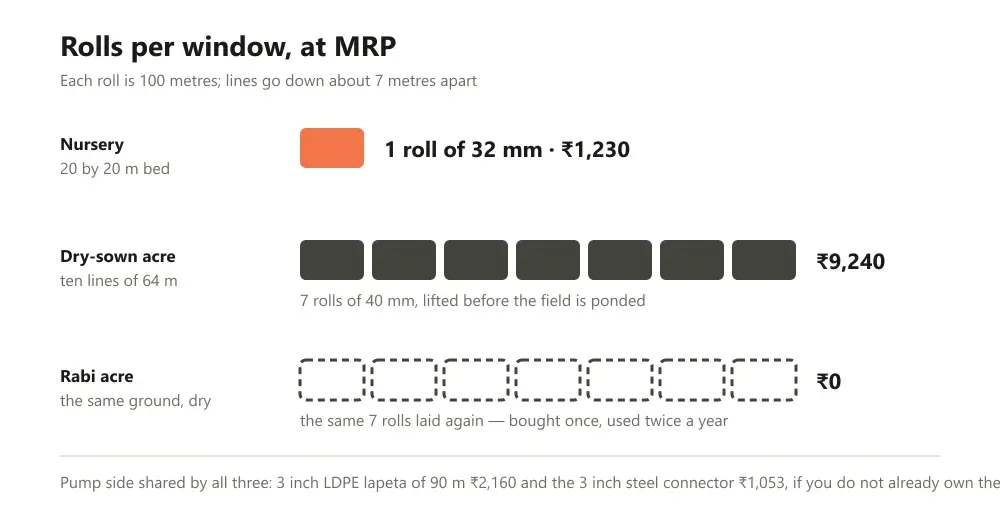
Every rain pipe on our listing is laid out from the same two numbers: a working pressure of 1 to 1.5 bar, and a wetted strip of about 7 metres, so lines go down roughly 7 metres apart. An acre is about 64 metres a side, which is ten lines of 64 metres, close to 640 metres of pipe, or seven rolls of 100 metres with a little to spare.
The nursery needs one roll. The 32 mm eco series roll of 100 metres is ₹1,230, and three lines across a 20 by 20 metre bed use 60 metres of it. The rest stays on the roll for the repair that will eventually be needed.
The full acre, for direct-seeded establishment or the rabi crop, is seven rolls. In 40 mm at ₹1,320 a roll that is ₹9,240; in 63 mm at ₹3,780 a roll it is ₹26,460, and the larger bore is for a longer run or a pump with more to give, not for a bigger shower. Both bills carry 5% GST already.
The pump side is shared by all three windows and is the part most growers already own. If not, a 3 inch LDPE lapeta of 90 metres is ₹2,160 for the run from pump to field, and the 3 inch steel connector that joins it to the delivery is ₹1,053. That puts the nursery setup at ₹4,443 from nothing, and the 40 mm acre at ₹12,453. The rain pipe range lists every roll above with any discount running.
The steps, and what the nursery teaches you
Start with the nursery, because it is small, it is near the pump, and it fails cheaply. A grower who has run one nursery under a shower knows the pressure the pump gives, how far the arc reaches, and how long a watering takes, before a single roll goes on the main field.
We do not stock filters or pressure gauges, so the valve and your eye are the controls. The pump-to-field chain describes staging the main, the connector and the rolls when you are buying all three.
- Level the nursery bed and sow it dry or lightly puddled; lay three lines 7 metres apart with the holes facing up.
- Open the delivery valve slowly until the arc stands up evenly along the line; stop there, because more pressure distorts the pattern before it widens it.
- Water in two short runs a day until the seedlings are ready to pull, then roll the pipe loosely and keep it in shade.
- For a direct-seeded field, lay the ten lines before sowing and lift them the day before the field is ponded.
- For the rabi crop, lay the same lines on the dry stubble ground after harvest and leave them down for the season.
- Flush the open ends every few waterings; the holes are fine and silt closes them the way it closes a dripper.
Who should keep the channels
The water saving in the nursery and at establishment is real, but it is a few weeks of saving, and we will not dress it up as a season's. The large saving in paddy remains the water lost between pump and plot, which is a pipe question, not a method question.
Rain pipe has drawn Pradhan Mantri Krishi Sinchayee Yojana support under Per Drop More Crop in several states, with the rate and the paperwork varying by state and year; ask the agriculture office before counting on a figure. If you want the rolls and the main priced for your own field, send us the acreage, your pump and the rabi crop you grow and we will quote what we sell at MRP, marking the filter as an item from elsewhere.
- Anyone growing only transplanted paddy with no rabi crop and a wet nursery that already works: there is no window to fill.
- Fields on canal rotation with no pump and no bore; a rain pipe needs 1 bar of pressure that a canal does not give.
- Heavy clay that puddles on its own and holds a flooded nursery without loss; the shower saves little there.
- Growers who will not lift the lines before ponding, because a rain pipe left under standing water is a rain pipe lost.
Where these numbers come from
- TNAU Agritech Portal (opens in a new tab)
Crop-wise spacing, water requirement and drip layout references for southern India.
- ICAR (opens in a new tab)
Indian Council of Agricultural Research — crop agronomy and regional package-of-practices.
- PMKSY — Per Drop More Crop (opens in a new tab)
The central micro-irrigation scheme. Subsidy rates and eligibility are set here, not by suppliers.
Keep reading
Flood to drip conversion for vegetables: cost and steps
A flood to drip conversion for vegetables, priced at MRP three ways, with the beds relaid every crop, the water and labour that change, and who should wait.
GuidesConverting chilli from flood to drip: cost and steps
Converting chilli from flood to drip: what you keep, what you buy, what it costs at MRP, how the work and the water change, and who should not convert.
GuidesConverting banana from flood to drip: cost and steps
Converting banana from flood to drip suits a crop that drinks heavily for a year and suffers with wet roots: the acre bill, the pump check, the steps.