Drip for paddy? No — paddy is a conveyance job
Drip for paddy is the wrong question — a flooded crop needs water moved, not dripped. What actually does that work, and the pipe sizes that fill plots fast.
14 September 2026 · 3 min read · REDYPLAST
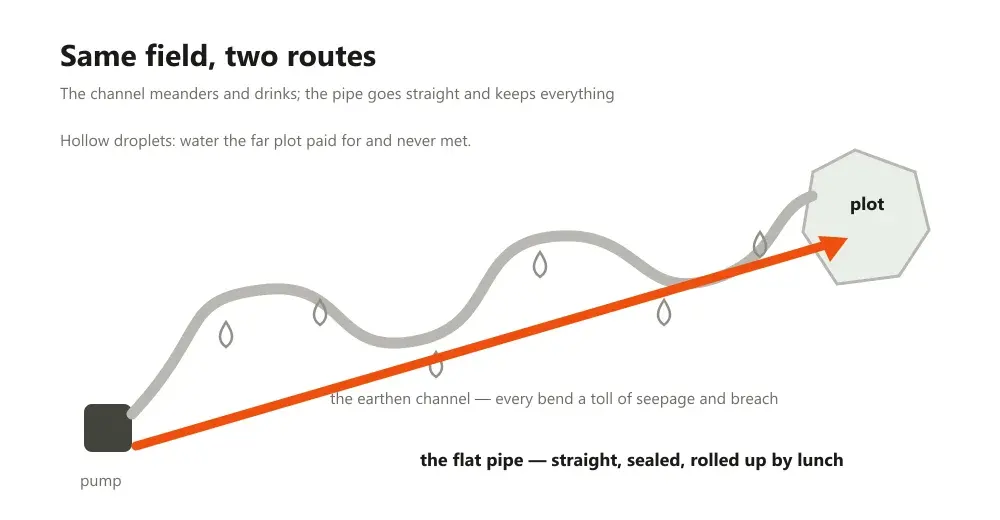
People ask us about drip for paddy every season, and our counter gives the same answer every time: no — and we would rather lose that sale than fit the wrong system. Paddy grows in standing water; there is no root-zone-only trick to play when the whole plot is the root zone.
But the question behind the question is real. Paddy farmers lose enormous water getting it from the bore to the plot, and that problem has a proper solution on our shelves. It is just not drip.
Why laterals have no job here
Every method we sell drip for does one thing: it rations water to a plant's roots and keeps the rest of the field dry. Puddled paddy inverts the goal — the plot is flooded edge to edge on purpose, topped up as it draws down. Emitters that meter out litres per hour are comically mismatched to a crop that takes its water by the plot-full.
So the method-by-crop guide files paddy under neither drip nor sprayline, and this page exists to say it plainly rather than quietly: if someone is pricing drip laterals against your paddy acreage, walk away with your money.
The water you lose before the plot
Where paddy farmers genuinely bleed water is the journey. An earthen field channel drinks along its whole length — seepage into its own bed, breaches at rat holes and weak bunds, spills where it crosses low ground — and what it loses, the bore pumped for nothing. The far plots pay the most: the longer the channel, the fatter its toll.
There is a quieter saving too. A channel is a permanent negotiation — it crosses other people's bunds, needs their tolerance and its own upkeep, and occupies a strip of ground that grows nothing. A pipe rolled out for the morning and rolled up after crosses the same ground without owning any of it, and without a single bund dispute attached.
Flat, rollable pipe ends that toll. Water enters at the pump and every litre of it arrives at the gate you pointed it at — over paths, past other plots, across ground no channel could hold. That is the conveyance job, and it is what lay flat tubes and lapeta pipe exist for. We stock both, and for paddy we reach for them before anything with an emitter in it.
Sizing the pipe that fills a plot
Filling a paddy plot is a volume job on a clock, so the bore of the conveyance pipe is the whole specification — a wider bore moves the same water in fewer pumping hours, and friction punishes narrow pipe on long runs hardest at exactly paddy's distances.
That tax split is worth reading twice: two pipes doing the same carrying job can sit nine points of GST apart, a quirk our listing-reading guide covers — on a long run of large-bore pipe, it is real money. Match the bore to your pump's outlet or one size up, never down.
- Lay flat tube runs 63 mm (₹3,843), 75 mm (₹4,140) and 90 mm (₹4,860) — and carries 5% GST as micro-irrigation equipment.
- Tarpaulin lapeta runs 3 to 6 inch, ₹43.50 to ₹67.50 a metre, for the biggest flows and the roughest handling — at 18% GST.
- LDPE lapeta at about ₹24 a metre in 3 inch is the budget carrier for shorter, gentler runs.
The habit that makes one pipe serve five plots
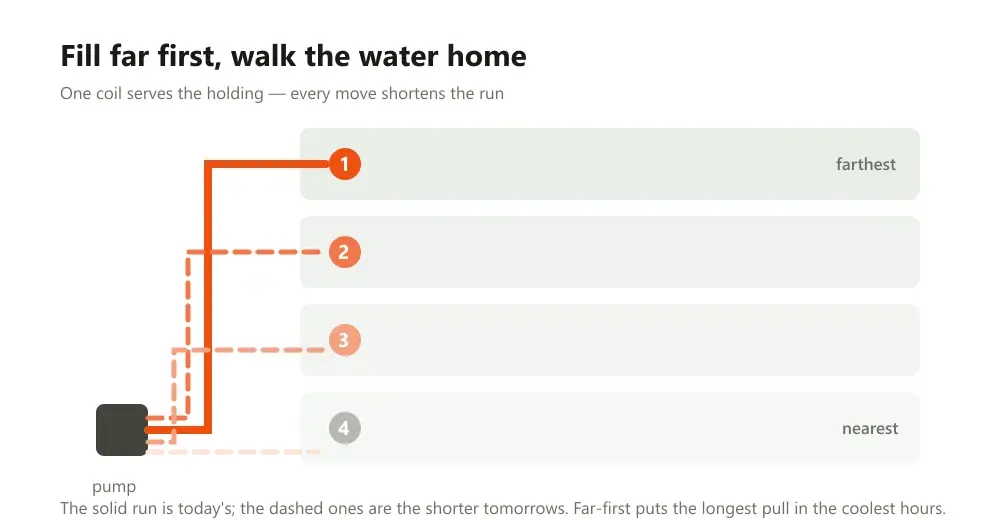
Flat pipe's talent is that it moves. The working pattern across a paddy holding is fill-and-shift: run the pipe to the far plot first, fill it, roll the pipe back to the next gate, fill that, and walk the water home plot by plot. Far-first matters — it puts the longest run in the coolest hours and means every later shift shortens the pipe, not lengthens it.
Mind the outfall while you are at it. A full-bore discharge landing on a bund eats it in a week — drop the pipe's mouth past the bund onto the plot itself, or lay an old sack or a flat stone under the splash. It is a thirty-second habit that saves an evening of mud work, and it is the only maintenance this whole method asks for.
Handled like this, one coil serves the whole holding all season — which is also why the pipe's storage life matters; rolled flat and kept shaded, it comes back season after season. And where a channel section genuinely must remain, lining or piping just the leakiest stretch buys most of the saving for a fraction of the pipe.
Where water saving in paddy really lives
If the bore is weak and the question behind your question is "how do I grow paddy on less water", the honest answer is agronomic, not a product: practices like alternate wetting and drying change how often plots are topped up, and your local agriculture office is the right guide to them. What we can promise is the plumbing side — that every litre you pump reaches a plot instead of a channel bed. The water requirement calculator will show you what the block truly drinks, and send us your plot map and pump details and we will size the conveyance in one pass: bore, length, and which of the two flat pipes fits your runs and your tax position.
We sell drip happily where drip belongs — chilli is a fine example. Paddy is not that crop, and a supplier who says so to your face is the one worth buying pipe from.
Where these numbers come from
- ICAR (opens in a new tab)
Indian Council of Agricultural Research — crop agronomy and regional package-of-practices.
Keep reading
Drip for banana: sizes, grades and the two pitfalls
Which drip laterals suit a banana crop, why the heavy wall earns its keep over a year in the ground, and the two mistakes banana buyers repeat.
GuidesDrip for orchard rows: sizes, grades and the pitfalls
Orchard trees take the least drip pipe of any planting — if the system is built for the mature canopy. Sizes, the online-emitter choice, and two pitfalls.
GuidesDrip for groundnut? Usually not — and what fits instead
Asked for drip for groundnut, we usually talk you out of it. The arithmetic that says so, the rain pipe that fits, and the one case drip still earns.