Drip emitter spacing for pomegranate on red loam, per bush
Drip emitter spacing for pomegranate on red loam is counted per bush, since each dripper wets its own column. The count by age, the hours a day, and the bahar.
6 November 2026 · 5 min read · REDYPLAST
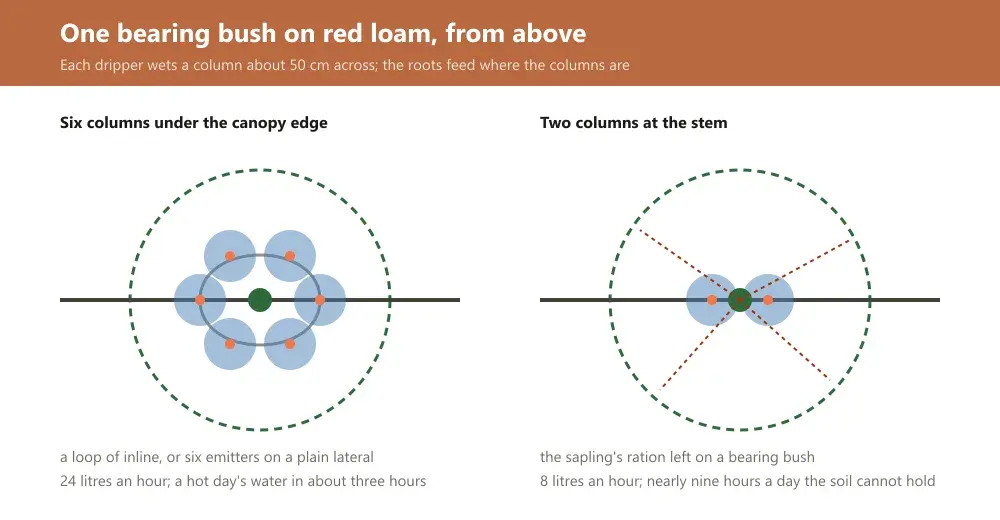
Drip emitter spacing for pomegranate on red loam is a count per bush rather than a distance along a pipe, because on this soil every dripper wets a narrow column of its own and a bush can only drink from the columns it has been given.
Drip emitter spacing for pomegranate on red loam therefore grows with the plant: two columns carry a sapling, a bearing bush three or four years on wants six or more spread under the edge of its canopy, and the run time follows from that count.
Red soil is where much of the region's pomegranate stands, and it suits the crop: it drains, it never leaves a bush standing in water, and it dries fast enough to impose the rest the bahar needs. This guide covers the column, the count per bush at each age, the hours per day, and what red loam does to the rest-and-restart that times the crop.
The column on red loam, and why the count matters
Red loam spreads water little and takes it down fast; under a 4 litre per hour dripper the wet column is about half a metre across and reaches the murrum, the gravel most red soils lie on, within an hour or two of a run.
A pomegranate root system on a bearing bush spreads a metre or more from the stem in every direction, so a bush with two drippers at its base has most of its roots in soil the water never reaches, and feeds from a wet patch the size of a bucket.
On a heavier soil two columns widen and merge into a patch a bush can live on. On red loam they do not, and the shortfall shows in the fruit: small size on a bush that looked healthy, and split skins when a rain finally wets the roots the drippers never did. The pomegranate drip guide explains why steadiness is fruit-grade insurance; on red loam the count of columns is what makes steadiness possible.
- Column: about 50 cm across, deep rather than wide, no merging between drippers 60 cm apart.
- Roots: a metre or more from the stem on a bearing bush, so the columns must sit out under the canopy edge.
- Storage: a day or two in the column; daily runs through the bearing season.
- Drainage: anything past the roots reaches the murrum and is gone.
Drip emitter spacing for pomegranate on red loam, by age
The lateral runs along the row at the 3 to 4.5 metre spacing pomegranate is planted at, one line per row. The question is what sits on it at each bush, and there are two honest ways to answer it with what we list.
The round inline pipe carries a dripper every 40 cm, so a 2 metre length of it along the row gives a bush five columns in a line; laid as a loop around the bush it gives the same five in a ring, which is the better shape here. The plain online lateral carries no drippers and takes emitters from elsewhere, pushed in exactly where each column should stand.
Count by age. A sapling in its first year wants two columns 30 cm from the stem, on opposite sides. By the third year, when the canopy is a metre and a half across, four columns at 50 to 60 cm from the stem. A bearing bush in its fifth year and after wants six to eight columns in a ring at 60 to 90 cm from the stem, where the feeding roots are.
On the inline pipe that is a longer loop each time; on the online lateral it is more emitters pushed into the same pipe, which is why the orchard drip guide leans to the online pattern for plantings that grow for decades. The system estimator plans four drippers to a bush, so on red loam count the extra columns a bearing bush wants on top of its figure.
Both laterals are 16 mm from the drip range; the emitters for the online pattern are not ours to sell. Whatever the pattern, nothing on red loam is gained by a dripper between bushes: the gap is a dry gap, and the water put there drains to the murrum.
The hours, from the count
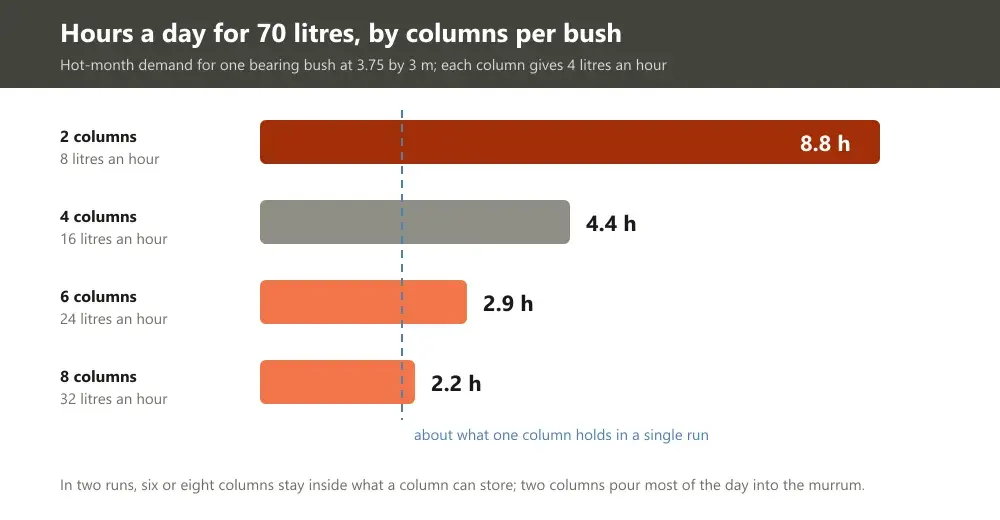
Per bush, at 3.75 metres between rows and 3 metres along them, that is about 30 litres a day in a mild month and 70 in a hot one.
Each 4 litre column gives 4 litres an hour, so the run time is the day's litres divided by four times the count. In a hot month a bearing bush on six columns, 24 litres an hour, takes just under three hours for its 70 litres; on eight columns a little over two; on the two columns it was planted with, nearly nine, which is a run the soil cannot hold and the murrum simply takes.
The count is not a luxury; it is how the day's water gets into the roots in a run the column can store.
On red loam those hours go in daily through the bearing months, split into a morning and an evening run once they pass ninety minutes, so each run fills the columns without pushing past them.
Pomegranate at full cover uses about 2.5 to 6 mm a day, the top of it a hot-month figure for the driest district, which on one acre is roughly 10,100 to 24,300 litres at the root, or about 11,200 to 27,000 litres from the pump once drip's losses are allowed for; the water requirement calculator gives the figure for your own acreage.
The bahar on red loam
Pomegranate is cropped by resting the orchard dry and then bringing the water back to force one synchronised flowering, and red loam is the easiest soil to rest on, because the columns empty within days of the valve closing. That is the advantage. The hazard is the restart: a bush brought back from rest with a full day's water on day one, into dry red loam, takes up water faster than the developing skin can stretch, and the first fruit set after that bahar cracks.
So on this soil the restart is a ramp. Short runs for the first week, lengthening over two or three weeks to the full daily hours, and a valve per block so the block being rested and the block being brought back never share a run. The pomegranate conversion guide prices the block valves as items from elsewhere; on red loam they are what makes the ramp possible on one pump.
- Two columns on a bearing bush: small fruit, split skins after rain, hours the soil cannot hold.
- One long daily run instead of two: the second half drains to the murrum.
- A full-day restart after the rest: cracked fruit in the first set.
- The check: a trowel at a hand's depth under the canopy edge, not at the stem, the morning after a run.
The figures are a starting point
The 2.5 to 6 mm a day and the column widths are published agronomic ranges, not measurements from your orchard, and red loams vary in depth over the murrum from one bund to the next. Treat two hours on six columns as the first month's schedule for a bearing bush and let the trowel correct it.
The same soil's arithmetic on row crops is worked in the red-loam chilli guide and the red-loam cane guide. A blocked column shows on this soil as one side of a bush wilting; the blocked-line guide covers flushing.
If you want the column count and the lateral length worked for your orchard's age and spacing, send us the row spacing, the bush spacing, the planting year and the acreage and we will say how many columns each bush needs now and how the loop or the emitter count grows from here.
Where these numbers come from
- FAO Irrigation and Drainage Paper 56 (opens in a new tab)
The reference method for crop evapotranspiration and crop coefficients that daily water figures derive from.
- ICAR (opens in a new tab)
Indian Council of Agricultural Research — crop agronomy and regional package-of-practices.
- TNAU Agritech Portal (opens in a new tab)
Crop-wise spacing, water requirement and drip layout references for southern India.
Keep reading
Drip emitter spacing for cotton on red loam: the dry inter-row
Drip emitter spacing for cotton on red loam keeps the water in a band under the plant line and the inter-row dry. The band, the minutes, the monsoon break.
GuidesDrip emitter spacing for sugarcane on red loam, and the minutes
Drip emitter spacing for sugarcane on red loam settles the paired-row question, since the bulb is narrow. The pair that works, the minutes by phase, the ratoon.
GuidesDrip emitter spacing for chilli on red loam, and the run time
Drip emitter spacing for chilli on red loam matters, because the wet bulbs barely meet. Where the plants go, the minutes per day, and two schedules that fail.