Rain pipe for vegetables: sizes, prices and pitfalls
Where rain pipe for vegetables earns its keep — the leafy, close-sown blocks and the replant rhythm — with sizes, roll prices and pitfalls.
9 October 2026 · 4 min read · REDYPLAST
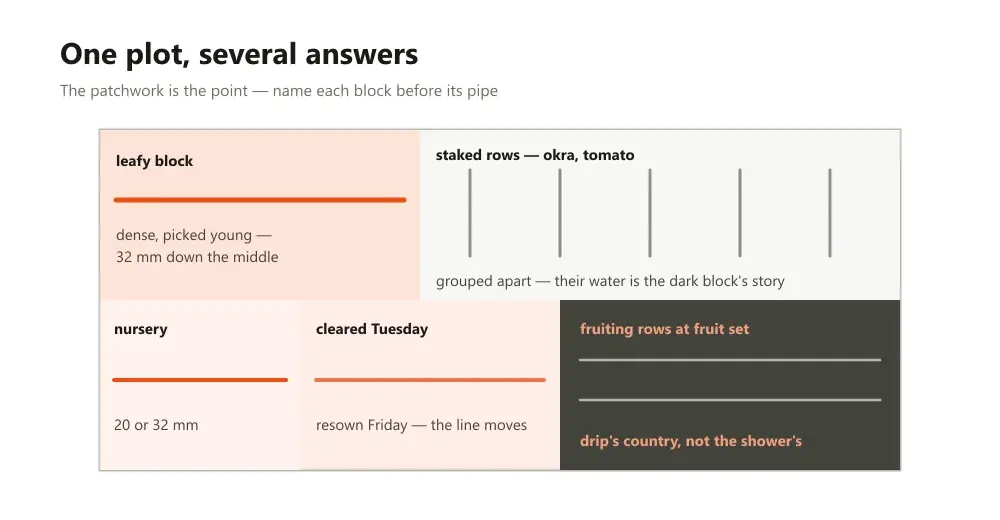
Rain pipe for vegetables earns its keep on the half of the plot that grows as a carpet: the close-sown, leafy, quick-cycling blocks that replant two or three times a year. A vegetable plot is really several plots at once, and this guide is honest about which blocks the spray line serves, which belong to drip, the sizes and roll prices, and the pitfalls particular to a plot that never stops changing.
The blocks that want a shower
Onion deserves its own sentence, because the maker gives it one: it is named outright on both the 32 mm and 40 mm lists, ahead of vegetables generally. The clear fit is the onion nursery bed — sown dense and watered gently until transplanting day. The transplanted bulb crop after it is a judgement call, not a promise: foliage that sleeps wet invites the same disease pressure the fruiting rows face, so the shower's case weakens as the bulbs' season lengthens.
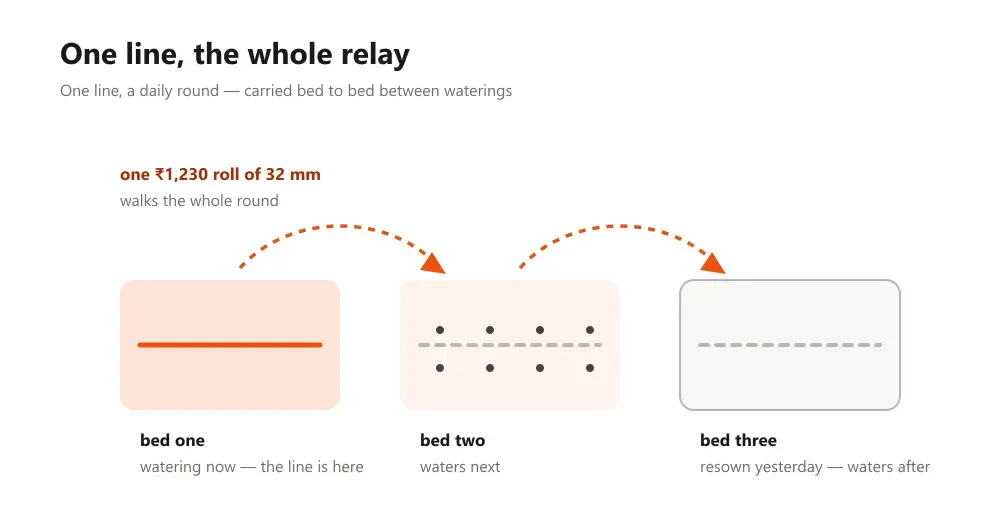
The second thing these blocks want is a line that moves. A bed cleared on Tuesday is resown by Friday, and the maker's own feature list — light weight, easy to carry, easy to install — is the replant rhythm's shopping list. The line lifts off the finished bed and lies down on the next one in one pair of hands, which keeps the watering in step with the relay instead of a step behind it.
Leafy greens, coriander, onion beds, seedling nurseries — these are sown dense, picked young and resown within weeks, and they want water the way rain gives it: light, even, over the whole block at once. There are no rows to target because the crop has no rows worth the name; the rain irrigation overview puts dense-sown vegetables on its natural list for exactly this reason. The blanket advice to water vegetables at the root is about fruiting rows — a bed sown as a carpet has no root line to find.
The blocks that do not
Fruiting vegetables are the other half of the plot, and the honest line runs straight through them. Tomato, brinjal and chilli past flowering want water at the root and a canopy that dries — the standard extension guidance behind our sources — and overhead spray on those rows raises fungal pressure. Our own crop pages and estimator plan vegetables as drip, with their reason stated plainly — drip waters the row without wetting the paths — and the estimator will not count rain-pipe rolls for this crop. The drip case for vegetables covers that side of the plot.
And the smallest corner has its own tool already: a few beds within reach of a tap are garden hose country. Rain pipe sits between the two — more block than a hose serves, more carpet than drip suits.
Which rain pipe for vegetables: sizes
Vegetables appear on four of the five sizes' own use lists — the longest crop run across the family:
Every size wants the same thing from the water source: the listed 1 to 1.5 kg/cm² of pressure — a pump's job, not a trickling tap's.
- **20 mm** lists leafy vegetables and closely spaced crops by name, and its roll is 200 metres — enough line to leapfrog a whole season of beds.
- **32 mm** is the mixed plot's centre of gravity: vegetables, flowers and nursery on one list, one size.
- **40 mm** steps up to the bigger open plot; vegetables sit on its list beside groundnut.
- **63 mm** earns its price only when the plot rotates into field crops — its list runs cotton, maize, pulses and vegetables together. The 75 mm's own use list skips vegetables — treat that as emphasis, not exclusion, and leave it to the cane and banana fields all the same.
Rolls and prices
The listing page is the word on what is actually on the shelf and at what discount this week; these are the printed MRPs. On clean water the family runs without a filter, by its own listing — and since we stock no filters or screens, a silty source means budgeting for screening elsewhere before the first roll is cut.
MRP with tax inside — 5%, the micro-irrigation band — from the rain pipe listing:
- 20 mm × 200 m: ₹1,140.
- 32 mm × 100 m: ₹1,230.
- 40 mm × 100 m: ₹1,320.
- 63 mm × 100 m: ₹3,780.
Pitfalls in a plot that never sits still
- **One line across mixed heights.** A spray that clears the palak drowns against the staked tomatoes beside it. Group blocks by height and give the line to the low, dense ones — that is its country.
- **Evening water on picking beds.** Leaves picked wet stay muddy, and leaves that sleep wet invite disease. Water early; let the morning dry what the kitchen will pick.
- **The line the relay forgot.** When a bed finishes, its line is lying under debris within the week. Lift it the day the bed clears — moving is this pipe's whole job; being buried and then yanked out is not.
- **Skipping the one-lateral test.** Spacing comes from your pump's real reach, measured once on one line before the rest are cut. Guessed spacing shows up as a dry stripe down every bed.
- **The idle months.** Even relay plots pause. The roll waits best drained, loosely coiled, on planks in shade — [the pipe-life guide](/blog/making-your-pipe-last) has the rest.
Buying it for your plot
For scale, use the house planning width rather than a guess: spray strips run roughly seven metres across, so a plain half-acre laid corner to corner would want around 300 metres of line — three or four short rolls — before the mixed blocks subtract their share. Almost no real plot buys the full-plot number; the low blocks alone decide the order, which is why naming them honestly matters more than the arithmetic.
Name the blocks before the millimetres: 32 mm for the leafy and nursery blocks (the 20 mm too, where the listing shows it in stock), 40 mm when the open plot grows, 63 mm only if field crops share the rotation. The vegetables crop page states the drip-first case alongside the agronomy, and the water calculator gives a rough daily water budget for the acreage before the pump is asked.
Rain-pipe joiners, end plugs and cocks are not parts we list, so a cut-down, many-bed layout needs those sourced separately — say so when ordering. For a plot too mixed to size from a page, send the measurements and we will put sizes against your actual blocks, line by line.
Where these numbers come from
- ICAR (opens in a new tab)
Indian Council of Agricultural Research — crop agronomy and regional package-of-practices.
- TNAU Agritech Portal (opens in a new tab)
Crop-wise spacing, water requirement and drip layout references for southern India.
Keep reading
Rain pipe for chilli: sizes, prices and pitfalls
Where rain pipe for chilli genuinely fits — the nursery and the unconverted field — with the right sizes, real roll prices and the pitfalls.
GuidesRain pipe for groundnut: sizes, prices and pitfalls
Which rain pipe for groundnut — 40, 63 or 75 mm — with real roll prices, the layout that suits the pod zone, and the pitfalls that waste a roll.
GuidesGarden pipe for vegetables: sizes, grades and pitfalls
Choosing a garden pipe for vegetables — sizes from 3/4 to 1.5 inch, rolls from 10 to 100 metres, real prices, and the pitfalls that waste one.