Rain pipe for chilli: sizes, prices and pitfalls
Where rain pipe for chilli genuinely fits — the nursery and the unconverted field — with the right sizes, real roll prices and the pitfalls.
8 October 2026 · 3 min read · REDYPLAST
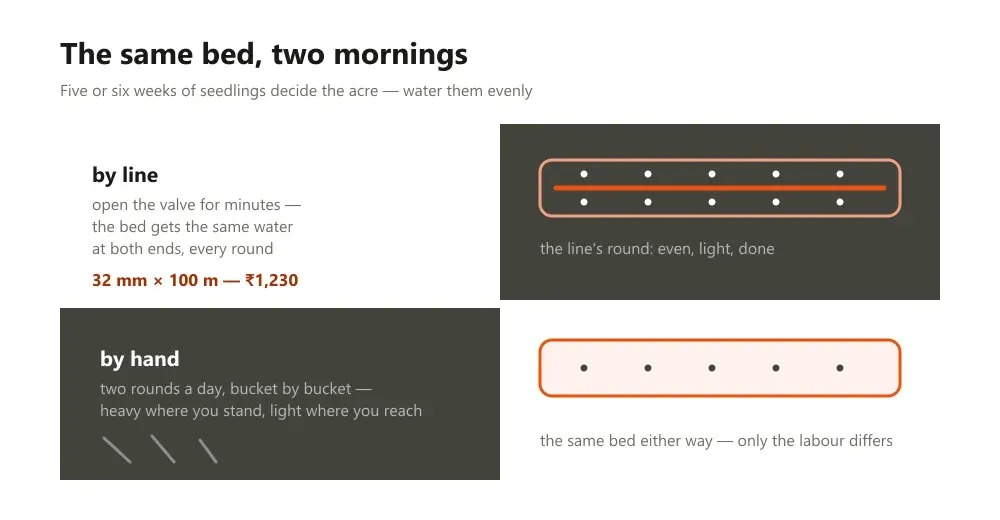
Rain pipe for chilli earns its place in two situations, and honesty about them is the whole guide: the nursery where every chilli acre begins, and the open field that has not converted to drip yet. For the crop itself through flowering and fruit set, the drip case for chilli remains the recommendation — this page covers the two jobs that are genuinely rain pipe's.
The chilli nursery is rain pipe country
Every transplanted acre starts as a seedbed, and for its five or six weeks the nursery wants exactly what a rain hose throws: a fine, even shower that never batters seedlings flat or washes seed out of rows. Mind the scale: the spray lands metres to either side, making this a tool for a nursery block or a row of beds, not one seedbed island. And it wants real pressure — the listing says 1 to 1.5 kg/cm², a pump's job, not a trickling tap's.
This is not our framing — it is the maker's. Both smaller sizes list nursery among their uses: the 32 mm's reads onion, chilli, vegetables, flowers, nursery; the 20 mm's reads kitchen garden, nursery, leafy vegetables. A 32 mm roll costs ₹1,230.
The routine the line makes possible is the part worth having. Nursery beds want water often and lightly — enough to keep the surface from crusting, never enough to stand — and that is a discipline a bucket fights and a pump-fed line keeps: open the valve for a short round in the morning, again if the afternoon demands it, and close it. The block gets the same water at both ends every single time, which hand watering never quite manages.
A hundred-metre roll is far more line than one nursery needs, and that is not waste. Cut what the block takes — noting that the joiners, end plugs and cocks a cut-down line wants are not parts we list, so they come from elsewhere — and the rest waits for the next sowing or the neighbour's beds. The roll is a nursery tool for years, not a season.
Rain pipe for chilli in the open field
The second honest fit is the field that still waters the old way. Converting a chilli field to drip is a real project — the worked layout sheet counts what its 105 rows take — and the season does not wait for the decision. Rain pipe is the affordable middle step: even water this season, at a fraction of a system's cost, from a line that rolls away when the drip decision finally lands.
For scale: around seven 40 mm rolls cover a square acre with lines about seven metres apart — the spray-line spacing our own planning assumes — call it ₹9,240 of hose. Note the system estimator will not rerun this count for chilli: it plans chilli as drip, which is itself the honest signal about where this crop is headed. For a rain-pipe count on your plot, send the measurements.
Mark the stage limit plainly: rain pipe carries establishment and early growth. By flowering and fruit set chilli wants water at the root and a canopy that stays dry, mulch or no mulch — and over mulch film a shower waters nothing but plastic anyway. That is when drip takes over; the method comparison is plain about it.
- **40 mm** names chilli outright on its use list, and it is the size the acre arithmetic below runs on.
- **63 mm** is the size whose list spans chilli, cotton, maize and pulses — the pick when one line must serve the whole rotation, not just this crop.
Rolls, prices and the 5% line
Sizes move in and out of stock at their own pace, and the listing may show a discount off these MRPs — so treat the listing page, not this article, as the word on the shelf this week.
From the rain pipe listing, MRP with tax inside — and the tax inside is 5%, micro-irrigation's band:
One caveat travels with every size, this crop or any other: the no-filter claim on the listing holds for clean water. A silty source closes spray holes the same way it closes emitters, and we stock no filters or screens — budget that from elsewhere, as the rain pipe guide says plainly.
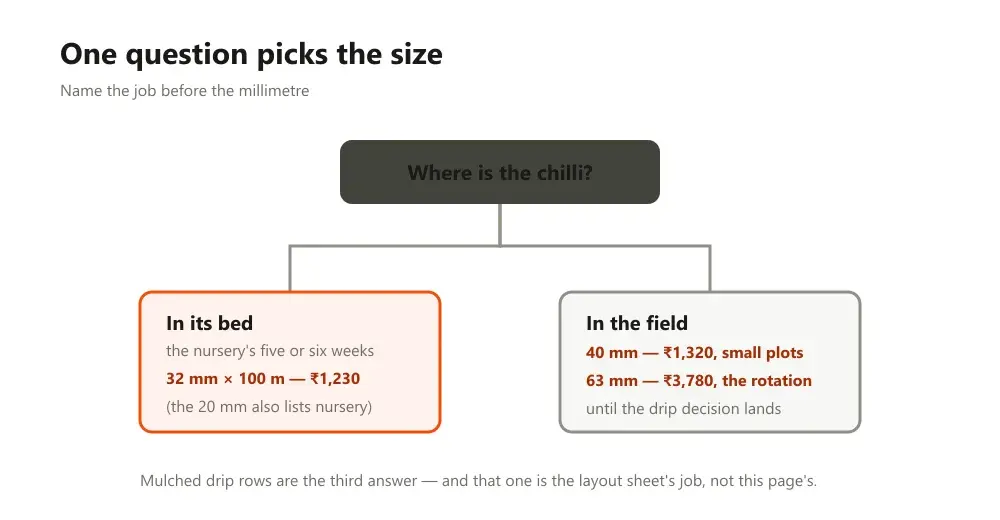
- 32 mm × 100 m: ₹1,230 — the nursery line.
- 40 mm × 100 m: ₹1,320 — the small field plot.
- 63 mm × 100 m: ₹3,780 — the rotation's size.
- Also in the family: 20 mm × 200 m at ₹1,140, and 75 mm × 100 m at ₹4,410 — though the 75's own list runs sugarcane, banana, turmeric, fodder and large groundnut and maize fields, not chilli.
Pitfalls with chilli in particular
- **Drowning the nursery.** Seedbeds fail wet more often than dry: constantly soggy beds invite damping-off, the seedling rot every chilli nursery fears. The fine shower makes frequent light watering easy — use that control, and let the surface dry between rounds.
- **Evening showers on a flowering crop.** Chilli foliage that goes into the night wet is an invitation to fungal trouble. Water in the morning, so the canopy dries with the day.
- **Soft seedlings.** A bed watered generously to the very last day pulls up lush and wilts in the field. Ease the rounds back through the final week — hardening is part of the nursery's job, and a valve makes tapering easy in a way a bucket never was.
- **Rain pipe by default.** The line that carried establishment quietly becomes the field's only water at flowering because nobody decided otherwise. Book the drip decision before the nursery empties, not after the first fungal patch.
- **The roll between seasons.** Chilli's calendar idles the roll for months at a stretch. Shade, planks, loose coils — [the pipe-life guide](/blog/making-your-pipe-last) is a page, and this roll is its ideal reader.
Choosing and buying
The size question answers itself once the job is named: 32 mm for the nursery block, 40 mm for the open field, 63 mm when the line must serve the rotation beyond chilli. The system estimator plans chilli as drip — use it to price the conversion this page keeps pointing at — and the chilli crop page keeps the agronomy beside the parts.
And if this is the season the drip decision finally lands, nothing is wasted: the nursery line stays a nursery line — every future crop of seedlings wants it — and the field learns drip with the layout sheet already counted. For a field or a shared arrangement that does not fit these tidy cases, send the measurements and we will size the rolls against your real pump and beds.
Where these numbers come from
- ICAR (opens in a new tab)
Indian Council of Agricultural Research — crop agronomy and regional package-of-practices.
- TNAU Agritech Portal (opens in a new tab)
Crop-wise spacing, water requirement and drip layout references for southern India.
Keep reading
Rain pipe for groundnut: sizes, prices and pitfalls
Which rain pipe for groundnut — 40, 63 or 75 mm — with real roll prices, the layout that suits the pod zone, and the pitfalls that waste a roll.
GuidesDrip irrigation layout for one acre of chilli, worked
A drip irrigation layout for one acre of chilli at 60 cm rows, fully counted — 105 laterals, seven coils of tape, valves, pump hours and the total.
GuidesDrip for groundnut? Usually not — and what fits instead
Asked for drip for groundnut, we usually talk you out of it. The arithmetic that says so, the rain pipe that fits, and the one case drip still earns.