Drip pressure dropping mid-season: fixes ranked by likelihood
Drip pressure dropping mid-season is a leak, a supply problem or a filter, rarely the emitters. The cup test, the causes in order, and what to repair.
27 October 2026 · 4 min read · REDYPLAST
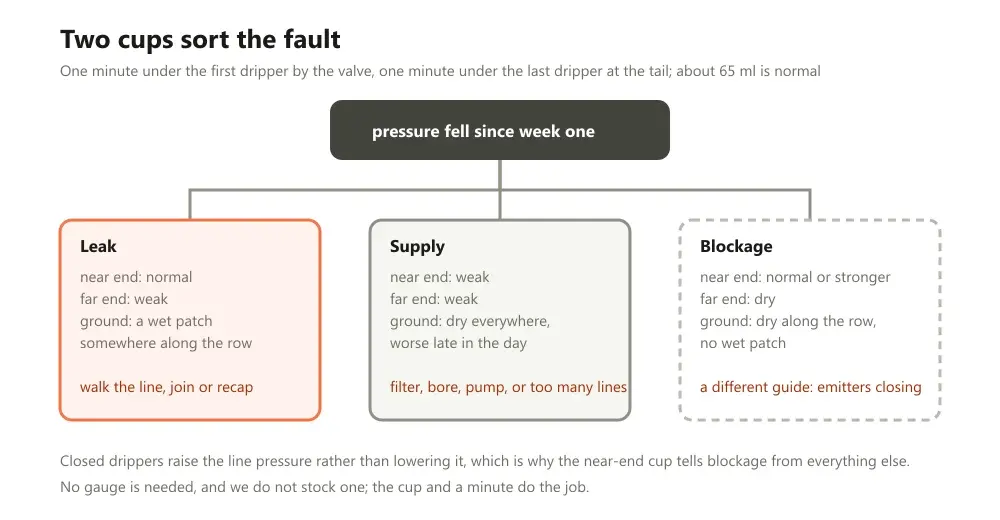
Drip pressure dropping mid-season nearly always comes from one of three places: water escaping through a leak, less water arriving from the pump or the bore, or a filter choked with the season's silt and algae. Blocked emitters, the fault everyone suspects first, do the opposite: when drippers close, the pressure in the line goes up, not down. So the first job with drip pressure dropping mid-season is to sort the fault into its family, and two drippers and a cup will do that in ten minutes.
This guide ranks the causes by how often they turn out to be the one, gives the field test for each, and says which are a ₹6 repair and which mean replacing a lateral or calling the pump shop. We stock the pipe and the fittings; the filter and the gauge this problem turns on are not ours, and we say so where it matters.
Drip pressure dropping mid-season: leak, supply or blockage
Every drip line we list runs at about 1 to 2 kg per square centimetre, and none of us has a gauge on the line, so pressure is read from the drippers themselves. A 4 litre per hour dripper fills a cup to roughly 65 ml in one minute at working pressure. Hold a cup under the first dripper by the valve for a minute, then under the last dripper at the far end, and the two readings sort the fault.
The blocked-line guide takes the third case from here. The rest of this page is for the first two, where the line itself is open and the water is going somewhere else.
- Both drippers weak, near end as much as the far end: the shortfall starts upstream, at the filter, the pump or the bore. Supply family.
- The near end fine and the far end weak, and the ground somewhere along the row wetter than it should be: water is leaving the line before it reaches the tail. Leak family.
- The near end fine or stronger than usual, the far end dry, and the ground along the row dry: the drippers are closing. Blockage family, which is a different article.
Cause one: the filter
On a drip system that ran well in week one and fades in week six, the filter is the likeliest single cause, and it is the one thing on the head we do not sell. Open-well and tank water grows algae as the weather warms; borewell water after the first rains carries fine silt it did not carry in March. Both load the screen, and a loaded screen drops the pressure to every lateral behind it at once.
The test is to read the near-end dripper, clean the screen, and read it again; the fix is the cleaning, and a schedule for it that tightens as the season goes on. A filter that needs cleaning every day has been undersized for the water, and a settling tank or a larger unit, both from elsewhere, is the mid-season buy that pays back fastest.
Cause two: a leak
A tape or a lateral loses pressure to a leak anywhere upstream of the point you are reading. Rats chew the thin tapes in dry weeks when they want the water inside; a cutter nicks a lateral at weeding; a joiner pushed on in a hurry in April works loose in June; an end cap pops off and nobody notices because the tail is under the canopy.
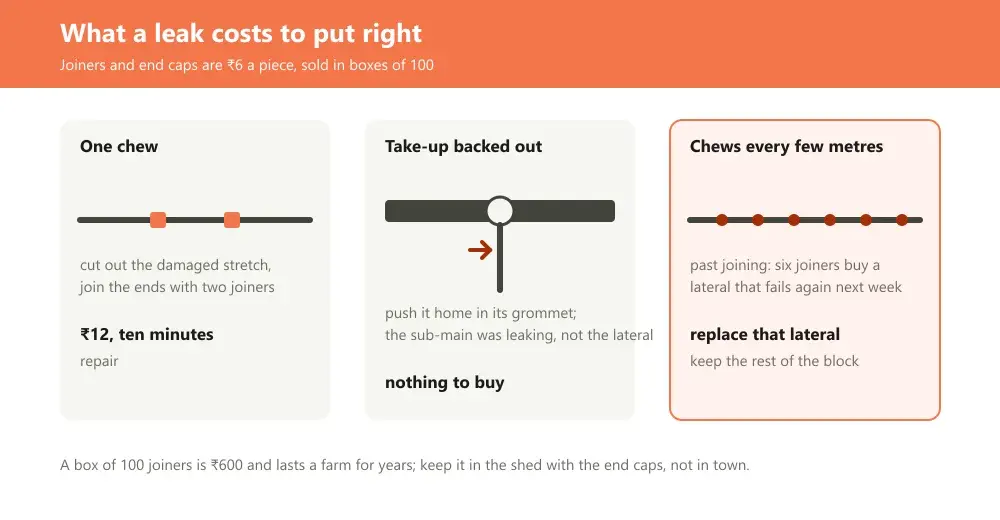
The test is a walk with the pump running and the valve to that block fully open. A jet shows itself; a weep shows as a dark patch wider than the dripper band, or as a stretch of row growing better than its neighbours. Check the sub-main joints and every take-up as you pass, because a take-up that has backed out of its grommet leaks more than any chewed tape.
The repair is the cheapest in this guide. Cut out the damaged stretch and join the ends with two 16 mm joiners at ₹6 each, or refit the end cap; a box of 100 joiners is ₹600 and lasts a farm for years. A tape with chews every few metres is past joining; replace that lateral and keep the rest. Rat damage has the same causes and cures on drip as it does on rain pipe.
Cause three: the bore gives less
A system that is strong at six in the morning and weak by nine, with a clean filter and a dry walk, is reading its borewell rather than its pipe. Many bores give less through the dry months and hold their yield for fewer hours before the water level draws down, so the pump lifts from deeper and delivers less to the same laterals.
The test is a drum: time the pump filling a drum of known size at the start of pumping and again after two hours. The fix is not a bigger pipe or a bigger pump, which add no water, but smaller blocks: fewer laterals open at once, more turns through the day, each block getting the pressure the bore can still give. The borewell guide has the arithmetic, and the fix needs a valve per block, which is not ours to sell.
Cause four: the block grew
Pressure also drops mid-season because the system did: a few more rows piped in May, a second block opened on the same valve, a neighbour's line tied into the sub-main. Every lateral added to a running set shares the same pump, and the cup reading falls at every dripper in proportion. The test is the one-block run with everything else shut; the fix is turn-taking between blocks, not a longer pumping day for all of them at once.
Repair, replace or call someone
The non-return valve at the head is the one pump-side part we do carry, a 2 inch socketed ball type at ₹1,440, and a leaking one shows as a pump that must prime again every morning and a surge of air through the drippers at start-up. The pump-to-lateral guide covers the head part by part, and the rain pipe version of this problem covers the same supply causes on a sprayline.
- Repair: popped end cap, loose joiner, backed-out take-up, a single chew. Fittings from the [drip range](/category/drip-irrigation), ten minutes in the field.
- Replace: a lateral chewed or cut in several places, a sub-main split along a seam, a tape past its second season.
- Clean and reschedule: the filter, and the flushing routine behind it.
- Call the pump shop: a pump that delivers less into an open pipe than it did, with the bore level unchanged; a worn impeller or a slipping foot valve shows there, not on the laterals.
Before buying anything
Do the cup test, the filter clean and the walk before a single new part is ordered, because the first two cost nothing and find most of the faults. If the system still reads low on a clean filter with a dry walk, send us the bore yield, the pump, the number of laterals open at once and the two cup readings and we will say whether the pipe is the problem, and if it is, which part.
Keep reading
Converting cotton from flood to drip: cost and steps
Converting cotton from flood to drip roughly doubles the ground one bore can water. The published acre bill at MRP, the order of work, and who should wait.
GuidesFixing pressure dropping mid-season in a rain pipe system
Pressure dropping mid-season in a rain pipe system means something changed since week one: the bore, the lines, leaks or silt. How to find which, and fix it.
GuidesFixing joints leaking in a rain pipe system
Joints leaking in a rain pipe system happen at three places on the pipe - the head, any mid-line join, and the tail. The field test and honest fix for each.