Lapeta pipe joints leaking: the head tie, the join, the seam
Lapeta pipe joints leaking are the head tie first, the coil join second, and a seam split that only looks like one. The walk, the fix for each, when to replace.
27 October 2026 · 4 min read · REDYPLAST
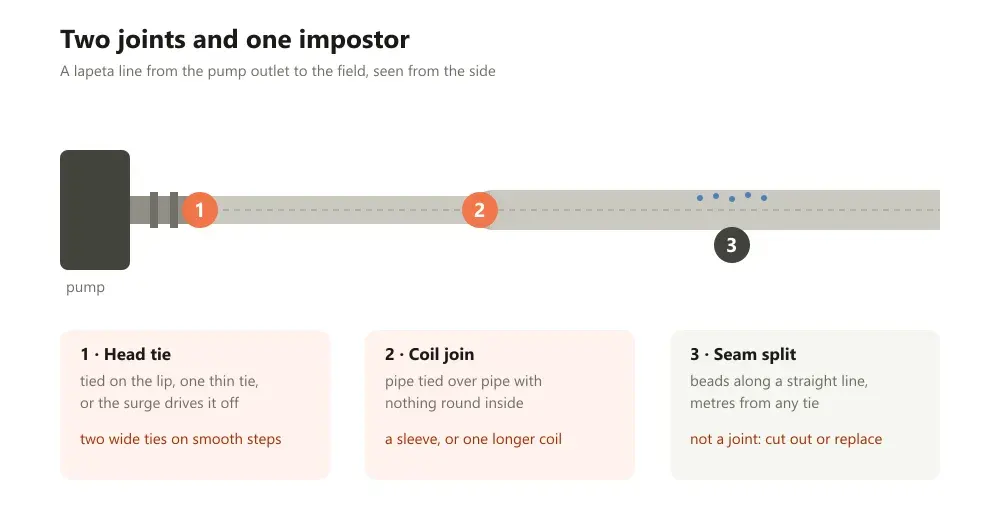
Lapeta pipe joints leaking come down to three places: the tie where the pipe meets the steel at the pump, the join where one coil meets the next, and a split along the pipe's own seam that looks like a joint from ten metres away and is not.
A lapeta line carries the whole output of the pump at 2 to 4 kg per square centimetre, so lapeta pipe joints leaking waste more water in an hour than a drip block loses in a week, and the first one, the head tie, can let go altogether when the pump starts.
This guide gives the walk that tells the three apart, the reason each fails, the fix, and the point at which a length is replaced rather than tied again. Two different pipes are sold as lapeta, the woven tarpaulin and the LDPE film, and where they fail differently it says so.
Lapeta pipe joints leaking: three places, one walk
Start the pump, let the line fill and round out, and walk it from the connector to the delivery end at full working pressure, not at the trickle used while it fills. Look at the pipe, not the ground: a lapeta lying in a wet furrow proves nothing, a drip or a jet from the pipe does.
- At the head: water creeping from under the tie on the steel connector, or spraying back along the pipe when the pump starts.
- At a join: a jet or a weep at the overlap or the coupler, often on one side only.
- Along the pipe: a fine jet or a line of beads from a straight seam, metres from any tie. That is the seam, not a joint.
- At the delivery end: a jet past the fold or the tie, which is the same fix as the head in reverse.
The head tie: the pipe is trying to leave
The head is where a 3 inch lapeta is tied over a stepped steel connector, the 3 inch at ₹1,053 on our listing, and it leaks or lets go for three reasons. The tie sits on the connector's lip or a burr rather than on a step; a single thin tie bites unevenly into the pipe; or the pump starts with the valve open and the surge drives the pipe off the end before the tie can hold it.
The last one is the lapeta failure that soaks the person standing nearest, and it is the one that re-tying harder does not cure.
The fix is two wide ties a hand apart, both on smooth steps clear of the lip, with the pipe pulled on straight and not twisted. Cut the stretched mouth back square to fresh pipe first; a mouth that has been tied before has thinned where the old tie bit. Start the pump against a closed valve and open it slowly, so the line fills before the full head arrives at the tie.
The two pipes behave differently here. The tarpaulin pipe is woven and frays at a cut, so leave the mouth long enough that the fray stays outside the tie; the LDPE pipe is film and stretches, so pull it on warm rather than cold. The pump-to-lateral guide covers the connector itself and the steel behind it; the ties and the thread tape are hardware-market items we do not stock.
The coil join: avoid it, or build it round
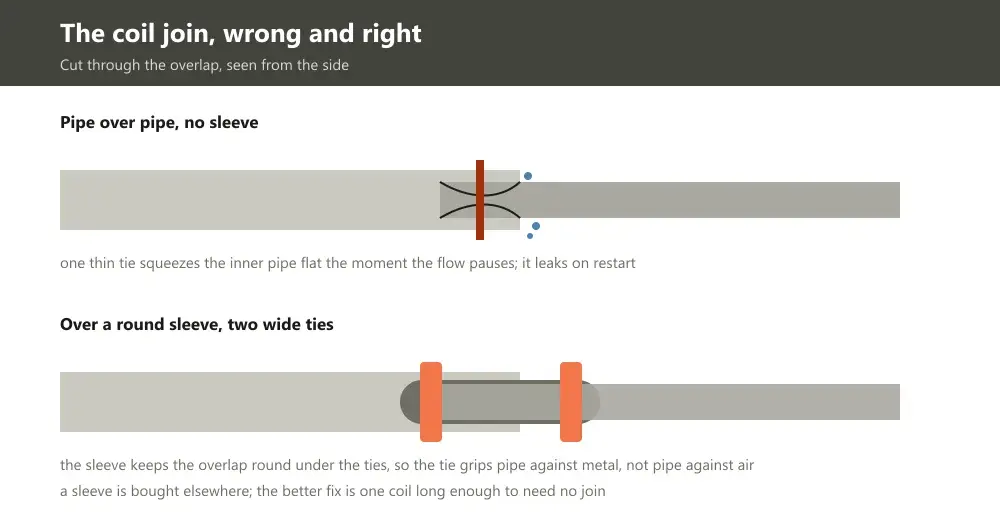
We list no lapeta couplers, so a join between two coils is an overlap tied over something round, or a coupler bought elsewhere. Either leaks for the same reason the head does: the pipe is tied over a ridge, a wrinkle or nothing at all. A join tied pipe over pipe with no sleeve inside holds a trickle and fails at working pressure, because the inner pipe collapses under the tie as soon as the flow pauses.
Where a join is unavoidable, slide a short round sleeve inside, overlap a hand's width, and tie both ends wide and flat as at the head.
The honest answer is to need fewer joins. Our coils run to 150 metres in the tarpaulin pipe and to 180 metres in LDPE, and a line laid from one coil has no join to fail; buy the length the run needs rather than two short coils, and the coil guide explains why the weight on the label is the length you are buying.
The seam split: not a joint at all
Both lapeta pipes are made flat and sealed along their length, the tarpaulin by welding and the LDPE by extrusion, and a leak along that line is the pipe failing, not a tie. It shows as a row of fine jets or beads along a straight line, often where the pipe has lain creased on the same fold for a season or been dragged over stubble. Re-tying anything near it does nothing.
A seam split is cut out and the two sound lengths joined as above, which turns one pipe into two and adds the join you were avoiding. On a pipe that is splitting at the seam in more than one place the plastic has gone, usually from a season rolled up in the sun; the pipe-life guide says how that happens, and the quality check says what to look for before buying the next coil.
Repair, replace or re-lay
Prices for the lengths that avoid joins are on the lapeta listing and the LDPE listing: a 3 inch tarpaulin coil of 90 metres is ₹3,915 and the 3 inch LDPE coil of 15 kg, also 90 metres, is ₹2,160, tax inclusive. If the pipe leaves the connector every time the pump starts even with two ties, the connector size or the step is the problem rather than the tying; send us the pipe size, the connector and a photo of the head before buying another coil.
- Repair: a head tie on the lip, a single tie, a mouth that has thinned, a join tied without a sleeve. Ties and a sleeve, ten minutes, nothing to buy from us.
- Replace the coil: a seam splitting in more than one place, a mouth cut back so often the coil is short of the run, a tarpaulin pipe frayed through at every tie.
- Re-lay: a line that crosses a stubble field, a stone bund or a cart track; the joins and the seam both fail where the pipe is dragged, and moving the line costs less than mending it every week.
Keep reading
Drip joints leaking: find the joint, then the ₹6 fix
Drip joints leaking are nearly always the take-up at the sub-main, then a joiner, then an end cap. How to find which, why each fails, and what to repair.
GuidesDrip pressure dropping mid-season: fixes ranked by likelihood
Drip pressure dropping mid-season is a leak, a supply problem or a filter, rarely the emitters. The cup test, the causes in order, and what to repair.
GuidesFixing joints leaking in a rain pipe system
Joints leaking in a rain pipe system happen at three places on the pipe - the head, any mid-line join, and the tail. The field test and honest fix for each.