Rats chewing drip lateral pipe: thirst, cover or the shed
Rats chewing drip lateral pipe do it for water, for cover, or in the shed, and each leaves its own mark. Read it, then choose a joiner or a new length.
13 November 2026 · 5 min read · REDYPLAST
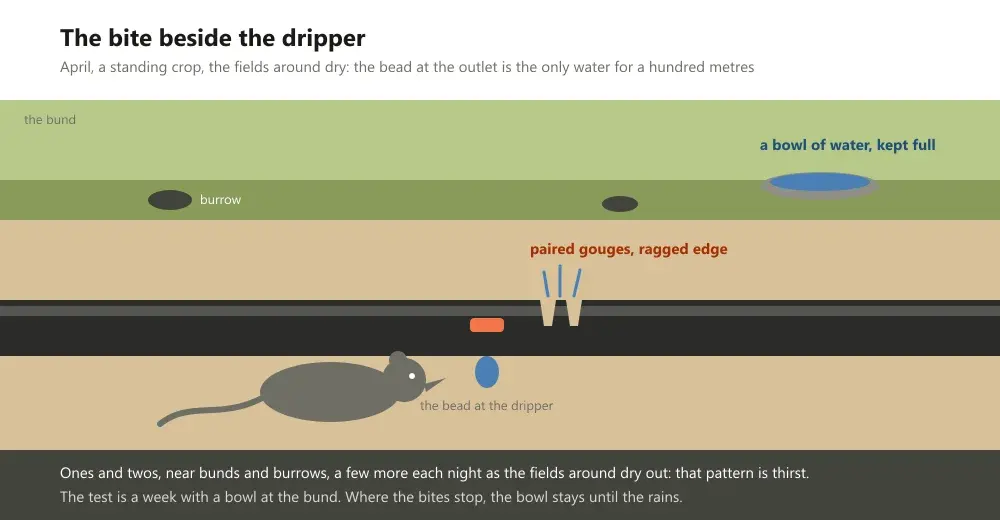
Rats chewing drip lateral pipe are after one of three things, and the mark says which: a pair of chisel gouges beside a dripper in the dry months is thirst, a shredded stretch under weeds or old mulch is cover, and ragged holes at even spacing down a freshly laid line were made in the shed while the tape was rolled.
Each has a different cure, so rats chewing drip lateral pipe is a problem to read before it is a problem to repair. A bitten length is mended with a 16 mm joiner, replaced when the joiners get too many, and protected by taking away what the animal came for.
This guide ranks the causes by how often they turn out to be the one, gives the field test for each, and says when a joiner is the answer and when a new length is.
Rats chewing drip lateral pipe: read the mark first
Walk the line with the pump running and look at three things at every leak: the shape of the hole, where it sits on the pipe, and where it sits in the field. Teeth leave paired gouges with a ragged edge, never a clean slit and never a round puncture, and a rat rarely bites once.
Thirst is the first and commonest cause in a standing crop. From February to the first rain the bead at a dripper is the only water for a hundred metres, and rats, bandicoots and squirrels bite at the dripper or at any low spot where the line stays wet. The holes come in ones and twos, near bunds and burrows, a few more each night as the fields around dry out.
Cover is the second. A line left under weeds, crop trash or last season's mulch is a roofed run, and the animals nesting along it gnaw the pipe where they live: a stretch of a metre or more chewed ragged, with droppings and a worn path beside it. The shed is the third: a rolled tape bitten once is holed through every layer, and laid out it shows ragged holes one wrap of the coil apart.
- Paired gouges at a dripper, near a bund, in the dry months: thirst.
- A ragged stretch under weeds or old mulch, with droppings and a run: cover.
- Ragged holes at even spacing on a line just laid out: the shed, while it was rolled.
- A clean straight slit along the weeding path, or one round puncture at a dripper: not a rat.
The field test for each
Thirst is tested with a bowl. Set a shallow dish of water at the bund nearest the damage, keep it filled for a week, and count the new holes each morning; where the bites stop or halve, the animal was drinking, and the dish stays until the rains. It is the cheapest fix on this page and the one most growers do not believe until they try it.
Cover is tested by lifting it. Roll back the mulch or part the weeds along the bitten stretch; a nest, a run worn smooth, or droppings settle it, and so does the pattern, because cover damage follows the cover and stops where the ground is bare. The shed is tested with a tape measure: holes at one regular interval, on a line that has not yet spent a night in the field, were made before it left the store.
The marks that are not rats are worth knowing. A hoe or a sickle leaves a clean slit along the path the weeders walk. A crow or a peacock after water leaves one round puncture at a dripper, in daylight. A dog or a pig drags and tears, and the line is out of place. The blocked-line guide covers the leaks that are no animal's doing.
A joiner, or a new length
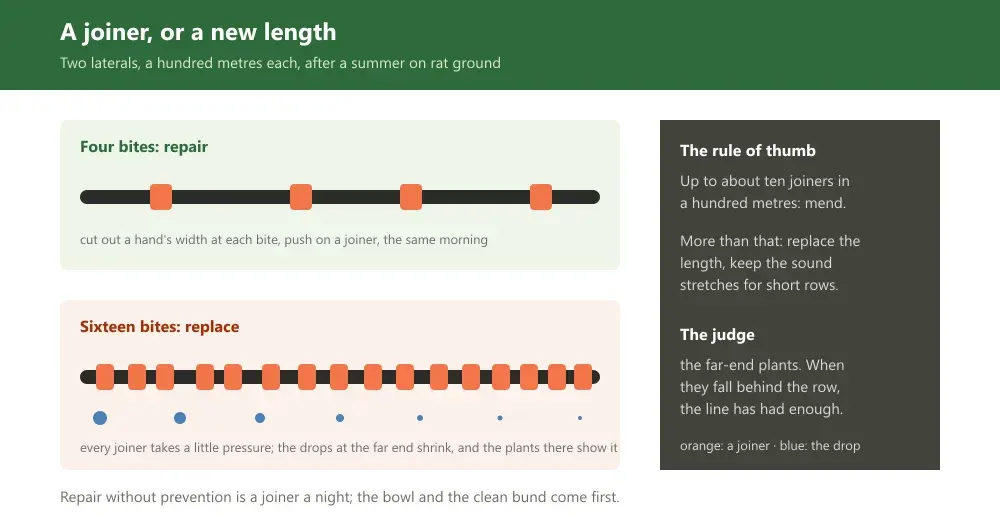
A bite is repaired by cutting out the damaged hand's width and pushing both ends onto a joiner. The 16 mm poly joiner is ₹6 a piece, sold in a box of 100, and a grower on rat ground keeps a box and a knife in the pump house; each repair takes a minute and costs the plants nothing if it is done the morning the hole appears.
The limit is the count. Every joiner is a small step in the pipe and a place a leak can start, and a lateral with more than about ten in a hundred metres has lost enough pressure by its far end to show in the crop. Past that, the length is replaced from the drip range, and the old pipe's sound stretches are kept for short rows.
The wall decides how often this happens. The 0.2 mm flat tape is bitten through in one bite and suits ground where rats are few; the 0.4 mm tape and the round inline pipe have more wall to get through and take a gnawing that would finish a tape, though no polyethylene pipe is rat-proof and none is sold as such. The end caps are worth a look on every walk too, because a cap is a favourite place to start.
- One to ten bites in a hundred metres: cut out and join, the same morning.
- More than ten: replace the length; keep the sound stretches for short rows.
- Holes at coil spacing on a new line: the roll was bitten in store; replace it and fix the store.
- Thin tape on heavy rat ground: move up a wall thickness at the next relay.
Taking away what they came for
Repair without prevention is a joiner a night. Against thirst, the dish at the bund stays out through the dry months, one for each side of the field the damage comes from. Against cover, the bunds are cut clean for two metres either side of the first lateral, crop trash is cleared off the lines between crops, and a line under mulch is checked along its length once a month, not only where it leaks.
Against the shed, tape that comes up between crops is flushed, dried, rolled loose and hung off the floor, away from grain and feed; a roll on the ground beside the fodder is bitten before the next planting. For a long crop, a lateral buried a hand deep is out of sight of most animals, though a thirsty bandicoot will still dig to a leak.
Burrows along the bund are the source in every case. Trapping and baiting are the grower's choice and the agriculture office's advice, and we sell neither traps nor poison; what we can say is that a field with clean bunds and water at its edge buys a small fraction of the joiners its neighbour does.
The rules of thumb are a starting point
The ten-in-a-hundred limit and the week with a bowl are working rules rather than measurements from your field, and a line on a strong pump tolerates more joiners than one at the end of a long main. Let the far-end plants be the judge: when they fall behind the rest of the row, the line has had enough repairs.
If you want joiners, caps and replacement lengths counted for a field that is being bitten, send us the row length, the number of rows, the pipe you have now and where the damage is and we will say what to keep in the pump house and which wall to lay next.
Keep reading
Drip joints leaking: find the joint, then the ₹6 fix
Drip joints leaking are nearly always the take-up at the sub-main, then a joiner, then an end cap. How to find which, why each fails, and what to repair.
GuidesDrip irrigation layout for one acre of cotton at 90 cm rows
A drip irrigation layout for one acre of cotton at 90 cm rows, counted: 71 laterals, nine coils, the head, the blocks your bore can run, and a bill of ₹35,919.
GuidesLapeta pipe joints leaking: the head tie, the join, the seam
Lapeta pipe joints leaking are the head tie first, the coil join second, and a seam split that only looks like one. The walk, the fix for each, when to replace.