Fixing pressure dropping mid-season in a rain pipe system
Pressure dropping mid-season in a rain pipe system means something changed since week one: the bore, the lines, leaks or silt. How to find which, and fix it.
16 October 2026 · 5 min read · REDYPLAST
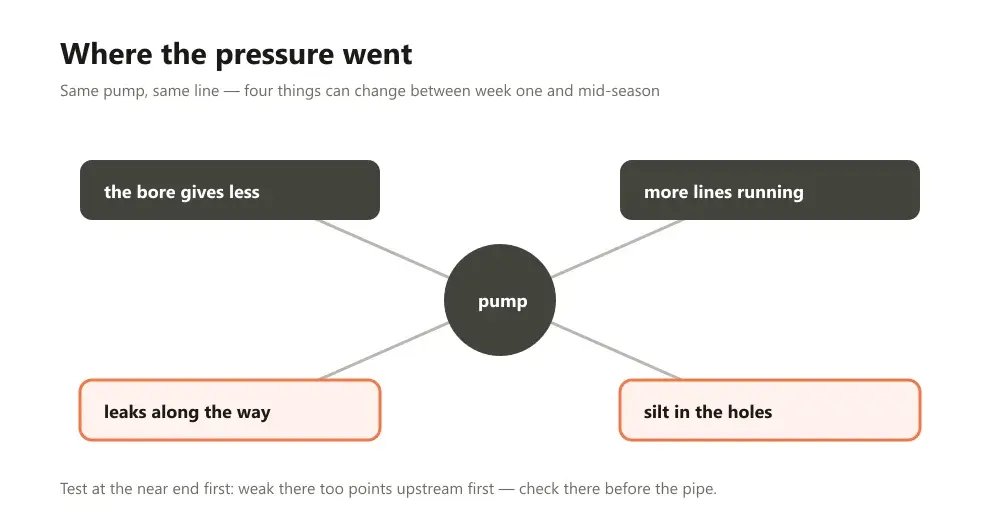
Pressure dropping mid-season in a rain pipe system is a different complaint from a weak far end: the whole line throws less than it did in week one, from the valve to the tail. Something has changed since then, and there are four things to check — the bore giving less, more lines running at once, leaks, and silt in the holes. Each has a test that costs nothing, and none of them needs a gauge.
Pressure dropping mid-season: split upstream from the line
Look at the near end first, beside the valve. If the spray there is as weak as the spray at the tail, the shortfall most likely starts upstream of the holes: a valve not fully open, the head tie weeping, the bore giving less, or the pump shared with more than it was. If the near end is strong and only the tail is weak, that is a different problem with its own guide.
Then compare the same thing twice. Run one line on its own, with every other line and every other draw on the pump shut. One line alone throwing as it did in week one means this line is sound at this hour. One line alone throwing weakly means the bore, or something on this line — flush it and walk it before blaming the bore.
Repeat the single-line run late in the pumping day, because a bore that is drawing down shows there, not in the first half hour.
Keep the comparison fair: same hour, same pump, nothing else drawing. A tank filling from the same pump, or a second pump on the same power line at the busy hour pulling the voltage down, can cut what reaches the line, so count those too before blaming the pipe.
The far-end guide covers the tail-only case. The rest of this article is for a line that is weak from end to end.
- Weak at the near end as well as the tail: look upstream first — valve, head tie, bore or sharing.
- Fine on its own, weak when the other lines run: sharing — more lines than the pump has water for.
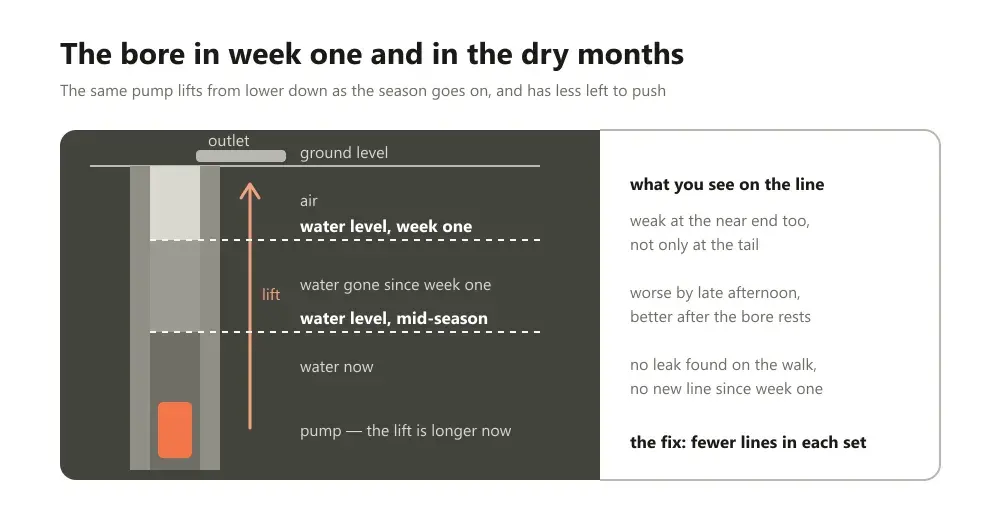
- Weak on its own after a flush and a walk, worse late in the day, better after the bore has rested: the bore is giving less.
- Fine after a flush, weak again after a few waterings: silt arriving with the water.
- A jet or a weep found on the walk, from anywhere but a punched hole: a leak, stealing pressure from everything past it.
The bore gives less than it did
In a season that runs into the dry months, many bores give less than they did at its start, and hold their yield for fewer hours before they draw down. The pump then lifts from further below and has less left over to push the line.
One sign is a system that throws well first thing and fades through the day, with nothing on the pipe to explain it; a bore that gives less in its fourth hour than in its first is not the bore the layout was planned on.
Find the bore's yield now rather than remembering it. Time the pump filling a drum of known size at the start of pumping, and again after an hour or two; the two times tell you both the yield and how fast it falls.
A wider pipe adds no water, so the fix is to run fewer lines at once, in smaller sets — a set being the lines you run at the same time — each set getting the water the bore can still give.
The borewell guide has the arithmetic: the day's water is the bore's yield times the hours you can honestly pump, and a layout drawn for more water than that sits dry.
A tank does not add water either; what it does is let you pump through the good hours and water on the crop's schedule — the borewell guide's "store, then apply" — provided filling it and watering from it do not overlap on the same pump. The water requirement estimator gives the litres the crop needs each day, to set against what the bore is giving now.
More lines than the pump has water for
Count the lines, and call the lines you run at the same time a set. A set with more lines in it than in week one shares the same pump across all of them, and every line throws less — sharing, which the far-end guide also names among the near-end causes. Load is easy to add without noticing: a line laid for a new block, two run together to finish the evening sooner, a tank filling from the same pump.
The test is the one-line run above, and the fix is turn-taking: fewer lines in each set, and more sets through the day. Each line needs its own cock to shut it, and none is on our shelf for rain pipe, so that part is bought elsewhere. The groundnut guide says to test one lateral before laying the field; this is the same test, run again mid-season.
Silt and leaks
Silt weakens the whole line when it arrives with the water — a source gone muddy after rain, a tank stirred by filling, a bore pumping sand — because then every hole is closing at once, not the tail first. Catch a bottle of water from the open tail and let it stand; a layer on the bottom says the line is carrying what the source carries.
The listing's FAQ says filtration depends on water quality, and we list no filters or screens, so screening the source is bought elsewhere; flushing through the open tail is free and is the habit that keeps the holes clear.
A leak weakens the whole line when it sits at the head — a tie weeping at the mouth, a split just past it — or when there are many small ones along the roll, such as rat bites. Walk the line at full working pressure and mark every jet from anywhere but a punched hole.
The joints guide covers the ties and the sun-cracking guide reads the splits; for silt closing the tail first, and a leak that only starves the far end, the far-end guide is the right page.
Before buying anything
None of the four is fixed by a part on our shelf. The fixes are fewer lines in each set, a flush, a re-tie, and a layout matched to the bore it has now rather than the bore it had in week one; the one purchase, a cock for each line, is made elsewhere.
Do not answer a weak spray by opening the valve past the listed 1 to 1.5 kg/cm² — we stock no gauges or regulators, so the rule is to open the valve gradually and stop while the spray is still even, and pressure past the window can split the wall or pull a tie.
If the bore has changed, the layout may need to change with it: fewer lines at once, or a smaller area under rain pipe this season than last. Send us the details — the bore's yield, the hours, the number of lines and the pipe size — and we will say whether the match still works; the rain pipe range is there if a redesign needs different sizes, not before.
Keep reading
Fixing uneven flow at the far end in a rain pipe system
Uneven flow at the far end of a rain pipe has three usual causes. Here they are in order of likelihood, with a field test and an honest fix for each.
GuidesFixing laterals lifting off the ground in a rain pipe system
Laterals lifting off the ground in a rain pipe system can be a flat hose rolling as it fills, or moving in the wind. Three causes, each with its test and fix.
GuidesFixing rats chewing lateral pipe in a rain pipe system
Rats chewing lateral pipe can ruin a stored roll before the season opens. How to tell rat bites from other holes, what to repair, and how to protect the roll.