Drip emitter spacing for sugarcane on red loam, and the minutes
Drip emitter spacing for sugarcane on red loam settles the paired-row question, since the bulb is narrow. The pair that works, the minutes by phase, the ratoon.
5 November 2026 · 5 min read · REDYPLAST
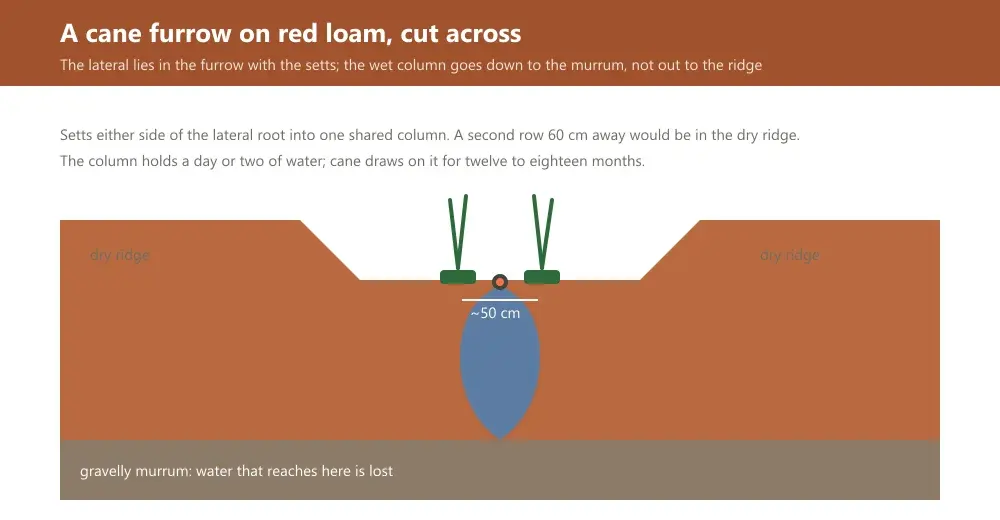
Drip emitter spacing for sugarcane on red loam is where the paired-row saving meets its limit: the wet bulb under a dripper on this soil is a narrow column about half a metre across, so one lateral can water two cane rows only if both sit within a hand's length of it.
Drip emitter spacing for sugarcane on red loam along the lateral is the easy part, since the 40 cm drippers every inline pipe we list carries merge into a continuous band along the furrow; across the field, the layout is set by how close the pair is planted.
Cane on red soil is common across southern Telangana and the border districts, and it is a long crop on a soil with a short memory. This guide covers the bulb, the pair that works and the pair that does not, the minutes per day through the three phases of a cane year, and what the ratoon and its trash change.
The bulb on red loam, and why cane feels it
Red loam drains fast and spreads water little. The column under one dripper is 40 to 60 cm wide and goes down to the murrum, the gravelly layer most red soils sit on, within an hour of a long run; whatever reaches the murrum is gone.
The soil holds a day or two of crop water in the top half metre, which is where young cane roots are, and a cane plant that has gone dry for three days in April shows it in the tiller count for the rest of the season.
Cane's demand is heavy and runs for twelve to eighteen months, so the small store is refilled every day for a year rather than for a season. The upside is the same as for every crop on this soil: the inter-row stays dry, the stool never stands in water, and a ratoon's stubble is never drowned. The sugarcane crop page says a borewell has to meet the grand-growth peak rather than the yearly average; on red loam that peak has to arrive every day.
- Bulb: 40 to 60 cm across, deep rather than wide, merging along the row at 40 cm drippers.
- Reach across the row: about 25 cm each side of the lateral, no more.
- Storage: a day or two in the young root zone; daily runs for the whole cycle.
- Drainage: anything past the roots reaches the murrum and is lost.
Drip emitter spacing for sugarcane on red loam, across the field
Along the furrow, the 4 litre per hour dripper every 40 cm wets a continuous band on this soil, because the columns overlap at 40 cm as they do on most soils; a sett planted anywhere along the furrow has water. The lateral lies in the furrow beside the setts at planting, not on the ridge, so the column it makes is the column the roots start in.
Across the field is the decision. Cane planted in single rows takes one lateral per row, and under drip the plan is wide rows 1.5 metres apart. On red loam there is no shortcut to closer rows: a lateral between two rows a metre apart wets neither.
The paired-row layout that the cane conversion guide prices as the cheaper plan still works here, but only when the pair is planted 30 to 40 cm apart with the lateral between them, so both rows sit inside the 50 cm band. A pair at 60 cm, which is comfortable on a black or alluvial soil, leaves both rows at the dry edge of the column.
That one rule decides the coil count. Tight pairs at 1.8 metres between pairs put about 2,250 metres of lateral on an acre; single rows at 1.5 metres put about 2,700, and closer rows more. The grower chooses the planting pattern before the pipe, and the cane drip guide covers the wall thickness a lateral needs to stay down through the ratoons on either pattern. The lateral itself is 16 mm inline from the drip range.
The minutes, by phase
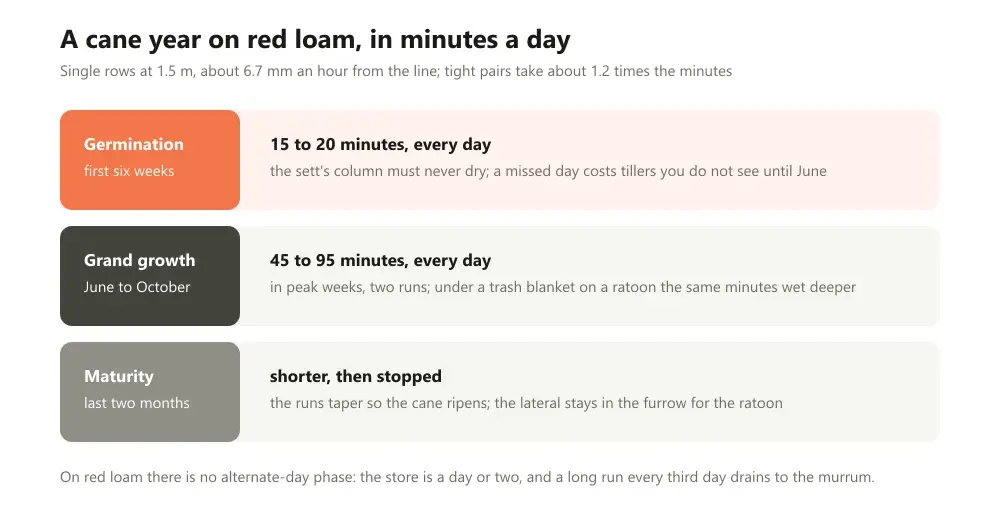
The line applies it at about 6.7 mm an hour on single rows at 1.5 metres, since a metre of lateral with 10 litres an hour serves a square metre and a half; on tight pairs at 1.8 metres the same metre serves 1.8 square metres and the rate falls to about 5.6 mm an hour.
An acre of single rows is about 2,700 metres of lateral drinking 27,000 litres an hour, and of tight pairs about 2,250 metres drinking 22,500. So the 9.5 mm peak is about an hour and a half on single rows and just under two hours on pairs, and the 4.5 mm end of the range about 45 minutes or 55.
The phases set the frequency. Germination, the first six weeks, wants a short run every day so the sett's column never dries; grand growth, June to October, wants the full minutes daily, split into two runs in the hottest weeks; maturity, the last two months before harvest, wants the runs shortened and then stopped so the cane ripens. On red loam none of these phases can be stretched to alternate days without the murrum taking the difference.
Cane at full cover uses about 4.5 to 9.5 mm a day, the top of it a hot-month figure for the driest district, which on one acre is roughly 18,200 to 38,400 litres at the root, or about 20,200 to 42,700 litres from the pump once drip's losses are allowed for; the water requirement calculator gives the figure for your own acreage.
The ratoon, the trash and the two mistakes
After harvest the stubble shoots within days and the laterals are already in the furrow, so the ratoon starts under drip from its first week. Leave the trash as a blanket over the lateral and the red loam under it loses far less to evaporation; the same minutes then wet deeper and the surface stays cool. Burn the trash and the laterals burn with it, which is the end of the system rather than a scheduling question.
The first mistake is the black-soil habit: a long run every second or third day, which on a heavy soil fills a store that lasts. On red loam the second half of that run drains to the murrum and the stool is dry by the second evening, and the tiller count tells the story in June.
The second is the wide pair, planted at 60 cm around one lateral because it worked on the neighbour's black soil; both rows root towards a column they cannot reach, and the stand is thin from the start.
- Alternate-day long runs: water past the roots, a dry stool on the second evening, fewer tillers.
- Wide pairs on one lateral: both rows at the dry edge, a thin stand from planting.
- Burned trash: a burned lateral; decide the trash plan before the first coil is laid.
- The check: a trowel a hand deep beside the stool the morning after a run, moist not shining and not dusty.
The figures are a starting point
The 4.5 to 9.5 mm a day and the bulb widths are published agronomic ranges, not measurements from your field, and red soils vary in depth over the murrum from one bund to the next. Treat the 45 minutes as the first month's schedule and let the trowel correct it.
The same arithmetic on other soils and crops is worked in the red-loam chilli guide and the black-soil cotton guide, and a blocked dripper on this soil shows within days as one short stool; the blocked-line guide covers flushing.
If you want the lateral count and the shifts sized to your row plan and your bore, send us the planting pattern, the acreage and the bore yield and we will say whether your pair is tight enough for one lateral on red loam, and how many coils that is.
Where these numbers come from
- FAO Irrigation and Drainage Paper 56 (opens in a new tab)
The reference method for crop evapotranspiration and crop coefficients that daily water figures derive from.
- ICAR (opens in a new tab)
Indian Council of Agricultural Research — crop agronomy and regional package-of-practices.
- TNAU Agritech Portal (opens in a new tab)
Crop-wise spacing, water requirement and drip layout references for southern India.
Keep reading
Drip emitter spacing for chilli on red loam, and the run time
Drip emitter spacing for chilli on red loam matters, because the wet bulbs barely meet. Where the plants go, the minutes per day, and two schedules that fail.
GuidesDrip emitter spacing for vegetables on sandy loam, bed by bed
Drip emitter spacing for vegetables on sandy loam decides whether one lateral can serve a two-row bed. The beds that work, the minutes a day, the leaching trap.
GuidesDrip emitter spacing for banana on alluvial soil, and the hours
Drip emitter spacing for banana on alluvial soil is easy; the run time is long. Why the whole row is wetted, the hours a day, and what alluvium punishes.