Flood to drip conversion for sugarcane: cost and steps
A flood to drip conversion for sugarcane priced at MRP two ways, single or paired rows, with the work, the pumping change, and who should keep the furrow.
23 October 2026 · 5 min read · REDYPLAST
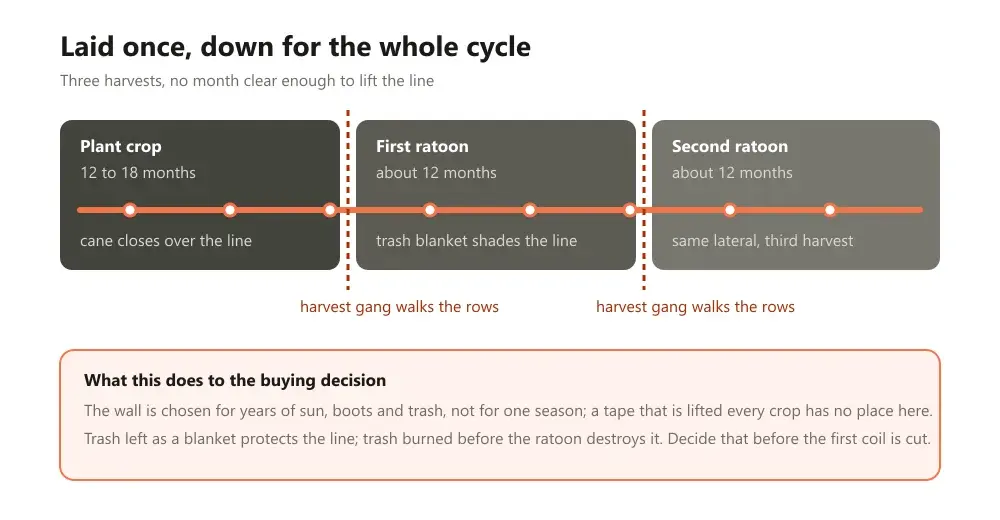
A flood to drip conversion for sugarcane keeps the bore, the pump and the delivery main, and adds a lateral in every cane row or every pair of rows, fed from a sub-main across the head of the field. Two things make a flood to drip conversion for sugarcane unlike the same job on chilli or vegetables: the lateral stays in the ground through the plant crop and every ratoon, and the saving is mostly a pumping saving spread over twelve months rather than a yield jump in one.
So the decision is made once and lived with for years. This guide prices the acre at MRP two ways, sets out the work in order, says how the water and the labour change, and names the farmers who should keep flooding the furrow.
Flood to drip conversion for sugarcane: the field never empties
Under flood, cane is watered down the furrow between rows, and the furrow is also the path the harvest gang walks. Under drip, a 16 mm lateral runs along each row or between each pair, and once the cane closes over it the line is in shade and under trash for the rest of its life. No month is clear enough to lift it, so whatever is laid at planting is what the ratoons get.
That is why the wall of the lateral is a cane decision before it is a price decision. Our listing carries a round inline pipe with the dripper built in, in coils of 500 metres, and a 0.4 mm flat tape in the same coil length. A heavier round inline exists on the listing too, and is out of stock as this is written; ask before you plan around it.
Cane rows sit 0.9 to 1.2 metres apart, and the acre arithmetic below uses the middle of that. Planted in pairs, two rows share one alley and one lateral waters both, which is the single biggest lever on the bill. The sugarcane crop page says the same in three lines, and the cane drip guide argues the wall question at length.
- Keep: the bore or well, the pump, the delivery pipe and the valve on it.
- Add: a filter from elsewhere, a non-return valve, a sub-main across the row heads, one lateral per row or per pair, a take-up at each lateral start, an end cap at each tail, and joiners for harvest-season repairs.
- Decide before planting: single rows or pairs, and whether the trash will be left as a blanket or burned, because no surface lateral survives a field fire.
Two bills at MRP: one lateral per row, or one per pair
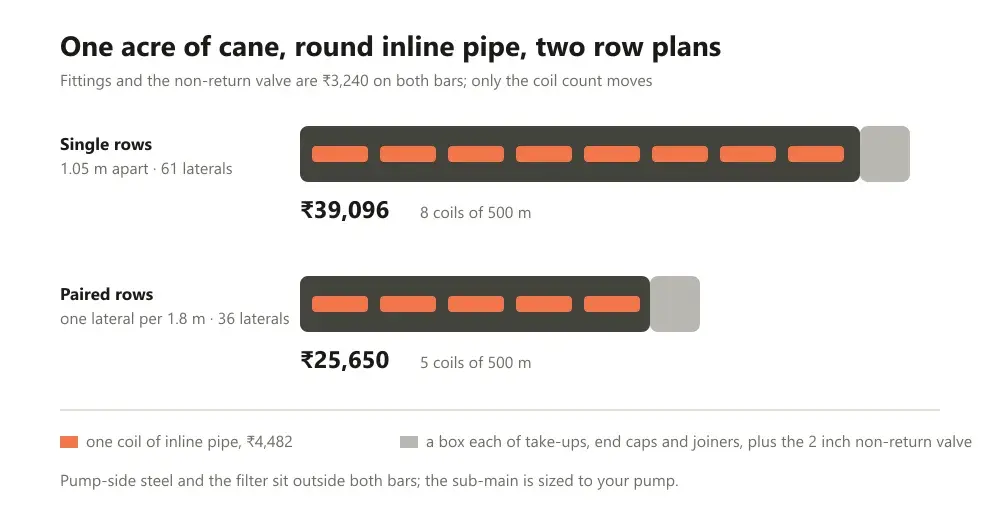
One acre at 1.05 metres between rows carries about 3,855 metres of lateral in 61 runs. In the round inline pipe at ₹4,482 a coil, that is eight coils for ₹35,856. Add a box of 100 take-ups, a box of 100 end caps and a box of 100 joiners, ₹6 a piece and sold by the hundred, which is ₹1,800, and the 2 inch socketed ball-type non-return valve at ₹1,440. The single-row bill is ₹39,096, tax inclusive.
Plant the same acre in pairs with a lateral every 1.8 metres and the pipe falls to about 2,249 metres in 36 runs: five coils for ₹22,410, the same three boxes and the same valve, and a paired-row bill of ₹25,650. That is the lever. The fittings and the valve do not move; the coil count does.
The 0.4 mm flat tape at ₹3,366 a coil would make the single-row acre ₹26,928 in pipe and ₹30,168 all in. It is the honest choice for a crop that is lifted each season, which cane is not; under harvest traffic for a plant crop and two ratoons it is a bet, and we say so rather than sell it quietly.
The system estimator builds the single-row version from the crop and the acreage, pricing laterals, take-ups, end caps and joiners by count rather than by the box, and reports about ₹36,700 for an acre of cane. The pump side sits outside every bill: a 3 inch LDPE lapeta of 90 metres is ₹2,160 and the 3 inch steel connector is ₹1,053, if you do not already own them, and the filter is not ours to price.
The work, from the pump to the last row
The order matters more for cane than for any annual crop, because the laterals go down with the setts and are not seen again until the first harvest. Test everything before the cane hides it.
The pump-end fittings guide takes the first three steps part by part, and the drip irrigation range lists every item above that we sell, with any discount running today.
- Settle the row plan first, single or paired, because the lateral count and the coil count follow from it and nothing else.
- Fit the head in order from the pump: steel connector, non-return valve, then the filter bought elsewhere.
- Run the sub-main across the row heads and punch one take-up per lateral.
- Lay each lateral with the drippers up, fold and cap the tail, and flush the whole system with the caps off before closing it.
- Run it and walk every row before the setts go in; a dry run now is a ₹6 joiner, and after planting it is a row that fails for a year.
- Mark every lateral position at the row ends, so the harvest gang and the trailer know where the line is when the trash hides it.
Water, labour and the first twelve months
Cane's demand is heavy and steady for the whole year rather than sharp in one month, so what drip changes is the pumping hours, every month. Flood pushes water down a 60 metre furrow and loses it to the ends and the paths; drip puts it at the stool, and the pump runs fewer hours for the same crop. On a bore that struggles in April that is the difference between finishing the field and abandoning the far rows.
Labour moves rather than disappears. Nobody opens and closes furrows after each turn of the pump, but someone walks the rows for blocked drippers, flushes the tails at the start of each ratoon, and finds the cuts the harvest left. The first twelve months are spent learning to water little and often, and to trust a surface that looks dry while the stool is wet.
Two habits protect the investment. Leave the trash as a blanket if you can: under it the lateral works shaded and the water barely evaporates. And walk the block with the pump running within days of every harvest, before the trash settles, because a crushed line announces itself in minutes and hides for months.
Who should stay with the furrow
Drip on sugarcane has drawn Pradhan Mantri Krishi Sinchayee Yojana support under Per Drop More Crop, with the rate and the paperwork varying by state and year; ask the agriculture office before counting on a figure. If you want the bill for your own rows, send us the row plan, the acreage and your pump and we price what we sell at MRP, marking the filter as an item from elsewhere.
- A grower on canal rotation with ample water and no pump; drip needs pressure the canal does not give, and the furrow costs nothing.
- Anyone who burns the trash before the ratoon and will not change that practice; the laterals burn with it.
- A single plant crop on leased land with no ratoon intended, because the bill is justified across the cycle, not one harvest.
- A field without a filter budget; cane laterals block over a year with no chance to lift and clean them.
Where these numbers come from
- TNAU Agritech Portal (opens in a new tab)
Crop-wise spacing, water requirement and drip layout references for southern India.
- ICAR (opens in a new tab)
Indian Council of Agricultural Research — crop agronomy and regional package-of-practices.
- PMKSY — Per Drop More Crop (opens in a new tab)
The central micro-irrigation scheme. Subsidy rates and eligibility are set here, not by suppliers.
Keep reading
Flood to drip conversion for vegetables: cost and steps
A flood to drip conversion for vegetables, priced at MRP three ways, with the beds relaid every crop, the water and labour that change, and who should wait.
GuidesConverting chilli from flood to drip: cost and steps
Converting chilli from flood to drip: what you keep, what you buy, what it costs at MRP, how the work and the water change, and who should not convert.
GuidesFlood to drip conversion for paddy: what actually works
Flood to drip conversion for paddy is the wrong buy for the flooded crop. Where rain pipe earns a place, what it costs at MRP, and who should keep the channels.