Drip irrigation layout for two acres of banana: 71 rows
A drip irrigation layout for two acres of banana: 71 rows at 1.8 m, ten coils of lateral, one hose along the head, and the bore yield that sets the blocks.
23 November 2026 · 5 min read · REDYPLAST
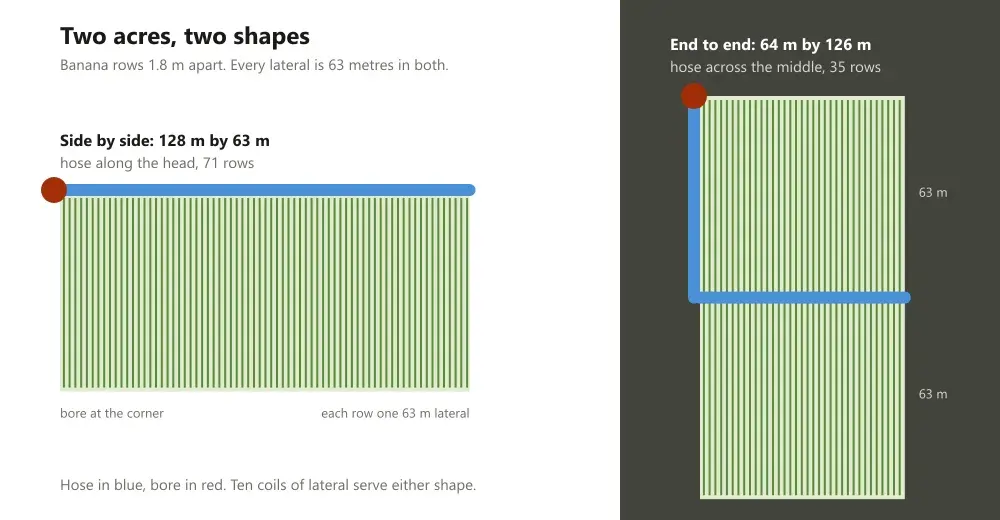
A drip irrigation layout for two acres of banana is 71 rows 1.8 metres apart, each with one 63 metre lateral, fed from a 3 inch hose along the head of the field. The parts we sell for it come to ₹41,058 at MRP, tax included.
What a drip irrigation layout for two acres of banana cannot do is run all at once. The 71 laterals together would draw about 45,000 litres an hour, so the field is watered in blocks, and the bore decides how many. The one acre sheet is the same planting on half the ground.
The field and the rows
Two acres laid side by side make a field 128 metres by 63. Rows are 1.8 metres apart, the spacing the one acre sheet gives for Robusta and Nendran, and they run the 63 metre way. That makes 71 rows and 4,473 metres of lateral. The bore is taken as standing at one corner of the head.
Rows run the short way so that no lateral passes 63 metres; the one acre sheet keeps its laterals under 70 for even dripping.
If your two acres lie end to end instead, 64 metres wide and 126 long, each row is 126 metres and is fed from the middle. The hose crosses the field halfway down, and every row becomes two laterals of 63 metres, one each way: 35 rows, 70 laterals. It takes the same ten coils and the same hose, with 70 takeoffs in place of 71.
The lateral and its drippers
One lateral lies along each row. With a dripper every 40 cm, each 1.8 metres of row has four or five drippers and receives about 18 litres an hour. A grower who wants water placed at each mat uses the plain lateral with drippers pushed in by hand; we list that lateral, but not the drippers.
The coils are 500 metres. Each cuts into seven lengths of 63 metres with 59 metres left over, so ten coils give 70 whole laterals and the 71st is two offcuts joined. Nine coils cover 4,473 metres on paper, but eight rows would then be joined offcuts. Buy the tenth coil.
The line is the 0.4 mm flat lateral, 16 mm, with a 4 litre dripper built in every 40 cm. Banana is in the ground for ten months or more, and the banana drip guide explains why the thin 0.2 mm tape is the wrong wall for a crop that stands that long.
Blocks: what the bore can open
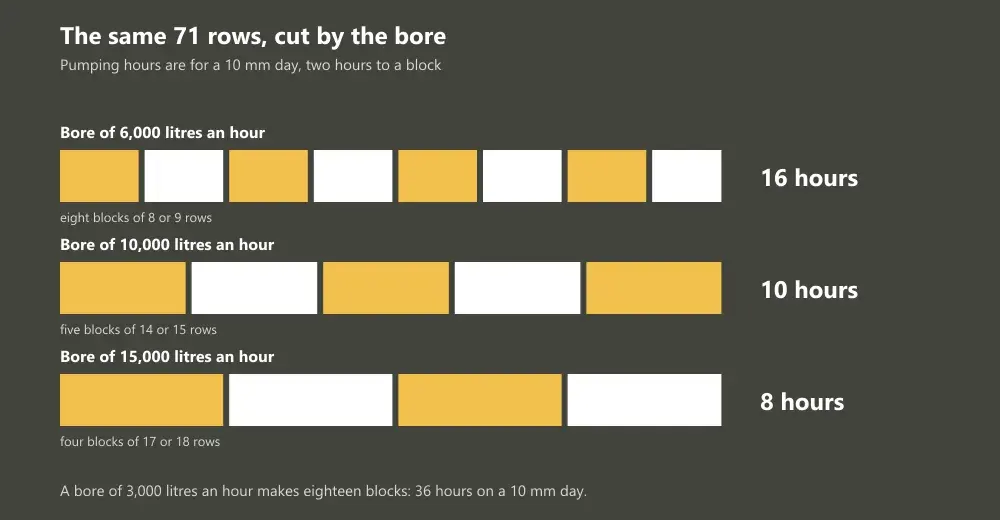
One 63 metre lateral draws about 630 litres an hour. A bore that yields 10,000 litres an hour can open fifteen at a time, so the 71 rows become five blocks. At 6,000 litres it is nine rows and eight blocks, and at 15,000 it is twenty-three rows and four blocks.
There are two ways to make a block. One is a small tap at each row's takeoff, turned by hand, fifteen at a time; the single hose along the head then serves. The other is a valve for each block, and that needs a second pipe: a main from the pump, with the hose along the head cut into one closed length for each block. On five blocks the main is about 100 metres more hose, run beside the head as far as the last block.
The bill below is for the single hose. The borewell guide explains why blocks are settled before the pipe is laid.
Drip irrigation layout for two acres of banana: pump hours
Each lateral waters a strip 1.8 metres wide at about 5.6 mm an hour. A block therefore runs about 40 minutes on a mild day, about an hour and 35 minutes at 8 mm, and two hours at 10 mm.
If you can pump about ten hours on the hottest days, two acres of banana want a bore near 10,000 litres an hour. On the one acre sheet a bore of 3,000 needs five hours in a mild month; two acres would ask the same bore for over twelve. Banana has no slack month in which to catch up, so measure the bore's yield and the hours your supply allows before choosing between one acre and two.
Banana at full cover uses 3.5 to 10 mm of water a day. On two acres that is about 28,000 to 81,000 litres at the roots, and 31,500 to 90,000 from the pump under drip. The water requirement calculator gives it for any acreage. The top of the range is a May figure for the driest districts; the one acre sheet puts a coastal acre's hottest month nearer 8 mm.
- Bore of 15,000 litres an hour: four blocks, 8 hours at 10 mm.
- Bore of 10,000: five blocks, 10 hours at 10 mm and 8 at 8 mm.
- Bore of 6,000: eight blocks, 16 hours at 10 mm and 13 at 8 mm.
- Bore of 3,000: eighteen blocks of four rows, over 12 hours even on a mild day.
The bill of materials
Prices are MRP with tax inside. The three small fittings are ₹6 a piece and sold in a minimum of 100.
That is about ₹20,530 an acre. One acre counted the same way is ₹22,788, so the second acre adds ₹18,270: the valve and the connector are bought once, and a hundred of each fitting covers 71 rows as it covers 35. The published one acre sheet reaches ₹22,188 before joiners.
Row spacing moves the bill most. At 1.5 metres the field has 85 rows and takes twelve coils, ₹47,790 in all. At 2.1 metres it has 60 rows and takes nine, ₹37,692. The system estimator will not match these line for line: it prices round inline pipe on a square field, and in round pipe at ₹4,482 a coil this layout is ₹52,218.
- Ten 500 m coils of 0.4 mm lateral at ₹3,366: ₹33,660.
- 100 [takeoffs](/products/poly-takeup-virgin-16-mm), for 71 rows, at ₹6: ₹600.
- 100 [end caps](/products/poly-end-cap-virgin-16-mm), for 71 row ends, at ₹6: ₹600.
- 100 joiners, for the joined row and for mends, at ₹6: ₹600.
- One 150 m coil of 3 inch LDPE hose, for the 128 m head and the run to the pump: ₹3,600.
- One 2 inch [non-return valve](/products/socketed-nrv-ball-type-ci-2): ₹1,440.
- One 2 inch connector from steel to plastic: ₹558.
- Total: ₹41,058.
What is not on the bill
- The filter. A crop this long cannot do without one, and we do not stock filters.
- The row taps or block valves, and the tees for them. We stock none of these.
- A second coil of hose if the blocks are valved: 120 metres is ₹2,880.
- The join from the 2 inch pump line to the 3 inch hose, and its clamp. We list no reducer, so settle that join with us before the hose ships.
- The bends, nipples and solvent cement at the pump stand. [The pump-to-lateral guide](/blog/fittings-pump-to-first-lateral) prices that chain part by part.
- The pump, the labour and the freight.
Before ordering
Walk the head of the field and count the rows, because a field that is not 128 by 63 changes the number of laterals and the length of hose. The banana crop page has the crop's side.
The water figures are ranges worked from FAO-56 crop coefficients for a full canopy, not a measurement of your field, and this sheet counts parts; it is not a pressure design. To have it checked against your own field, send us the two sides, the row spacing and the bore's yield. The lateral and fittings are on the drip range, and the hose is on the LDPE range.
Where these numbers come from
- FAO Irrigation and Drainage Paper 56 (opens in a new tab)
The reference method for crop evapotranspiration and crop coefficients that daily water figures derive from.
- ICAR (opens in a new tab)
Indian Council of Agricultural Research — crop agronomy and regional package-of-practices.
- TNAU Agritech Portal (opens in a new tab)
Crop-wise spacing, water requirement and drip layout references for southern India.
Keep reading
Drip irrigation layout for two acres of cotton: 142 rows
A drip irrigation layout for two acres of cotton at 90 cm rows: 142 laterals of 63 m, twenty coils, one hose along the head, and blocks the bore can run.
GuidesDrip irrigation layout for one acre of cotton at 90 cm rows
A drip irrigation layout for one acre of cotton at 90 cm rows, counted: 71 laterals, nine coils, the head, the blocks your bore can run, and a bill of ₹35,919.
GuidesDrip irrigation layout for one acre of garden and orchard
A drip irrigation layout for one acre of garden and orchard at 4 m: 16 rows, about 1,000 m of plain lateral and four drippers a tree. Parts ₹28,053 at MRP.