Drip irrigation layout for one acre of garden and orchard
A drip irrigation layout for one acre of garden and orchard at 4 m: 16 rows, about 1,000 m of plain lateral and four drippers a tree. Parts ₹28,053 at MRP.
20 November 2026 · 4 min read · REDYPLAST
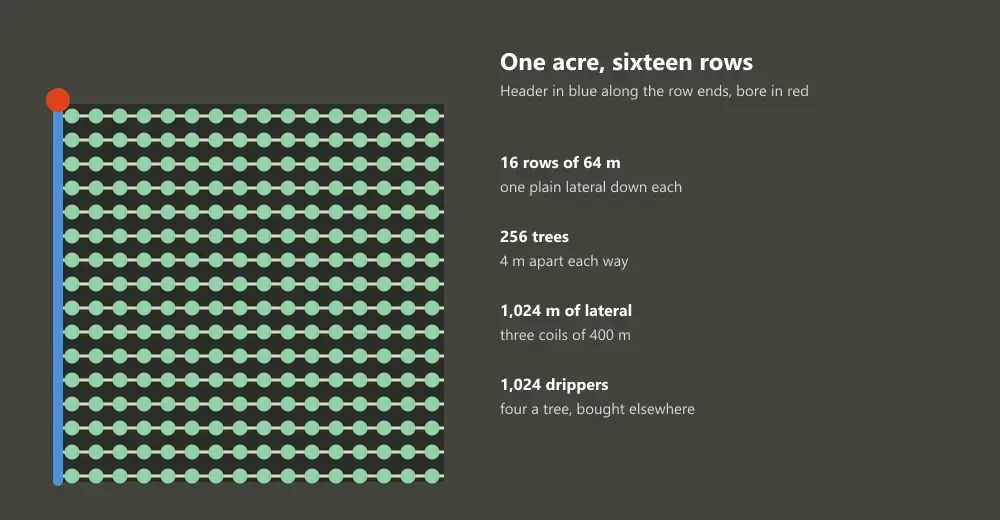
A drip irrigation layout for one acre of garden and orchard, with trees 4 metres apart each way, is 16 rows of 64 metres, one plain lateral down each row and four drippers at every tree. The parts we sell for it come to ₹28,053 at MRP, tax inside. The drippers are not among them.
This page works that layout as one sheet: the planting, the lateral and its drippers, what the pump has to do, the second lateral a mature orchard gets, and the bill. It counts parts and is not a pressure design.
Drip irrigation layout for one acre of garden and orchard: the planting
One lateral lies along each row, so the acre takes 1,024 metres of it. Other spacings change the count as follows.
Take a square acre, 64 metres by 63, with the bore at one corner. Trees stand 4 metres apart in rows 4 metres apart, the middle of the 3 to 5 metre range the garden and orchard crop page gives. Sixteen rows fit across the 63 metres and each runs the 64 metre way with sixteen trees on it: 256 trees.
- Rows 3 metres apart: 21 rows, 1,344 metres.
- Rows 4 metres apart: 16 rows, 1,024 metres.
- Rows 5 metres apart: 13 rows, 832 metres.
The lateral, and drippers that are not ours
The site's plan for this crop is four drippers a tree, 1,024 for the acre. We do not sell them, or the punch that seats them; both come from a drip dealer. Budget them before ordering the pipe.
Under trees the water belongs at the trunk and not in the gap between trunks. The orchard drip guide makes that case, and notes that Telangana's micro-irrigation scheme specifies this pattern for orchards: a plain lateral, with drippers placed at each tree.
The pipe is the plain online lateral, 16 mm, with no drippers built in, sold as 400 metre coils at ₹7,200. A coil cuts into six lengths of 64 metres, so three coils make eighteen lengths, two more than the rows need.
There is a cheaper line. The round inline pipe has a 4 litre dripper every 40 cm, and four 300 metre coils at ₹2,689 cover the same rows for ₹10,756. It waters the whole row, gaps included, and its drippers cannot be moved outward as the trees grow.
What the pump has to do
The drippers decide how fast it goes in. Online drippers come in several flow rates; this sheet uses 4 litres an hour, the rate of our inline pipe's dripper, so check the rate on the part you buy. Four 4 litre drippers give a tree 16 litres an hour, and all 256 trees together draw about 4,100 litres an hour, so a bore of 5,000 runs the acre as one block.
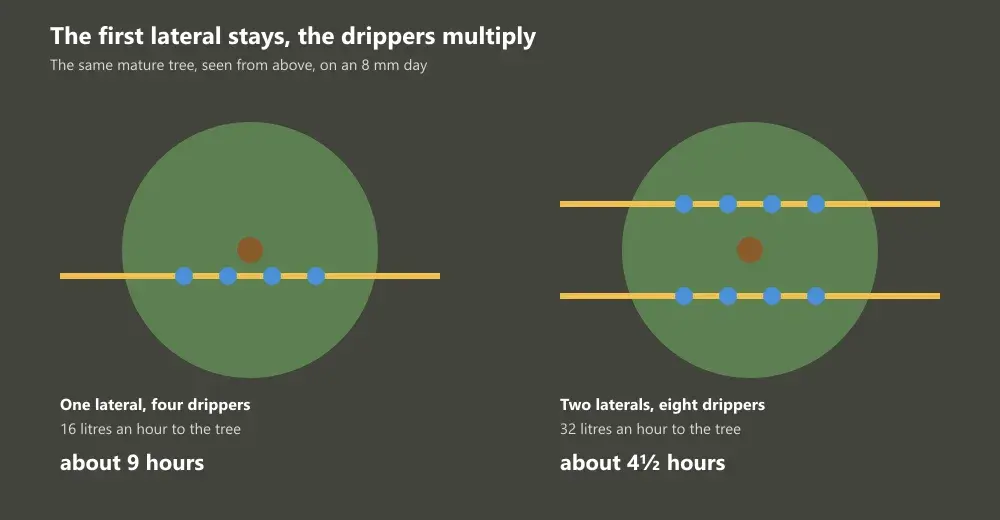
At that rate the hottest day is a long one. A tree that fills its 4 metre square needs about 142 litres from the pump on an 8 mm day, which is nearly nine hours on 16 litres an hour. A mild day is under three. That arithmetic is ours, from the range above, and it is the ceiling for a mature tree on the hottest day. A young tree needs a fraction of it.
A mature orchard with a closed canopy uses about 2.5 mm of water a day in a cool month and up to about 8 mm in the hottest. On an acre that is about 10,000 to 32,000 litres at the roots, and 11,000 to 36,000 from the pump once drip's losses are counted. The water requirement calculator gives the figure for your acreage. A young planting uses far less.
Built for the canopy: the second lateral
The crop page puts it in one line: build for the mature canopy, not the sapling. The orchard drip guide gives the scheme's own step. Orchards over eight years old move from one lateral and four drippers a tree to two laterals and eight.
On this acre that is three more coils, ₹21,600, and 1,024 more drippers. Drippers of 8 litres on the one lateral would double the flow too; the second lateral is the step the scheme takes. Eight 4 litre drippers give a tree 32 litres an hour, so the hottest day comes down to about four and a half hours. The acre then draws about 8,200 litres an hour. A bore of 5,000 runs it as two blocks of eight rows, and the pump's day is no shorter for it.
So check the bore against the orchard you are growing toward, and remember that the drippers set the pace. On four a tree, the hottest day's 36,000 litres takes about nine hours on any bore above 4,100 litres an hour. A bore of 3,000 cannot open the whole acre at once and needs twelve hours or more. Only eight drippers a tree on a bore near 10,000 bring the day down to about four and a half.
The header is laid once
Laterals extend row by row; the header does not. The conversion guide is firm that it is sized for the finished orchard on the day it is trenched, even if the last rows are years away, and that each planting year's rows get a valve of their own, because trees of different ages cannot share a run time.
This sheet prices a 3 inch LDPE hose along the 63 metre row ends. Whether that is large enough for your pump and your full planting map is a sizing question; the sizing guide covers it.
The bill for the parts we sell
Prices are MRP and include tax. The ₹6 fittings have a minimum order of 100 pieces, far more than sixteen rows use, and the spares serve every later row and repair.
The mature orchard's second lateral brings it to ₹49,653. In round inline pipe the first bill is ₹17,209. The system estimator shows ₹23,400 for this acre, because it counts the lateral and the three fittings and leaves out the hose, the valve and the connector. Its 1,012 metres is the acre's exact area without rounding to whole rows; both counts need three coils.
- Plain online lateral, 400 m coils: 3 at ₹7,200, ₹21,600.
- [Takeoffs](/products/poly-takeup-virgin-16-mm), 16 mm: the minimum 100, ₹600.
- [End caps](/products/poly-end-cap-virgin-16-mm), 16 mm: the minimum 100, ₹600.
- Joiners, 16 mm: the minimum 100, ₹600.
- [LDPE hose](/products/ldpe-lapeta-hose-pipe-3-15-kg), 3 inch, one 90 m coil for the header and the run to the pump: ₹2,160.
- Non-return valve, 2 inch: ₹1,440.
- [Steel connector](/products/ss-hdpe-connector-3), 3 inch, joining the hose to the delivery: ₹1,053.
- Total: ₹28,053.
Outside the total
The largest item is the drippers: 1,024 to start and as many again at maturity. After them come the filter, which a line hidden under mulch cannot do without, and a valve for each planting year, with one more for each block if the bore needs two. We stock none of the three.
The rest is the pump-side steel, the trenching, the labour and the freight. If feeding through the line is planned, the venturi or dosing unit is also bought elsewhere.
Before the order
Draw the planting map to its last row, and measure the tree and row spacing you will plant, since 3 metres against 5 is a difference of eight rows. The water range is worked from published crop coefficients for mature fruit trees and is not a reading from your orchard.
Send us the map, the spacing, the acreage and what the bore gives and we will count the coils and name the header for the finished planting. The lateral and fittings are on the drip range.
Where these numbers come from
- FAO Irrigation and Drainage Paper 56 (opens in a new tab)
The reference method for crop evapotranspiration and crop coefficients that daily water figures derive from.
- ICAR (opens in a new tab)
Indian Council of Agricultural Research — crop agronomy and regional package-of-practices.
- Telangana Horticulture Department (opens in a new tab)
State subsidy administration and the district offices that process micro-irrigation applications.
Keep reading
Drip irrigation layout for one acre of sugarcane, worked
A drip irrigation layout for one acre of sugarcane at 1.2 metre rows, counted: 53 laterals, seven coils, the head, the June pump hours and a bill of ₹36,963.
GuidesDrip irrigation layout for one acre of cotton at 90 cm rows
A drip irrigation layout for one acre of cotton at 90 cm rows, counted: 71 laterals, nine coils, the head, the blocks your bore can run, and a bill of ₹35,919.
GuidesDrip irrigation layout for two acres of cotton: 142 rows
A drip irrigation layout for two acres of cotton at 90 cm rows: 142 laterals of 63 m, twenty coils, one hose along the head, and blocks the bore can run.