LDPE pipe for banana: 3 or 4 inch, which wall, how many kilos
LDPE pipe for banana is the hose from the bore to the block. Which bore, which wall for a crop that stands over a year, and how to turn kilos into metres.
28 November 2026 · 4 min read · REDYPLAST
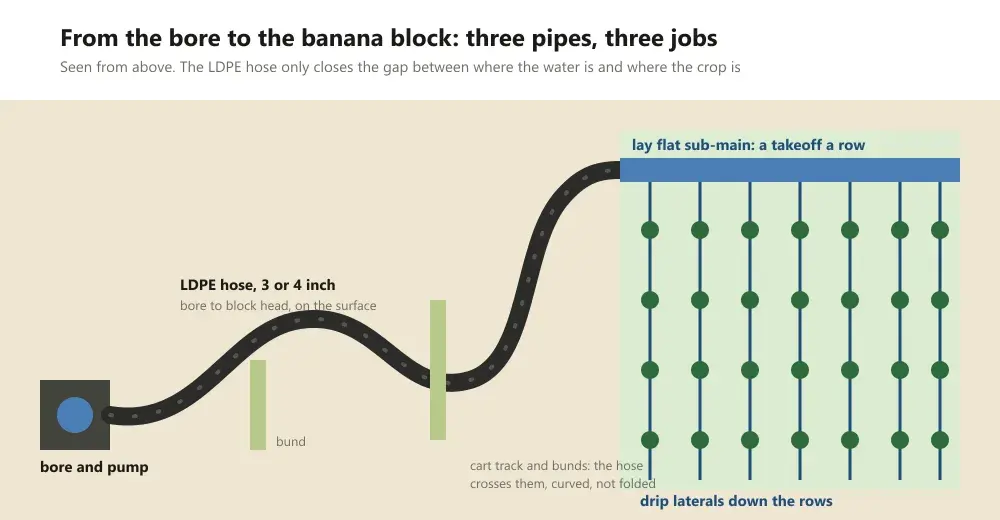
LDPE pipe for banana does one job: it is the flat hose that carries water from the bore to the head of the block, across the bunds and the cart track, without a trench. We list it in 3 inch and 4 inch, in three grades and two wall thicknesses, and it is sold by the weight of the coil, which is where most buying mistakes start.
The short answer on LDPE pipe for banana is a 3 inch hose for most bores, the 0.60 mm wall for a line that will be walked or driven over, and a length worked out in metres before anyone quotes in kilos. This page covers the job, the bore, the wall and the two mistakes buyers repeat.
LDPE pipe for banana: the job it does in a block
A banana block sits where the soil is good, and the bore sits where the water was found, and the two are often a hundred or two hundred metres apart. The LDPE hose closes that gap. It rolls out along the ground, takes the pump's delivery, and ends at the head of the block, where it feeds the basins of a flooded garden or hands over to the sub-main of a drip one.
It is also the pipe for the jobs between: the soak before planting, the rescue watering when a drip line is down for repair, and moving water to a second block from the same bore. What it is not is a sub-main with a takeoff at every row, which is what the lay flat tube is for, or a lateral; the banana drip guide covers those.
- From bore to block head: LDPE hose, on the surface, rolled up when the garden is renewed.
- Along the head of the block, with a takeoff a row: lay flat tube.
- Down the rows: drip lateral.
3 inch or 4 inch
Both sizes on the LDPE range are listed for 2 to 4 kg/cm², so the choice is about flow and distance, not strength. As a working rule the 3 inch suits the bores most banana blocks run on, and the 4 inch earns its price on a bigger pump or a run long enough that the 3 inch leaves too little pressure at the far end.
The bore changes what a coil reaches. A 15 kg coil of 3 inch is 90 metres; the same 15 kg in 4 inch is 65 metres, because there is more plastic in every metre. A grower who moves up a size and orders the same kilos comes up about a quarter short at the block.
Which wall, and what a metre costs
Three grades are listed in 3 inch, in two wall thicknesses, and banana changes which one is right. This is a crop that stands well over a year and then ratoons, with bunch carriers, propping poles and a cart crossing the supply line for much of that time. Where the hose is crossed like that, take the thicker wall.
The double layer is about ₹4 a metre more than the standard. Its listing says it is double-colour yellow, for visibility, and does not say what else it adds over the standard 0.60 mm, so ask before paying for it.
The standard hose has a 0.60 mm wall: a 10 kg coil is 60 metres at ₹1,440, which is ₹24 a metre. The double layer, also 0.60 mm, gives 70 metres in 10 kg at ₹1,980, about ₹28 a metre. The premium black has a 0.30 mm wall: 90 metres in 10 kg at ₹1,980, which is ₹22 a metre, the cheapest to lay and the lightest to carry.
So the thin wall is the cheaper metre, and for a hose laid once on a clear bund and lifted at the end of the crop it is the sensible buy. The listing calls the range hose for temporary use, so plan to lift it, not leave it. For a line that is shifted, dragged or rolled up between waterings, or that feet and wheels cross, the 0.60 mm wall is what the crop's calendar asks for. The weight-to-length guide works the same arithmetic across the whole range.
The two mistakes buyers repeat
The first is buying kilos. A dealer quotes fifteen or twenty kilo and a rate per kilo, the grower orders by habit, and the hose stops short of the block or runs long by a coil.
Kilos become metres only when the bore and the wall are known: about 6 metres a kilo for the 3 inch standard, about 9 for the 3 inch thin wall, a little over 4 for the 4 inch standard. Ask for the wall thickness with every quote, and compare quotes in rupees a metre.
The second is the thin wall in the wrong place. A 0.30 mm hose dragged across stubble and stones to a different block every week, or left for a season where the cart turns, splits along its folds, and a banana garden cannot wait while a supply line is patched in May. The same hose laid once along a clear bund and lifted at the end of the crop is what the thin wall is for.
Two habits shorten any wall. Running the pump against a closed or kinked far end takes the hose past its listed pressure, and it is the bund corners, where the hose folds, that go first; open the far end before the pump starts and lay the corners in a curve. And a hose left full in the sun between waterings ages faster than one drained and shaded.
- Quote in kilos, plan in metres: ask the wall, then convert.
- Up a bore size, same kilos: about a quarter short.
- Thin wall for a line laid once and kept clear; 0.60 mm where it is shifted, walked or driven over.
- Open the far end first, curve the corners, drain it after.
Buying it for your block
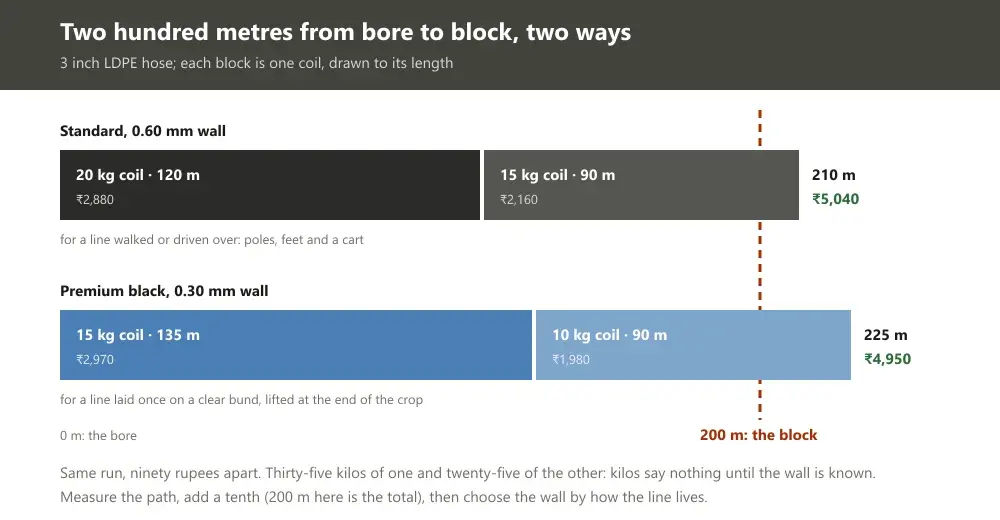
Measure the run from the bore to the head of the block along the path the hose will take, round the bunds and not through them, and add a tenth. The 200 metre run below is already that total, which is a 180 metre measured path.
For a 200 metre run in 3 inch standard, a 20 kg coil of 120 metres and a 15 kg coil of 90 make 210 metres for ₹5,040; in thin-wall premium black, a 15 kg coil of 135 metres and a 10 kg of 90 make 225 metres for ₹4,950. The ninety rupees between them buys the wall that suits a line under traffic.
The system estimator sizes the drip side of the block, and the banana crop page sets out what the crop asks of it. The sizing rule for 3 against 4 inch here is a working rule, not a pressure calculation for your pump, so for a long run or a large pump send us the distance, the pump and the block's size and we will say which bore and how many coils.
Keep reading
Lay flat tube for cotton: width, rolls and the holes you punch
A lay flat tube for cotton is the sub-main you roll out at sowing and lift after the last picking. Which width, how 60 metre rolls fit, and two mistakes.
GuidesDrip irrigation layout for two acres of banana: 71 rows
A drip irrigation layout for two acres of banana: 71 rows at 1.8 m, ten coils of lateral, one hose along the head, and the bore yield that sets the blocks.
GuidesDrip emitter spacing for banana on laterite soil, pit and lines
Drip emitter spacing for banana on laterite soil is two lines on a mound, over a pit that must not reach the pan. The pit as a bucket, the runs in May.