Drip emitter spacing for pomegranate on alluvial soil, by ridge
Drip emitter spacing for pomegranate on alluvial soil is four to six columns on a raised ridge, run on alternate days. The ridge, and the river's bahar.
20 November 2026 · 4 min read · REDYPLAST
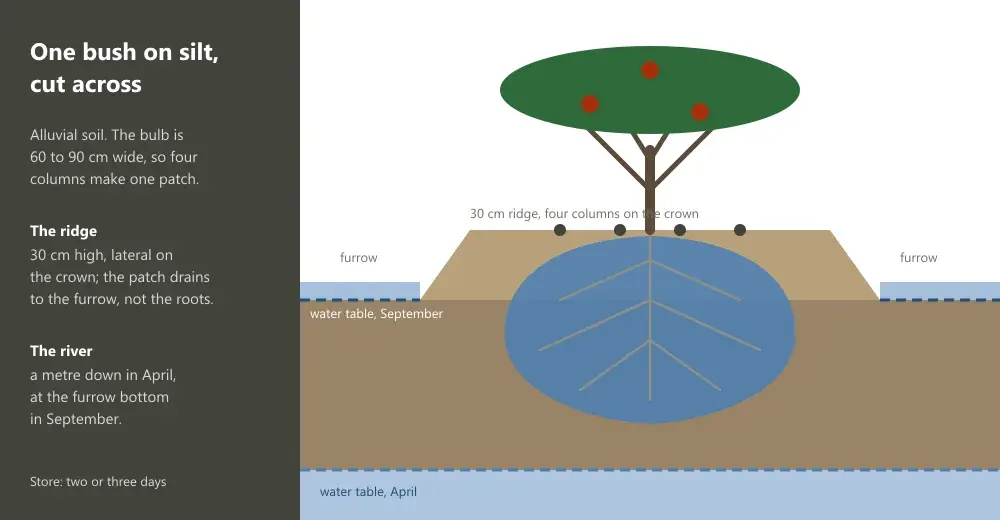
Drip emitter spacing for pomegranate on alluvial soil is the easiest count in this series and the hardest soil to grow the crop on: the bulb under a 4 litre dripper spreads 60 to 90 cm across on river silt, so four columns merge into one patch under a bearing bush, and the same silt sits over a water table that pomegranate roots cannot survive.
So drip emitter spacing for pomegranate on alluvial soil is four to six columns on a ridge raised a foot above the field, run every second day outside the heat, and a bahar chosen for the months the river is lowest.
Pomegranate on alluvial ground is a minority planting, on the levees and high patches of the Krishna and Godavari districts; it works on the high ground and fails on the low. This guide covers the bulb, the ridge, the hours between runs, and the bahar the river allows.
The wide bulb, and the water under it
Alluvial soil is deep, stone-free and medium in texture, and water from a dripper moves out as readily as down; the bulb is 60 to 90 cm across and the root zone holds two or three days of crop water once it is full. Columns 60 cm apart merge, and four of them under a canopy make one wet patch rather than four wet spots.
The hazard is below. The river under a delta field sits a metre down in April and at the furrow bottom in September, and pomegranate, which feeds from the top half metre and rots in soil that stays saturated for a week, loses whole bushes to wilt and collar rot on the low ground after every long monsoon. The pomegranate crop page covers the crop on any soil; on this one the water comes up to meet the roots.
- Bulb: 60 to 90 cm across, so four columns merge into one patch under a bearing bush.
- Store: two or three days in the root zone; alternate-day runs are honest outside the heat.
- Drainage: good on the levee, slow in the low patches and through the monsoon.
- The risk: saturated roots, wilt and rot, from water the bush cannot shed.
Drip emitter spacing for pomegranate on alluvial soil, on the ridge
Every bush on this soil stands on a ridge raised 30 cm, built along the row before planting, with the lateral on its crown; the ridge is not a refinement but the condition for growing the crop at all on silt.
The count by age is the smallest of any soil: two columns 30 cm from the stem for a sapling, four at 50 to 70 cm by the third year, and four to six in a ring at 60 to 90 cm on a bearing bush, six only in the hottest weeks of a dry year.
A dripper between bushes is unnecessary here: the bulbs under the ring already reach the roots between.
Rows run at 3 to 4.5 metres and the lateral runs with them, 16 mm from the drip range, as a plain online lateral with drippers bought elsewhere where each column should stand, or as a loop of the 40 cm inline pipe round each bush, which gives a tighter ring in which the columns merge. We do not sell the drippers.
The orchard drip guide leans to the online pattern for plantings that grow for decades; the emitters it takes are not ours to sell.
The hours and the days between
Six columns give 24 litres an hour, so the hottest day is about three hours of running, given daily and in one piece, because the silt holds all of it. In the mild months the store sets the days: 60 litres every second day on four columns is a little under four hours, and the bush feels no dry afternoon between.
What the schedule must never do here is run daily through the mild months as well. A bush given its full ration every day on silt that still holds two days of it stands in a saturated patch within a fortnight, and on the low ground that is the water table lifted into the roots and the wilt that follows a month later.
Pomegranate at full cover uses 2.5 to 6 mm a day across the year, which on one acre is roughly 10,000 to 24,000 litres at the root, or about 11,000 to 27,000 litres from the pump once drip's losses are allowed for; the water requirement calculator gives the figure for your own acreage. Per bush at 3.75 by 3 metres that is about 30 litres a day from the pump in a mild month and 75 in the hottest weeks.
Which bahar the river allows
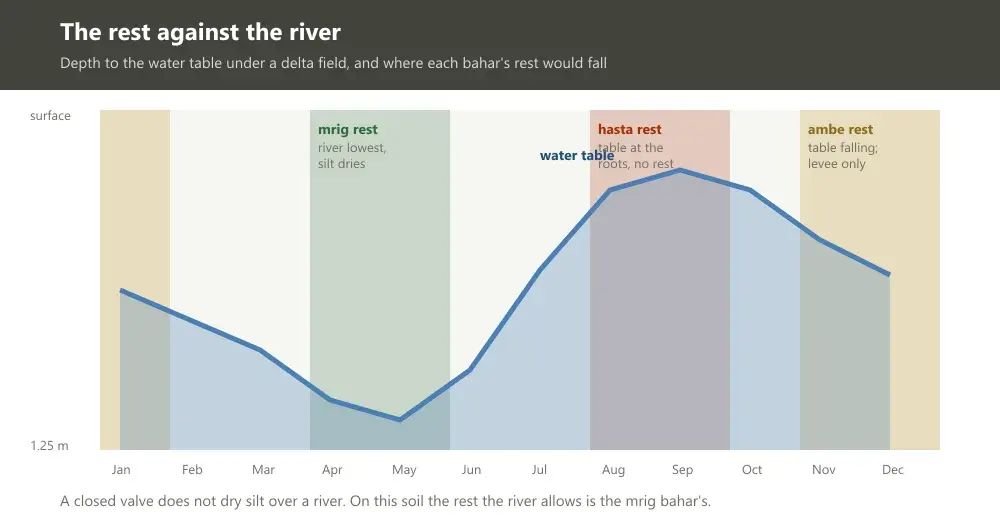
Pomegranate is cropped by resting the orchard dry for four to six weeks and then bringing water back to force one flowering, and on silt over a river the rest is the problem, not the restart. Soil that holds three days of water and sits a metre above the table does not dry on command; it dries when the river lets it, which on a delta field is April and May.
That settles the bahar. The mrig bahar rests the bush in April and May and flowers it with the first rain, and its rest falls in the only months the silt will dry.
The hasta bahar's rest falls in August and September, when the furrows are full and the table is at the roots, and no closed valve dries that field; the ambe bahar's rest in November and December asks the low ground to dry while the table is still falling, and the levee may manage it where the low patches cannot. The pomegranate conversion guide prices the block valves as items from elsewhere; here they separate the levee from the low ground.
A closed column on silt shows late, because the patch carries the bush for days; the blocked-line guide covers flushing, and the filter it depends on is not ours to sell.
- A full daily ration in the mild months: a saturated patch in a fortnight, wilt a month later.
- A hasta bahar on silt: a rest the river refuses, flowering that never synchronises.
- A bush on the flat instead of a ridge: collar rot after the first long monsoon.
- The check: a trowel a hand deep under the canopy edge the morning after a run, damp and crumbling, never glistening.
The figures are a starting point
Only the 2.5 to 6 mm a day is a published range. The bulb widths and the days the root zone holds are working rules, to be checked with the trowel test above, and none of them is a reading from your orchard.
One delta village holds sandy levee soil and heavy backswamp inside its boundary; on the sandy end the days move closer to daily, on the heavy end the ridge and the rest decide everything. Treat four hours every second day on four columns as the mild-month schedule for a bearing bush and let the trowel move it.
The same crop on soils that drain is worked in the red-loam pomegranate guide and the sandy-loam pomegranate guide, and the same silt under a row crop in the alluvial chilli guide. For the ridge, the count and the bahar sized to your field, send us the bush spacing, the planting year, the acreage and whether the field floods and we will say how many columns each bush needs and which bahar the ground will rest for.
Where these numbers come from
- FAO Irrigation and Drainage Paper 56 (opens in a new tab)
The reference method for crop evapotranspiration and crop coefficients that daily water figures derive from.
- ICAR (opens in a new tab)
Indian Council of Agricultural Research — crop agronomy and regional package-of-practices.
- TNAU Agritech Portal (opens in a new tab)
Crop-wise spacing, water requirement and drip layout references for southern India.
Keep reading
Drip emitter spacing for pomegranate on sandy loam, in short runs
Drip emitter spacing for pomegranate on sandy loam is a ring of narrow columns that empty by evening. The ring per bush, the short runs, fertigation on sand.
GuidesDrip emitter spacing for pomegranate on red loam, per bush
Drip emitter spacing for pomegranate on red loam is counted per bush, since each dripper wets its own column. The count by age, the hours a day, and the bahar.
GuidesDrip emitter spacing for vegetables on alluvial soil, by bed
Drip emitter spacing for vegetables on alluvial soil puts a pair of rows on one tape and a bed above the water. The pair, the rhythm by crop, the wet-feet rule.