Drip irrigation layout for one acre of pomegranate: 294 bushes
A drip irrigation layout for one acre of pomegranate at 4.5 by 3 metres is 294 bushes, two laterals a row and four drippers a bush. The pipe is ₹42,453 at MRP.
26 November 2026 · 4 min read · REDYPLAST
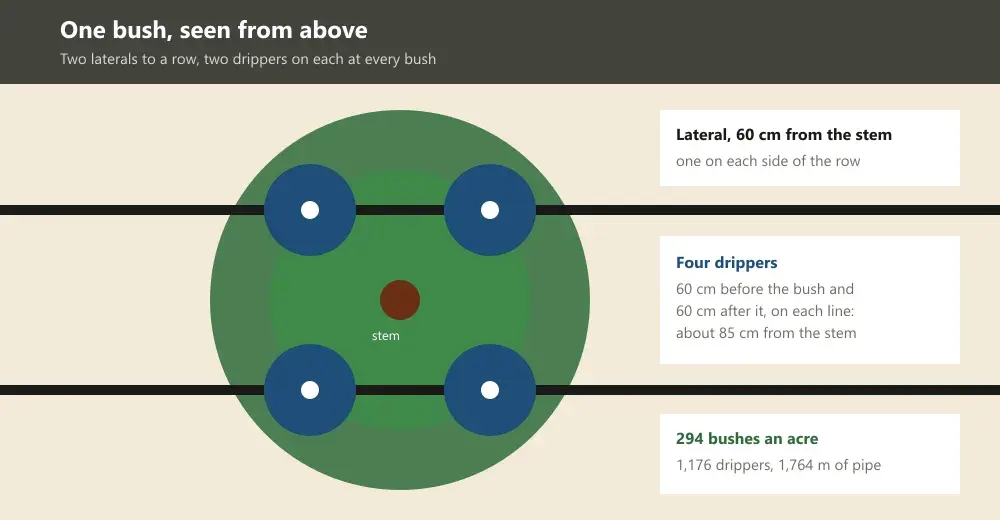
A drip irrigation layout for one acre of pomegranate is a short piece of arithmetic, because the bushes stand far apart: fourteen rows, 294 bushes, 1,764 metres of lateral and 1,176 drippers. The pipe and fittings we sell for it come to ₹42,453 at MRP, and a young orchard can start on ₹28,053 of that.
This page works one concrete drip irrigation layout for one acre of pomegranate from the planting distance to the pump's hours and the bill. It is a counting plan, not a pressure design, and it says where the parts are not ours.
A drip irrigation layout for one acre of pomegranate, on paper
Take an acre 64 metres by 63 and the planting most orchards here use, 4.5 metres between rows and 3 metres between bushes. Fourteen rows fit across the 64 metres, each running the 63 metre length with 21 bushes on it. That is 294 bushes, close to the 300 an exact acre holds.
Closer plantings exist, down to 3 metre rows, and the method below is the same for them: count the rows, multiply by the row length, and the pipe follows. The pomegranate crop page gives the range.
Two laterals to a row
ICAR's pomegranate centre puts four drippers round each bush, one on each side. A single lateral down the row holds all four in one line, which wets along the row and leaves the two sides to the soil. To put water on both sides with plain parts, this sheet lays a lateral on each side of the row, 60 cm out from the stems, with a dripper 60 cm before each bush and 60 cm after it.
The four drippers then sit at the corners of a square, each about 85 cm from the stem, under the canopy edge of a bearing bush. How far each wet patch spreads from there is the soil's business; the red loam spacing guide shows the test.
The lateral is the plain online pipe, which has no drippers built in. Each dripper is pushed in by hand where the bush needs it, and can be moved outward as the bush grows. We do not sell the drippers or the punch that seats them; both come from a drip dealer, and the drippers are made in 4 or 8 litres an hour.
The system estimator plans pomegranate the simpler way, one lateral a row on an average 3.75 metre row, and so shows about 1,080 metres and three coils for an acre. That is the young-orchard layout priced further down. This sheet shows more pipe because it lays two.
- Rows: 14, each 63 m.
- Laterals: 28, two to a row, 1,764 m in all.
- Drippers: 4 a bush, 1,176 for the acre.
- Coils: five of 400 m, which cut 30 lengths of 63 m and leave two spare.
What the pump has to do
The dripper decides how fast that goes in. Four drippers of 4 litres an hour give a bush 16 litres an hour, so the hottest day is a little under six hours of running and a mild one about two and a half. Drippers of 8 litres halve both.
The same choice sets what the acre draws. On 4 litre drippers all 1,176 together take 4,704 litres an hour, so a bore of 5,000 litres runs the whole acre as one block. On 8 litre drippers the acre takes 9,408 litres an hour: one block for a bore of 10,000, two blocks of seven rows for a bore of 5,000. Choose the dripper so that a block's draw sits just under what the bore gives.
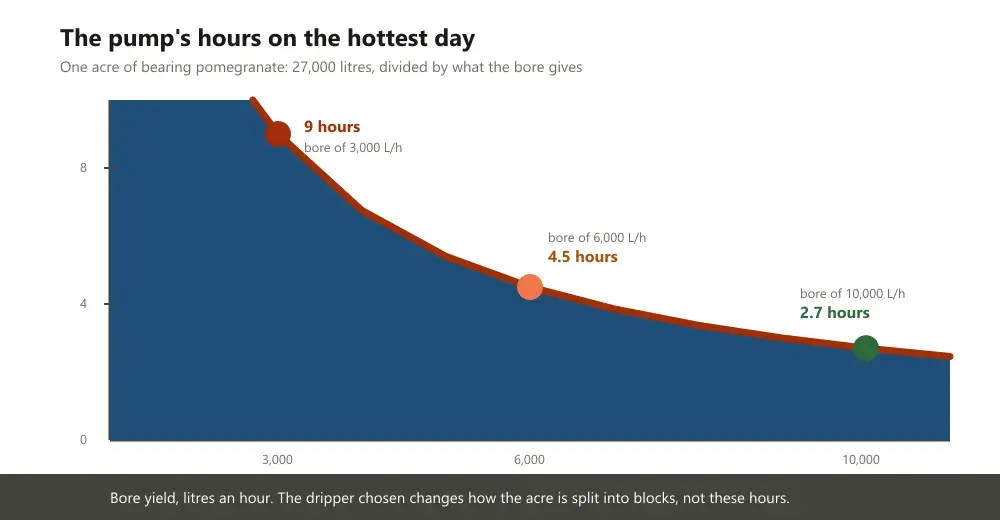
Whatever the dripper, the pump's day cannot be shorter than the litres divided by the yield. The hottest day's 27,000 litres is 2.7 hours from a bore of 10,000 litres an hour, four and a half from 6,000, and nine from 3,000.
A bearing pomegranate uses 2.5 to 6 mm of water a day through the year. On an acre that is about 10,000 to 24,000 litres at the roots, or 11,000 to 27,000 litres from the pump once drip's losses are allowed. Shared among 294 bushes it is about 38 litres a bush on a mild day and 92 in the hottest weeks. The water requirement calculator gives the figure for your own acreage.
Two blocks, even on a strong bore
The valves are not ours either. They cost little when the header is first laid and a good deal to add afterwards.
Pomegranate is cropped by resting the orchard dry and then bringing the water back to force a flowering. A system with one valve can only rest the whole acre. Split the fourteen rows into two blocks of seven, each with its own valve, and half the orchard can rest while the other half carries fruit. The pomegranate drip guide explains why that control is the reason to lay drip here at all.
The bill for the parts we sell
Prices are MRP with tax inside, each for one coil or one piece. The three small fittings are ₹6 a piece and are sold in a minimum of 100, so each of those lines is 100 pieces.
A sapling needs neither four drippers nor two laterals. Lay one lateral a row with two drippers a plant for the first two years, which is three coils and ₹28,053 with the same header and the same fittings. Add the second lateral when the bushes come into bearing: two more coils, ₹14,400, and nothing else, since the hundred takeoffs and end caps already bought cover all 28 laterals.
There is a cheaper pipe. Two laterals a row of the round inline pipe, with a 4 litre dripper built in every 40 cm, take four 500 m coils at ₹4,482, ₹17,928 in place of ₹36,000, and no drippers to buy. It waters the whole strip, the gaps between bushes included, draws 17,640 litres an hour for the acre, and its drippers cannot be moved as the bush grows.
- Five 400 m coils of online lateral at ₹7,200: ₹36,000.
- 100 [takeoffs](/products/poly-takeup-virgin-16-mm), for 28 laterals, at ₹6: ₹600.
- 100 end caps, for 28 lateral ends, at ₹6: ₹600.
- 100 joiners at ₹6, as spares: ₹600.
- One 90 m coil of [3 inch LDPE hose](/products/ldpe-lapeta-hose-pipe-3-15-kg) for the header: ₹2,160.
- One 2 inch non-return valve: ₹1,440.
- One 2 inch connector: ₹558.
- One tin of solvent cement: ₹495.
- The acre: ₹42,453.
What this sheet leaves out
Four things on a working pomegranate acre are not in the bill, because we do not stock them: the 1,176 drippers, the filter at the head, the two block valves, and a rigid header. The hose is priced because it is what we sell. On a planting meant to stand ten years, a buried PVC sub-main from a hardware shop is the better header, and the takeoffs go into that instead.
The water figures are published ranges for a full canopy, not a measurement of your orchard, and a young planting uses far less. The counts assume a square acre; a long narrow one has more rows, more takeoffs and the same metres of pipe.
If the orchard is coming off flood, the pomegranate conversion guide covers the first season. For this sheet worked on your own field, send us the row and bush spacing, the acreage and the bore's yield and we will count it with you. The laterals are on the drip range.
Where these numbers come from
- FAO Irrigation and Drainage Paper 56 (opens in a new tab)
The reference method for crop evapotranspiration and crop coefficients that daily water figures derive from.
- ICAR (opens in a new tab)
Indian Council of Agricultural Research — crop agronomy and regional package-of-practices.
Keep reading
Drip irrigation layout for one acre of sugarcane, worked
A drip irrigation layout for one acre of sugarcane at 1.2 metre rows, counted: 53 laterals, seven coils, the head, the June pump hours and a bill of ₹36,963.
GuidesDrip irrigation layout for one acre of cotton at 90 cm rows
A drip irrigation layout for one acre of cotton at 90 cm rows, counted: 71 laterals, nine coils, the head, the blocks your bore can run, and a bill of ₹35,919.
GuidesDrip irrigation layout for one acre of garden and orchard
A drip irrigation layout for one acre of garden and orchard at 4 m: 16 rows, about 1,000 m of plain lateral and four drippers a tree. Parts ₹28,053 at MRP.