Drip irrigation cost for two acres of chilli: ₹31,653
The drip irrigation cost for two acres of chilli is ₹31,653 at MRP for the parts we sell. The first acre is ₹18,333 of that and the second only ₹13,320.
24 November 2026 · 4 min read · REDYPLAST
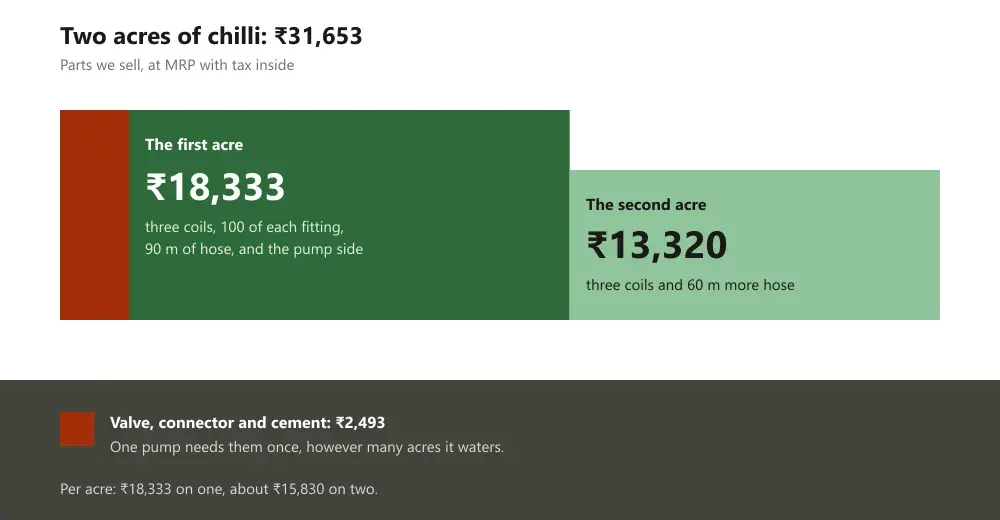
The drip irrigation cost for two acres of chilli is ₹31,653 at MRP for the pipe and fittings we sell, tax included. Six coils of tape make up ₹23,760 of it. The first acre accounts for ₹18,333 and the second for ₹13,320, because the parts at the pump and the row fittings are bought once.
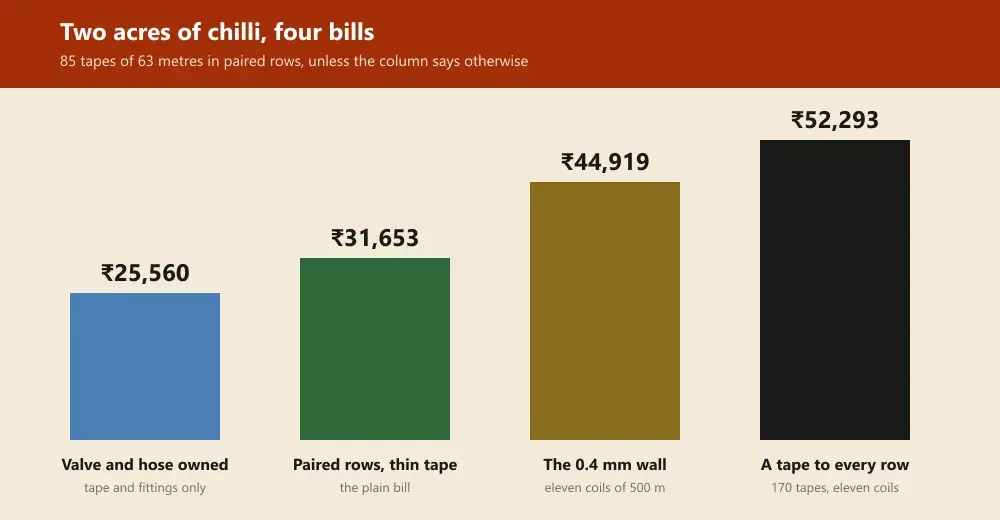
That is the drip irrigation cost for two acres of chilli planted in paired rows on thin tape. Plant single rows, or choose a heavier wall, and the same field costs up to ₹52,293. This page gives the bill, the three choices that move it, and what the bore has to manage before two acres is a sensible plan at all.
The field behind the figure
Two acres laid side by side make a field 128 metres by 63. Chilli is set in pairs, the two rows of a pair 60 cm apart and 90 cm between one pair and the next, with a single tape lying between the rows of each pair. That puts a tape every 1.5 metres: 85 tapes across the 128 metres, each 63 metres long, 5,355 metres in all.
The tape is the 0.2 mm flat lateral, a 4 litre dripper every 40 cm, in coils of 1,000 metres. Six coils leave 645 metres spare. The one acre chilli layout sets out the same planting on half the ground.
The system estimator will not match this bill line for line. It uses the same paired rows, but on a square field and in round inline pipe on 500 metre coils, where this page prices tape.
Drip irrigation cost for two acres of chilli, line by line
Prices are for one coil or one piece. The three small fittings are ₹6 a piece and are sold in a minimum of 100, so each of those lines is 100 pieces.
- Six 1,000 m coils of tape at ₹3,960: ₹23,760.
- 100 [takeoffs](/products/poly-takeup-virgin-16-mm), for 85 tapes, at ₹6: ₹600.
- 100 [end caps](/products/poly-end-cap-virgin-16-mm), for 85 tape ends, at ₹6: ₹600.
- 100 joiners at ₹6: ₹600.
- One 150 m coil of 3 inch LDPE hose, for the 128 m head of the field and the run to the pump: ₹3,600.
- One 2 inch [non-return valve](/products/socketed-nrv-ball-type-ci-2): ₹1,440.
- One 2 inch connector: ₹558.
- One 250 ml tin of solvent cement: ₹495.
- Total: ₹31,653.
What the second acre really costs
Counted the same way, one acre of this planting is ₹18,333: three coils, a hundred of each fitting, a 90 metre hose and the three parts at the pump. The published one acre sheet reaches ₹17,238 before joiners and cement, which are the difference. Going from one acre to two adds ₹13,320.
Two things are bought once. The valve, the connector and the cement, ₹2,493, serve one pump however much it waters. And a hundred takeoffs and a hundred end caps cover the 42 tapes of one acre and the 85 of two alike, so the second acre adds no fittings at all. What it does add is three coils and a longer hose. The bill for each acre falls from ₹18,333 to about ₹15,830.
That matters to a grower who is deciding between one acre this year and two. The dear part of a second acre is not the pipe. It is the water, and that is the next thing to check.
The three choices that move the total
Third is what already stands at the pump. A farm with a sound valve on the delivery and a hose that reaches the field buys only tape and row fittings: ₹25,560.
The row plan moves it most. Single rows 75 cm apart with a tape to each need 170 tapes and eleven coils, with the offcuts joined, and the bill becomes ₹52,293. Pairs halve the tape. They need the nursery and the transplanting gang to set out for them, and on a light soil the wetted strip should be checked against the pair's width first; the sandy-loam spacing guide for chilli shows how.
The wall is second. The 0.4 mm lateral is ₹3,366 for a 500 metre coil, so the paired field takes eleven coils, with the offcuts joined, and the bill rises to ₹44,919. Chilli is a long crop, in the ground from August into March, and the heavier wall is the one that can be lifted and laid again for a second year.
Can the bore carry two acres
One 63 metre tape draws 630 litres an hour, and the 85 together would want 53,500, so the field runs in blocks. A bore of 10,000 litres an hour opens fifteen tapes, six blocks in all. With tapes 1.5 metres apart a block needs about 35 minutes on a mild day and an hour on the hottest, so the hottest day is six hours of pumping.
Chilli at full cover uses 3.5 to 6 mm of water a day. On two acres that is 28,000 to 49,000 litres at the roots, and 31,500 to 54,000 from the pump under drip. The water requirement calculator gives it for any acreage.
A bore of 6,000 litres an hour opens nine tapes, ten blocks, and needs ten hours on that day. A bore of 3,000 would need twenty-two, which no supply gives. Two acres of chilli want a bore of about 6,000 litres an hour or better; below that, plant one acre and keep it watered through flowering. The borewell guide shows the sum.
What is not on this bill
Nor is next year on it. Tape that is flushed through the season, lifted with care after the last picking and stored in shade will lay a second crop. Tape that is torn up with the stalks will not, and replacing it is ₹23,760 again. The hose, the valve and the fittings carry over.
- The filter, which thin tape cannot do without. We do not stock filters.
- The valves for six or ten blocks. We do not stock those either.
- Mulch film, if the pairs go under it. The tape is laid before the film.
- The pump, the labour and the freight, which is quoted at checkout.
Before ordering
Walk the field and count the pairs, because a field that is not 128 by 63 changes the number of tapes and the length of hose. The chilli crop page has the crop's side.
The water figures are published ranges for a full canopy, and this sheet counts parts; it is not a pressure design. To have it checked against your own field, send us the two sides, the row plan and the bore's yield. The tape and fittings are on the drip range.
Where these numbers come from
- FAO Irrigation and Drainage Paper 56 (opens in a new tab)
The reference method for crop evapotranspiration and crop coefficients that daily water figures derive from.
- ICAR (opens in a new tab)
Indian Council of Agricultural Research — crop agronomy and regional package-of-practices.
Keep reading
Drip irrigation layout for two acres of banana: 71 rows
A drip irrigation layout for two acres of banana: 71 rows at 1.8 m, ten coils of lateral, one hose along the head, and the bore yield that sets the blocks.
GuidesDrip irrigation layout for two acres of cotton: 142 rows
A drip irrigation layout for two acres of cotton at 90 cm rows: 142 laterals of 63 m, twenty coils, one hose along the head, and blocks the bore can run.
GuidesDrip irrigation with iron-rich water for vegetables: tank first
Drip irrigation with iron-rich water for vegetables works when the iron comes out in a tank, not in the tape. The tank, the filter, the weekly flush, the tape.