Drip emitter spacing for pomegranate on laterite soil, by crust
Drip emitter spacing for pomegranate on laterite soil is a ring of eight columns over a crust that stores the dry months and floods the wet.
29 November 2026 · 4 min read · REDYPLAST
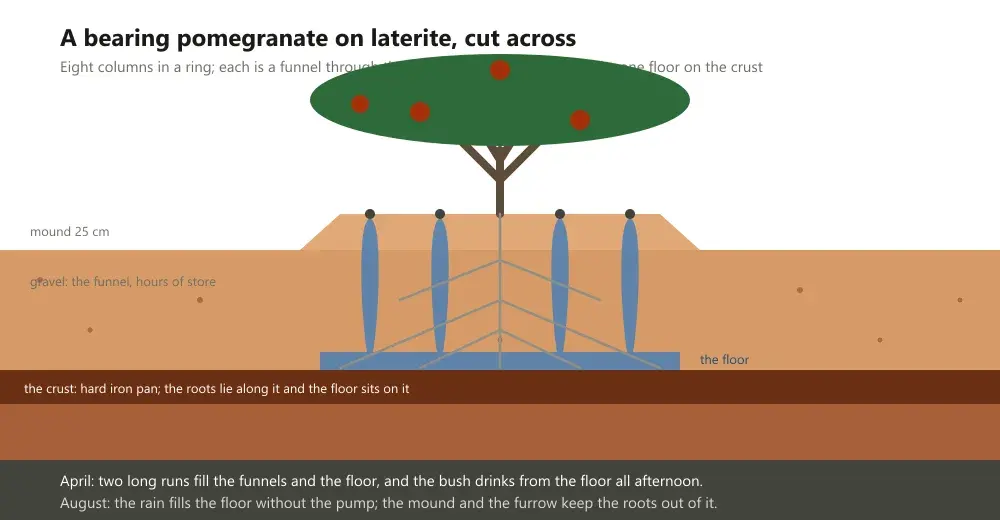
Drip emitter spacing for pomegranate on laterite soil is counted in columns round each bush, two at a sapling and eight under a bearing canopy, because the wet column under a 4 litre dripper on this gravel is 35 to 50 cm across and two of them 60 cm apart never meet in the gravel.
Where drip emitter spacing for pomegranate on laterite soil differs from the same count on red loam or sand is half a metre down: the columns all empty onto the iron crust, their saucers join into one floor under the bush, and a pomegranate's roots, which stop where the crust does, drink from that floor in the dry months and drown on it in the wet.
Pomegranate on laterite is a newer planting on the north-coast uplands and the gravel ridges of Vizianagaram. This guide covers the funnel and the floor, the ring by age, the hours in two seasons, and the bahar the crust allows.
The funnel and the floor
Laterite is leached red gravel over an iron crust at 40 to 80 cm. A dripper's column is a funnel here: it falls through the gravel in a quarter of an hour, keeps almost none of it, and spreads on the crust as a saucer. Under a ring of eight columns the saucers join into one wet floor the width of the canopy.
The floor is also the hazard. In the monsoon the crust holds the rain, the floors join across the orchard and a bush on the flat has its roots in standing water for weeks; wilt and collar rot follow.
A pomegranate's roots reach that floor. The bush feeds from the top half metre, which here ends at the crust, so the feeding roots lie along it and the floor is their store: a day or two of water in April where the gravel holds hours. The pomegranate drip guide calls steady water fruit-grade insurance; on this soil the floor is what makes the water steady between runs.
- Column: 35 to 50 cm across, through the gravel in minutes, a saucer on the crust beneath.
- The floor: the saucers joined under the ring, a day or two of store in the dry months.
- Monsoon: the crust holds the rain, so every bush stands on a mound and every row has a furrow cut to drain.
Drip emitter spacing for pomegranate on laterite soil, ring by age
The lateral runs along the row at the 3 to 4.5 metres pomegranate is planted, one line per row, laid on the crown of a mound 25 cm high at each bush. Two columns 30 cm from the stem carry a sapling; four at 50 to 60 cm by the third year; and a bearing bush takes eight in a ring at 60 to 90 cm from the stem, under the canopy edge.
The plain online lateral with emitters from elsewhere pushed in where each column should stand builds a ring that grows, or a loop of the 40 cm inline pipe round each mound, lengthened as the canopy widens. Both are 16 mm from the drip range; the emitters for the online pattern are not ours to sell.
The end caps sit at the headland, because laterite bores carry iron and iron closes a lateral from its far end; a flush every two weeks is our habit for iron water, not a published figure, and the blocked-line guide covers flushing.
The hours, in two seasons
Eight columns give 32 litres an hour, so the hottest day is about two and a quarter hours of running and a mild one about an hour. In the dry season those hours go in as two runs, each long enough to fill the gravel and put the rest on the floor.
In the monsoon the floor is already full. The pump runs only on the third dry day, for a short run that wets the gravel and no more. A sapling, with no floor worth the name, is watered in short daily runs all year.
Pomegranate at full cover uses 2.5 to 6 mm a day across the year, which on one acre is roughly 10,000 to 24,000 litres at the root, or about 11,000 to 27,000 litres from the pump once drip's losses are allowed for; the water requirement calculator gives the figure for your own acreage. Per bush at 3.75 by 3 metres that is about 30 litres a day from the pump in a mild month and 75 in the hottest weeks.
That is worked from 6 mm a day; the red-loam pomegranate guide gives 70 on its own basis.
The bahar the crust allows
Pomegranate is cropped by resting the orchard dry and then bringing the water back to force one flowering, and on laterite the rest is the easy part: close the valve and the gravel is dry in two days, the floor in a week.
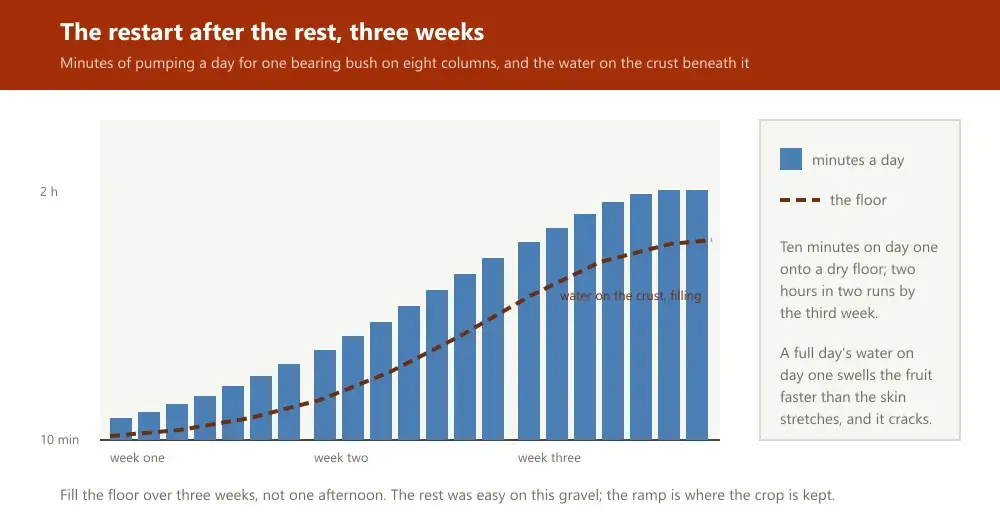
The restart is the hard part: a bush brought back from a dry floor with a full day's water on day one swells its fruit faster than the skin can stretch, and the first set cracks. So the restart is a ramp of short runs lengthening over three weeks, with a valve per block, from elsewhere, so a rested block and a bearing block never share a run.
The crust then chooses the bahar. Whatever the bush is carrying when the crust fills in August gets a fortnight of standing water after a dry July, and fruit near full size cracks across the orchard.
The mrig bahar, flowered in June, has fruit no bigger than a lime when the crust fills and finishes it on the dry floor of November; the hasta bahar's rest falls into the full crust and never dries; the ambe bahar, flowered in January, carries near-ripe fruit into the first rain.
On this soil the mrig bahar looks the one the crust allows, but that is our reading, not a rule; the agronomy of resting belongs to your horticulture officer. The pomegranate conversion guide prices the block valves as items from elsewhere.
- Two columns on a bearing bush: a floor the size of a bucket, small fruit, split skins after rain.
- A bush on the flat: roots in the joined floors through September, wilt in October.
- A full-day restart after the rest: cracked fruit in the first set.
- The check: a trowel pushed to the crust under the canopy edge the morning after a run; in April wet on the crust and moist above is right; in September wet to the top means the furrow is not draining.
The figures are a starting point
Only the 2.5 to 6 mm a day is a published range. The column width, the quarter of an hour through the gravel, the day or two of store on the crust and the bahar dates against the August crust are working rules to check in your own orchard with the trowel.
Treat two runs totalling two hours on eight columns as the April schedule for a bearing bush, and a short run on the third dry day as the August one, and let the trowel move both.
The same crop on soils with depth is worked in the red-loam pomegranate guide and the sandy-loam pomegranate guide, and the same crust under taller trees in the laterite orchard guide. For the ring, the ramp and the bahar sized to your orchard, send us the bush spacing, the planting year, the acreage and whether the field floods in August and we will say how many columns each bush needs now.
Where these numbers come from
- FAO Irrigation and Drainage Paper 56 (opens in a new tab)
The reference method for crop evapotranspiration and crop coefficients that daily water figures derive from.
- ICAR (opens in a new tab)
Indian Council of Agricultural Research — crop agronomy and regional package-of-practices.
- TNAU Agritech Portal (opens in a new tab)
Crop-wise spacing, water requirement and drip layout references for southern India.
Keep reading
Drip emitter spacing for chilli on laterite soil, by the pan
Drip emitter spacing for chilli on laterite soil is a plant at every dripper on a raised bed, transplanted once the pan has drained. Bed, date, runs.
GuidesDrip emitter spacing for orchard on laterite soil, on the pan
Drip emitter spacing for orchard on laterite soil is a ring of columns over a pan that stops the roots. The pan sets the depth, the dry season sets the window.
GuidesDrip emitter spacing for banana on laterite soil, pit and lines
Drip emitter spacing for banana on laterite soil is two lines on a mound, over a pit that must not reach the pan. The pit as a bucket, the runs in May.